
Russia’s State Duma elections are over. On Monday, September 21, the Central Election Commission (CEC) announced that United Russia had won with 58 percent of the vote on a turnout of 60 percent. The Communist Party of the Russian Federation (CPRF) received 13.67 percent, the Liberal Democratic Party of Russia (LDPR) 8.96 percent, New People 7.91 percent, and A Just Russia 5.1 percent. All other parties received less than 2 percent each.
By Thursday evening, September 24, results from several thousand polling stations had still not been entered into the State Automated System “Vybory.” These included polling stations in four occupied Ukrainian territories and in Leningrad Oblast. Results from Bashkortostan also appeared with a substantial delay.
This is extraordinary, and there is no satisfactory explanation for it. Even when a large number of elections are held simultaneously, results are normally published by Monday morning. That is what happened in every other region. The final results were therefore still unavailable as late as Thursday evening.
During this time, A Just Russia managed to cross the electoral threshold. At noon on Monday, when more than 95 percent of the protocols had been processed, the party was still below the threshold. Everything changed within a few hours.
Andrei Gusev, a former election observer from Primorsky Krai, noted that as the share of processed protocols rose from 96.95 percent to 97.37 percent — a period during which just 0.42 percent of all protocols were processed — A Just Russia’s result increased from 4.97 percent to 5.1 percent.
Until then, the party had been receiving less than 5 percent nationwide. During the final stretch, however, it suddenly began receiving 16.5 percent of the vote.
At polling station No. 2186, located in School No. 185 in St Petersburg near the city’s FSB headquarters, A Just Russia received 80.8 percent of the vote. United Russia received just 11.7 percent. At polling station No. 2201, in the same part of the city, the party also recorded an unusually high result of 78.5 percent. At the other polling stations within Territorial Electoral Commission No. 16, A Just Russia generally received around 3 percent.
Voting and the run–up
To understand the recent vote and its results, it is important to consider the conditions under which it was held. Over the past five years, the authorities have changed the law in ways that have made monitoring at polling stations considerably more difficult.
The country’s largest election-monitoring movement, Golos, was dismantled. Other specialized monitoring organizations either shut down or suffered a severe decline. The use of remote electronic voting (REV) was expanded to 33 regions. Three-day voting also became standard practice, even though it is extremely difficult to monitor because ballot boxes remain unattended overnight.
Video monitoring has likewise become largely meaningless: even single-mandate candidates were denied access to the live feeds.
This was compounded by two weeks of early voting in 12 regions — six occupied territories and six border regions — with a combined population of approximately 18 million voters. In many cases, it was not even clear where people were supposed to vote.
By the first day of voting, September 18, turnout in the Russian-occupied parts of Ukraine had reached more than 74 percent in the so-called Donetsk People’s Republic, more than 52 percent in the occupied part of Zaporizhzhia Oblast, more than 47 percent in Kherson Oblast, more than 38 percent in Sevastopol, around 28 percent in the so-called Luhansk People’s Republic, and 25 percent in Crimea.
In Russia’s border regions, the authorities also claimed that substantial numbers of voters had cast their ballots in advance: more than 54 percent in Bryansk Oblast, 44 percent in Voronezh Oblast, 42 percent in Belgorod Oblast, 35 percent in Rostov Oblast, more than 25 percent in Kursk Oblast, and around 22 percent in Krasnodar Krai.
Vladimir Putin’s active involvement in the campaign during the second half of August — his appearance at the second stage of United Russia’s congress, his meeting with the party’s top five candidates, his regional visits, and his televised appeal to voters to go to the polls — intensified the campaign.
Mobilisation of the loyal electorate was much more aggressive than usual. Reports of coercion came from a range of regions, involving both government bodies and state-funded institutions and private companies.
In Khabarovsk, officials set up an electronic system to monitor turnout. In St Petersburg, they used facial-recognition technology.
The pressure was greater partly because there was growing evidence that voters were not merely being forced to participate but were also being told whom to vote for. They were then required to submit photographs or screenshots to prove that they had marked the correct box.
In practical terms, such votes differ little from ballots inserted into the ballot box on voters’ behalf.
In many regions where remote electronic voting was available, 10−15 percent of voters — and sometimes more — applied to use it. Half of them had voted by noon local time. By the end of the first day, turnout through the REV system had reached 70 percent.
The same pattern was repeated across all regions using REV: mass voting began immediately after polling opened at 8 a.m., as soon as people arrived at work. The system could not cope with the load and, at one point, both platforms had effectively stopped working.
The groundwork for falsifying the final results was laid on the first day. The CPRF said that approximately 1,500 of its observers had been removed from polling stations — enough to cover two or three medium-sized regions. Yabloko reported that 350 of its observers had been removed.
On Sunday, it became known that New People had withdrawn all its observers from Sverdlovsk Oblast.
The most egregious incident occurred in Rostov Oblast. Plain-clothes law-enforcement officers wearing balaclavas removed Boris Miklyukov, a Yabloko observer, from a polling station and drove him 100 kilometers away.
Miklyukov and his parents subsequently had their phones and other equipment confiscated. He was later fined 100,000 rubles ($ 1177) under Article 20.1, Part 3 of the Code of Administrative Offences over a comment he had posted on social media. Some male observers also received military summonses during the voting days.
The scale of electoral fraud
Statistical evidence of mass fraud emerged during the voting itself, both at the regional and federal levels. It was presented by a range of experts, including Ivan Shukshin, Boris Ovchinnikov, Renat Fakiev, Andrei Gusev, Alesya Sokolova, and Pyotr Zhizhin.
The CPRF also reported that its results had been falsified in Krasnodar Krai. The party estimates that around half a million votes were stolen from it in that region alone.
In four regions, activists have already filed notifications of planned rallies against electoral fraud.
The available estimates broadly converge: genuine turnout was around 40 percent, while United Russia’s actual vote share was roughly the same. We agree with this assessment.
The experts’ charts, however, are often difficult to interpret, leaving many readers to take their conclusions on trust. We will present the same evidence in a simpler form. The charts will allow readers to assess the scale of the fraud, if not quantitatively, then at least qualitatively.
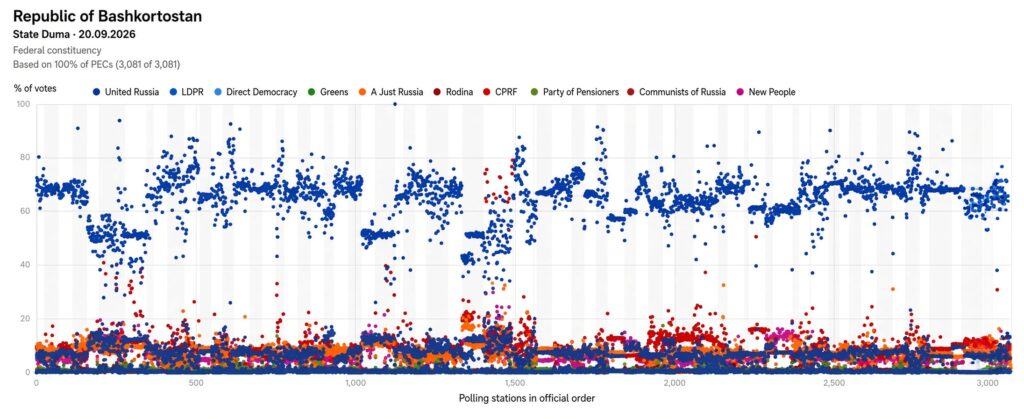
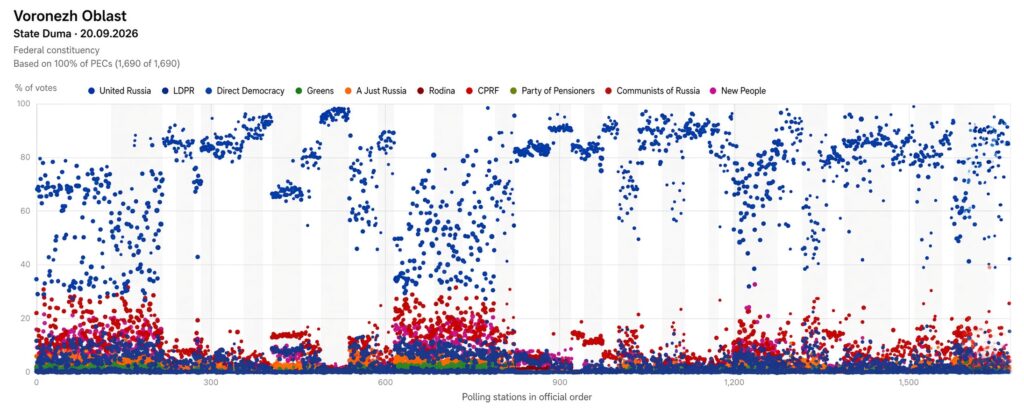
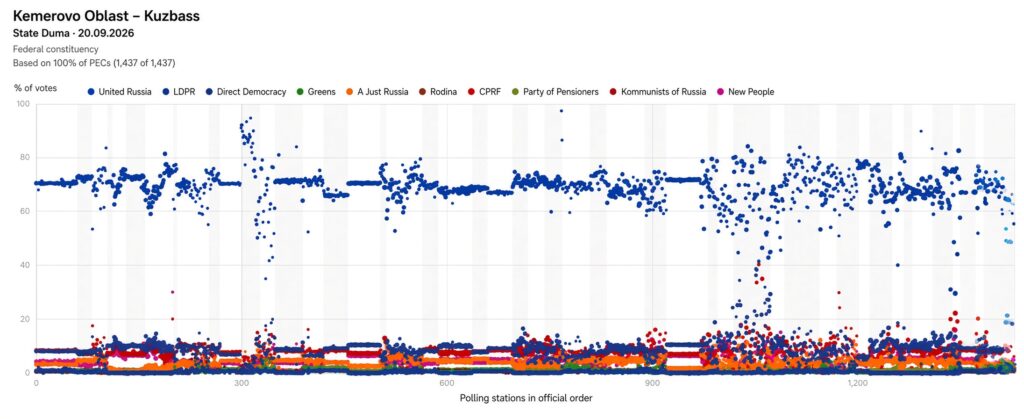
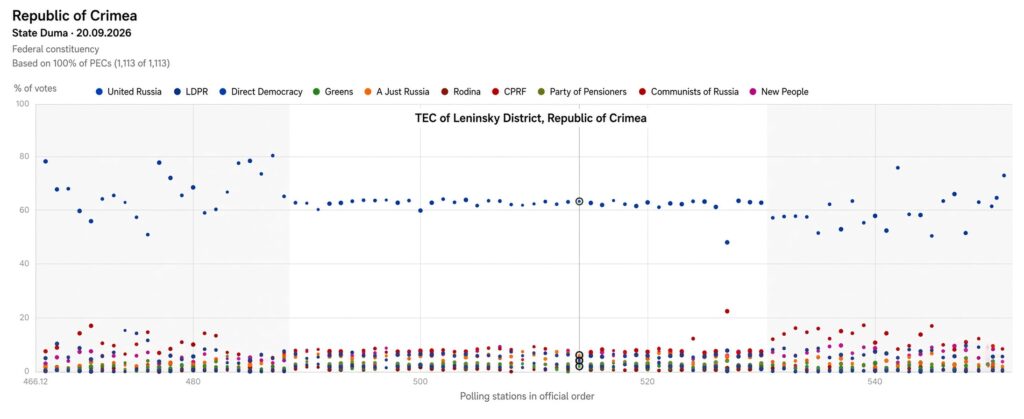
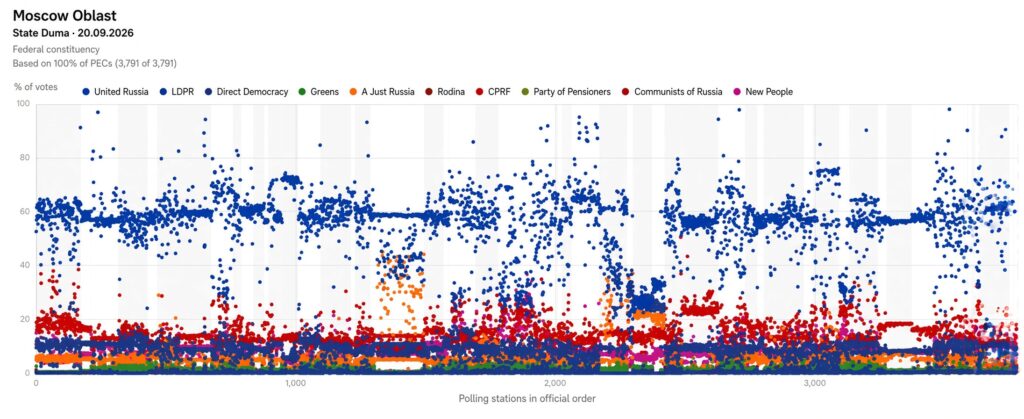
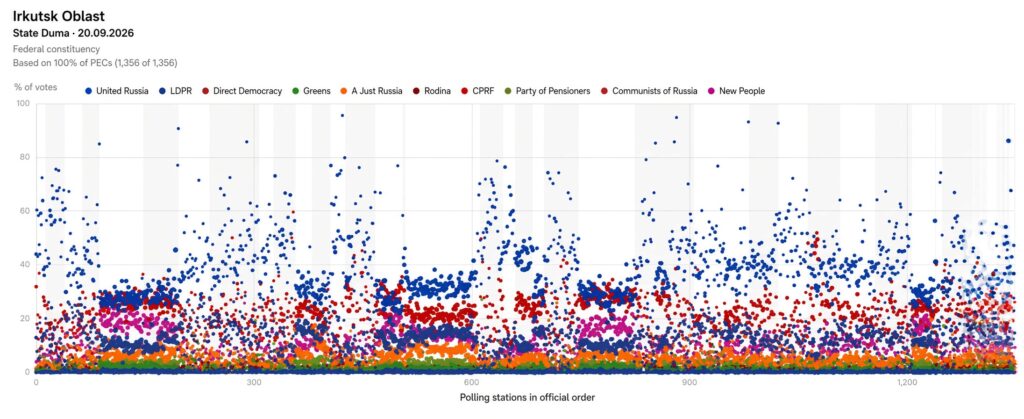
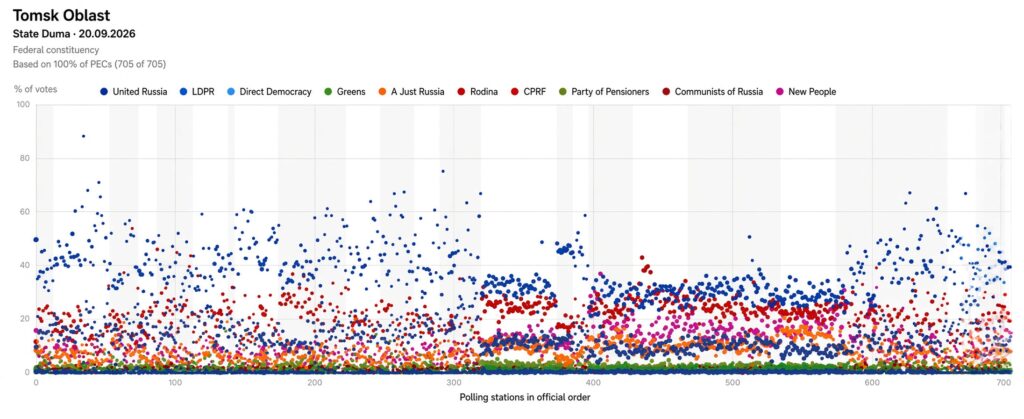
For this purpose, we use visualizations from the electoral database Vyboroteka. Each point on a chart represents a party’s result at an individual polling station. One axis shows the party’s share of the vote; the other shows the polling station’s number. From left to right, the polling stations are arranged in numerical order. Alternating background colors distinguish the polling stations belonging to different territorial commissions.
One classic sign of electoral fraud is visible even in the simplest statistical analysis. It appears when election commissions are given identical target figures. The charts then show lines of nearly identical results stretching across an entire municipality or, in larger cities, an entire territorial commission.
That is what the Bashkortostan chart shows: several lines at different levels. Even where polling stations are scattered geographically, their results still fall within the same narrow ranges. In other words, they too appear to have been falsified — only more skillfully.
A similar pattern can be seen in many districts of Voronezh Oblast, though at higher levels. Voronezh was one of the regions where early voting took place.
The same pattern is even more striking in Kuzbass, a region long associated with large-scale electoral fraud.
The same lines can be seen in annexed Crimea. The chart below shows the Leninsky District Territorial Commission, where every polling station gave United Russia approximately 63 percent of the vote.
Sometimes local officials decide not to falsify the results at every polling station, so that the municipal average does not attract too much attention. This often happens in regions where a semblance of political competition still exists.
The resulting charts look particularly absurd. Here are several examples.
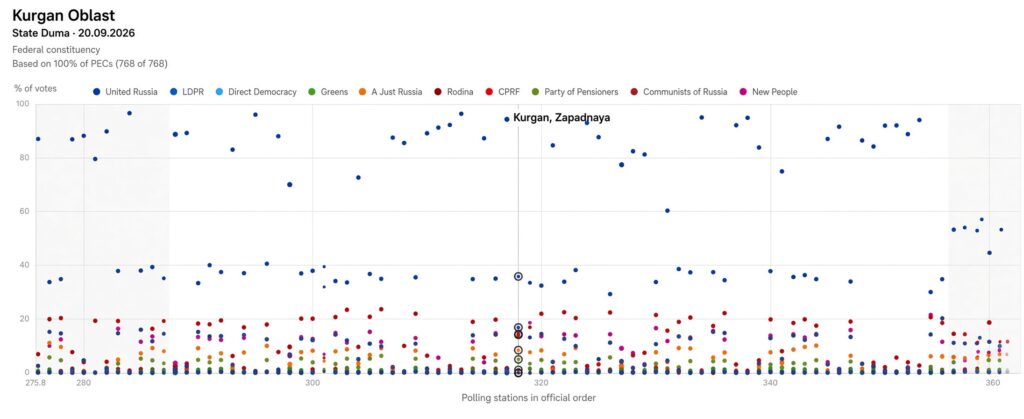
The chart below shows the results from polling stations within Kurgan’s Western Territorial Commission. Roughly half of the polling stations, or slightly more, recorded a United Russia result within the “honest” 40 percent range cited by analysts. Another group recorded results above 80 percent. Between the two groups there is almost no middle ground.
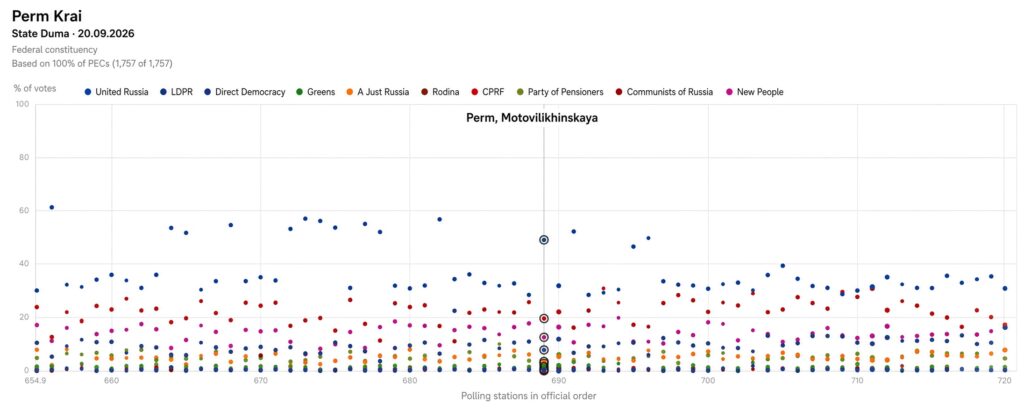
A similar picture emerges in the Motovilikha District Territorial Commission in Perm, although the gap is much narrower — between 40 and 47 percent for United Russia.
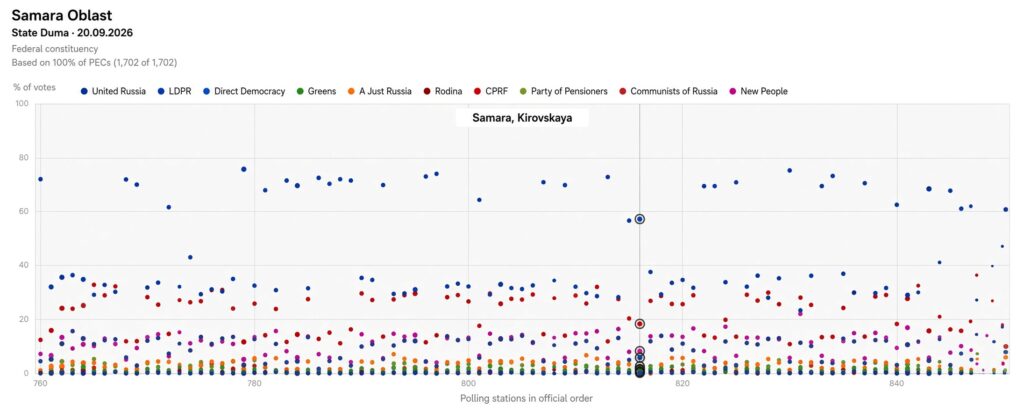
The same pattern appears in Samara’s Kirovsky District: an obvious gap between the same “honest” 40 percent and the dishonest 60 percent for United Russia.
Samara also contains districts with a different pattern. In the Promyshlenny District, for example, almost all polling stations fall below the 40 percent line, and the CPRF even won at some of them.
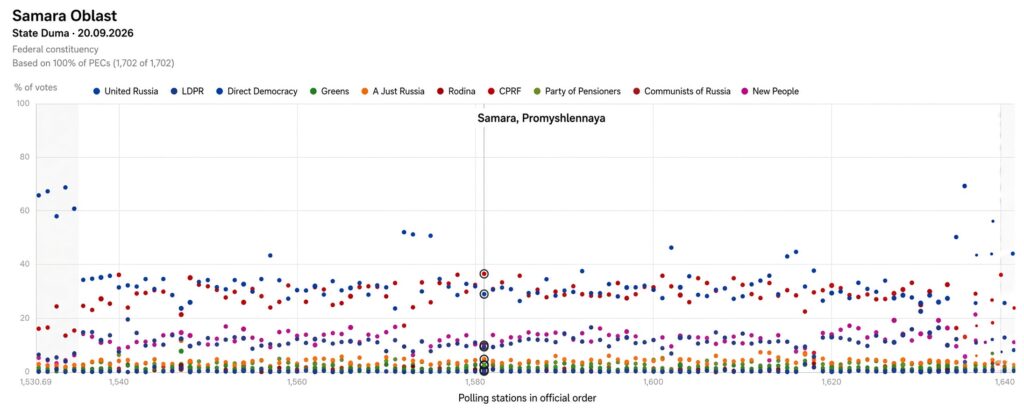
The district was part of the constituency in which Communist candidate Mikhail Matveyev was running a strong campaign backed by an extensive monitoring operation.
These lines of identical results now stretch across entire regions that were considerably less uniform only a few years ago.
Moscow Oblast has always been problematic, but a strong monitoring community could sometimes make a difference, allowing parts of the region to produce relatively credible results. This time, almost the entire oblast became a zone of systematic fraud. The only exception was the Pavlovsky Posad Territorial Commission.
The rest of the region looks as though it had been drawn with a ruler that occasionally slipped slightly upward or downward.
Regions that were previously considered relatively “clean” have also begun to move in the wrong direction. In Irkutsk Oblast, for example, several districts produced somewhat inflated results, though not on the same scale as in other parts of the country.
This year, the situation is even worse in the rural districts of Novosibirsk Oblast and Altai Krai.
Tomsk and Yaroslavl oblasts still look relatively good by comparison. There are very few such regions left, however — probably fewer than ten in the entire country.
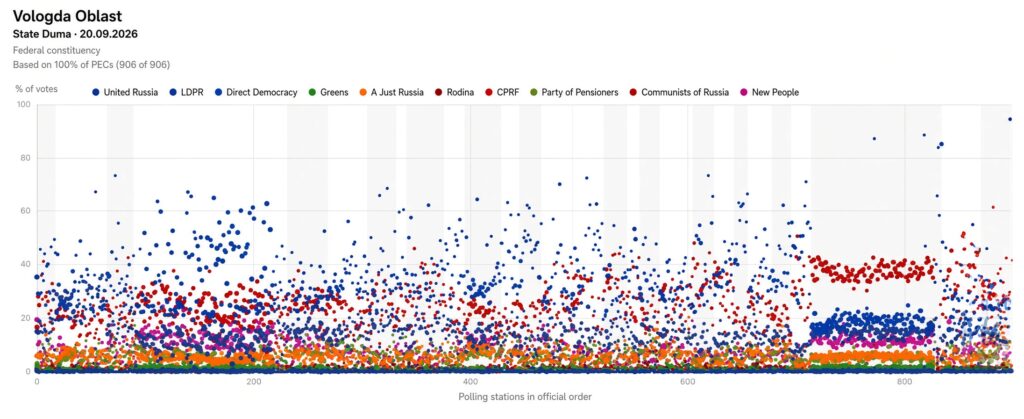
Vologda Oblast — and Cherepovets in particular — deserves a separate mention.
For several years, the region has been the scene of a conflict between Governor Georgy Filimonov, known for such controversial initiatives as an attempt to introduce prohibition and the installation of monuments to Stalin, and Alexei Mordashov, one of Russia’s wealthiest men and the owner of Severstal.
Cherepovets is the company’s home city and was run for many years by Mordashov’s team. The State Duma deputy representing the constituency was also a Severstal representative.
Against the backdrop of the conflict, Mordashov handed control of the city entirely to the regional administration. The result was striking: Vologda Oblast recorded the lowest turnout in Russia, while Cherepovets, a city of 300,000, voted for the CPRF. The Communists received around 40 percent, compared with approximately 20 percent for United Russia. The parties effectively swapped places.
As the chart shows, the results elsewhere in the region also worked against the ruling party. Without the administrative resources of the region’s largest company, the regional administration’s electoral machine simply failed to get off the ground.
In previous articles, we described the election campaign from the perspective of its media coverage, the authorities’ efforts to demobilize discontent, and public opinion.
But the election results point to one conclusion: Russian elections are an institution designed less than any other to reveal the will of the voters.
This is the result of mass coercion combined with even more widespread direct falsification. The recent vote was neither a “referendum on attitudes toward the current regime” nor a “referendum on the war.”
The 2026 elections merely demonstrated that the administrative machine can produce whatever visible result the authorities require. The consequences of such a blatant disregard for the voters’ will have yet to be assessed.


