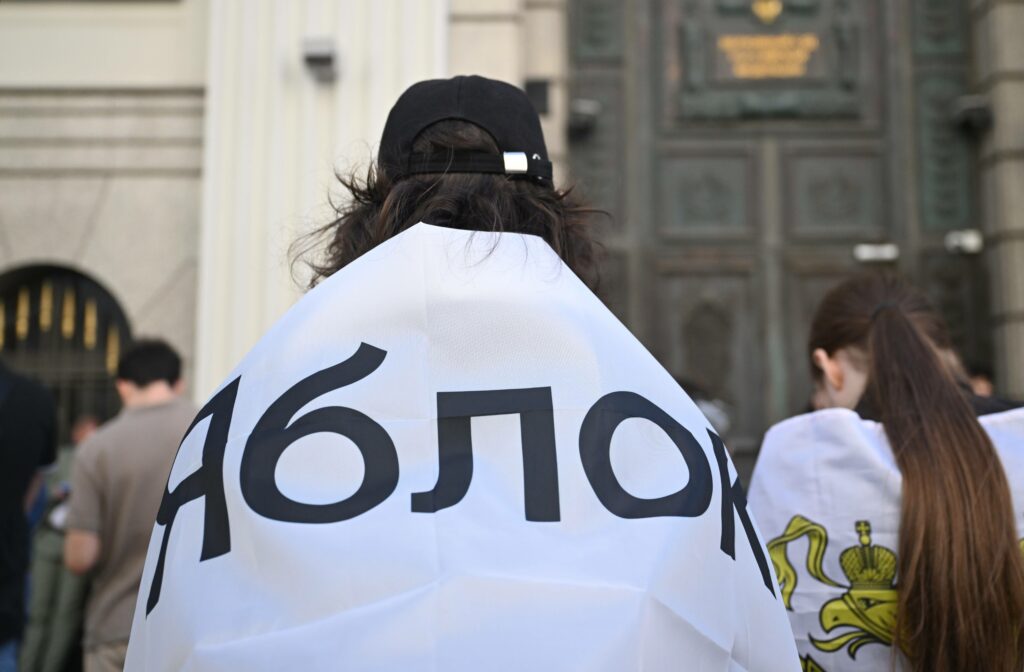
On 7 August the Rodina party filed a lawsuit seeking to cancel the registration of Yabloko’s federal candidate list — the party that had entered the race with anti-war slogans. By 10 August the Supreme Court had sided with the plaintiff and removed Yabloko from the elections.
Rodina had only ten days to prepare the document. Yet the lawsuit runs to roughly forty pages and advances arguments on four separate grounds. Parts of the text are written in a style familiar to anyone who has dealt with papers from the Justice Ministry or the FSB. Other sections read more like the standard fare of Russian electoral lawyers. This suggests that the lawsuit (or at least certain blocks of it) had been prepared in advance — a contingency tool ready to be activated if Yabloko needed to be removed from the race at short notice.
What exactly does Rodina allege?
The lawsuit consists of four parts. The first concerns “copyright infringement” in Yabloko’s campaign materials. This is one of the few grounds that, under Russian law, automatically results in a party or candidate being struck from the ballot. The provision itself has long been contested by lawyers because it allows civil-law relations to interfere disproportionately with public-law processes. Remarkably, such a claim does not even require the actual rights-holders to raise objections.
Rodina’s complaints are directed not at the campaign materials officially registered with the Central Election Commission, but at the party’s website, which hosts articles and publications spanning many years. Some of the contested materials date from 2012 — fourteen years before the current campaign began. There are also references to pieces from 2016, 2017, 2018, 2023, 2024, 2025 and early 2026, none of which have any connection to the present elections.
The arguments themselves look rather weak. As electoral lawyer Andrei Buzin has noted, the plaintiff does not cite a single instance in which an entire work was used. All the examples involve either short excerpts (for instance, the line “may there always be sunshine, may there always be mother” from a poem by Lev Oshanin), small fragments (data from the Levada Center), or images that only vaguely resemble protected works. Moreover, these examples were taken from the internet and are not supported by notarized copies.
In particular, the plaintiff claims that Yabloko’s logo infringes copyright because it was borrowed from a work by the avant-garde artist El Lissitzky. In reality the logo has existed for a long time: in its current form — a wedge inside a circle — the party used it in the 2011, 2016 and 2021 elections without any complaints being raised.
The legal grounds for removing parties and candidates from elections over copyright violations are formulated with extreme vagueness in Russian legislation. As a result, electoral disputes constantly arise: some candidates are struck off while others, in comparable circumstances, are allowed to remain. There have even been outright absurd precedents. One candidate was removed for posting on social media the phrase “Do what you must, and let what will be, be” — the court ruled that it violated the copyright of Marcus Aurelius.
For years lawyers and politicians have tried to obtain greater legal clarity, without success. Russia’s Constitutional Court has for several years rather openly avoided clarifying the issue. As a result, this entire category of claims has effectively been left to the discretion of judges, who can decide almost arbitrarily whether to remove a party or candidate on these grounds.
The second block of claims looks even more farcical. The plaintiffs assert that they discovered a large volume of social-media posts in which users expressed support for Yabloko. Rodina’s lawyers classify this as campaigning in favor of the party that was not paid for from its electoral fund. Yet as long ago as 2005 the Constitutional Court explicitly ruled that citizens’ right to actively defend their position during elections forms an inseparable part of their active suffrage.
During the hearings a Rosfinmonitoring report marked “for official use only” appeared. Its contents cannot be disclosed, but from the parties’ remarks it became clear what it concerned. The agency had identified a certain number of Russian citizens who received funds from abroad and at the same time made donations to individual Yabloko candidates. The sums involved were tiny — less than 20,000 rubles (around $ 240). In any case, the “funds from abroad” could perfectly well have been the citizens’ own money simply transferred from their accounts in foreign banks. Either way, the report has no bearing on the substance of the dispute.
The third block of claims potentially poses the greatest risk to Yabloko. It concerns accusations that campaign materials contain signs of extremism. This is another area of Russian law deliberately left wide open to arbitrary enforcement. Such an accusation can lead not only to deregistration from the elections but to a complete ban on the party as an extremist organization, as well as criminal prosecution of its members and candidates at every level.
The plaintiffs accuse Yabloko of supporting the “LGBT movement” (banned in Russia), of calling for the violation of the country’s territorial integrity (on the grounds that the party advocates ending the war with Ukraine), and of inciting hostility toward the authorities and other political parties. The latter charge rests, among other things, on formulations such as “If you vote for Yabloko, you are voting for change, for peace, for freedom, for a different life” and “the authorities keep adopting more and more repressive laws.”
The fourth block is the weakest of all. It does not even cite a specific legal provision. It merely expresses doubts about whether certain candidate documents were submitted within the prescribed deadlines.
The greatest danger lies in the first and third points — copyright and extremism. Both automatically trigger removal from the ballot. And it is the first, seemingly technical ground that has generated the most extensive case law, which the plaintiffs actively exploit. The second and fourth blocks serve mainly as camouflage and public-relations cover.
The authorities’ original plan
From the very start of the campaign many experts doubted that Yabloko would appear on the September ballots. Those doubts were fueled by a wave of cases against the party’s most prominent figures. Since the autumn of 2025 at least eight potential Yabloko candidates had been preemptively stripped of the right to stand in the State Duma elections on charges of distributing “extremist materials.” Party leader Nikolai Rybakov, for example, was fined 1,500 rubles (less than $ 20) for expressing condolences over the death of Alexei Navalny and posting his photograph on social media. Even after his death the Russian authorities continue to classify Navalny as an extremist and regularly fine citizens for sharing his images.
Nevertheless, the party list was eventually registered. This fitted the logic that electoral administrators had followed in previous years: they sought to preserve the appearance of stability in the political system and a certain status quo. Not a single party entitled to contest federal elections without collecting signatures was removed from the ballot in either 2016 or 2021. Candidates from such parties were likewise left untouched in presidential elections.
Allowing Yabloko onto the ballot was the baseline, standard option — intended to demonstrate to society that the system remained robust amid socio-political tension. The risks associated with that decision were to be neutralized, and the campaign kept as predictable as possible, through a prior purge of candidates — not only from Yabloko but also from the Communist Party and other political forces. Virtually all the key decisions about who could and could not take part had already been taken in advance. The entire arsenal of legal and administrative instruments was deployed for this purpose: “foreign-agent” status, administrative fines under “extremist” articles, criminal cases for “fakes” and “discrediting the army,” corruption charges. These tools surgically deprived unwanted politicians of passive suffrage and organizational resources.
Why the lawsuit appeared
The registration of Yabloko — even without recognizable leaders and without significant financial or organizational resources for a federal campaign — triggered a largely spontaneous mobilization of part of the anti-war electorate.
The “Election Atlas” project recorded a sharp rise in interest in Yabloko on social media (as well as in the New People party, which some opposition supporters regard as a more moderate alternative). Measured by engagement (the sum of reactions, comments and reposts), New People doubled their figures over the previous two weeks while Yabloko grew 4.5 times. As a result, in absolute numbers New People caught up with the Communist Party and Yabloko overtook A Just Russia.
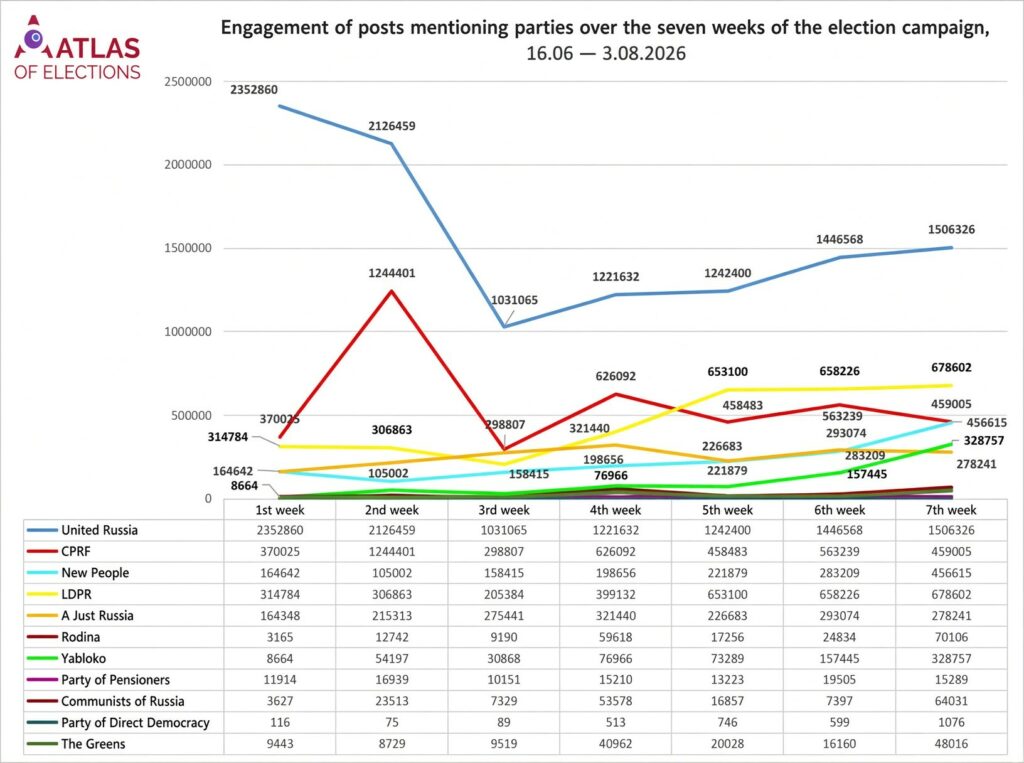
Source: “Election Atlas”
A similar dynamic is visible in view counts, although the growth is somewhat more modest: New People almost doubled their figures in two weeks and Yabloko nearly tripled. Both parties have virtually drawn level with the Communists on this metric. For the organizers of the elections, who had clearly counted on a calm and controllable campaign, an obvious risk emerged that the situation might slip out of control.
As electoral-statistics expert Boris Ovchinnikov notes, the number of Yandex searches containing the party’s name and the word “elections” rose more than fivefold for Yabloko over the past month. If one takes as 100% the sum of searches that include the word “elections” together with the names of the five parliamentary parties plus Yabloko, then before its removal Yabloko occupied first place with 36% (compared with 4% in 2021). By comparison, United Russia’s share stands at 27% (37% in 2021) and the Communists’ at 17% (42% in 2021). New People currently account for 10% (4% five years ago), while the LDPR and A Just Russia stand at 6% and 4% respectively (each having lost roughly 1.5 percentage points since 2021).
This growth was spontaneous and began even before statements of support for the party from Yulia Navalnaya and other opinion leaders. Publications about Yabloko in émigré Russian media and major blogs followed the rise rather than causing it. The decision to remove the party was clearly taken at the highest level, and we do not know which arguments proved decisive — the mobilization of part of the anti-war electorate itself, or the support expressed by those whom Vladimir Putin may regard as “traitors.” What is clear is that the authorities’ problems were not caused by the activity of the émigré community.
On the day of the court hearing, party supporters gathered outside the Supreme Court building in an attempt to gain access to the proceedings. More than 10,000 people watched the live stream on the court’s website simultaneously, while the number following the numerous text updates in the media and Telegram channels is impossible to estimate. In any event the resonance was considerable.
Of course, there is a distance between the emergence of interest and a concrete action (in this case, voting for the party). Nevertheless, interest itself is the first step, and given its emotional intensity it had every chance of converting into real support. Under these circumstances the activation of the contingency plan (removal from the ballot) looks entirely logical. The Russian authorities (or at least their security component) clearly took fright at the possibility that the election situation might escape their control.
A recurring scenario
Since 2018 the presidential administration has repeatedly encountered unexpected mobilization by its opponents. In the 2018 presidential election protest began to concentrate around the figure of the Communists’ coordinated candidate, Pavel Grudinin. The authorities had to unleash a rapid wave of “black PR” against him. In 2021 the explosive growth of interest in Alexei Navalny’s “Smart Voting” produced a noticeable increase in support for the Communist Party. The authorities were forced to scramble to block the Smart Voting app in online stores. In 2024 Boris Nadezhdin, whom almost no one outside the Moscow region had heard of before the campaign began, received completely unexpected support. He was relatively easy to keep off the ballot because he was running as an independent and collecting voter signatures. After the start of the 2026 campaign, in which Nadezhdin again tried to run as an independent, he was forced to leave the country.
All this points to the existence in Russian society of a fairly large group of voters capable of rapid self-mobilization around virtually any political force that carries even a minimal charge of opposition. Its most active segment is the anti-war opposition, and for them Yabloko became a rallying point. Opposition sentiment, however, is by no means limited to the war. Negative attitudes toward the authorities can also be found among those who actively support the military campaign and among those who are indifferent to it but feel its consequences — internet blackouts, the petrol crisis, rising prices, the impossibility of gaining university places because of the large number of preferential admissions for children of war participants.
Political forces themselves are far from always interested in such support. Judging by appearances, Yabloko at the start of the campaign did not expect a broad response and sought merely to take part in the elections in order to retain its party license for the next five years. Now the party faces the near-certainty of liquidation — either as an “extremist” organization or as one that failed to contest the elections.


