Since June 2026, independent Russian media have been reporting a sharply increased probability of a new large-scale mobilization, intended to cover the shortfall of volunteers and mounting losses. Investigative outlets’ sources claim that tens of thousands could be conscripted after the State Duma elections, and that authorities are allegedly planning to introduce martial law—or select elements of it—to prevent mass draft evasion.
In August, Western outlets reported on mobilization-readiness drills underway in Russian regions, as well as an expansion of the Defense Ministry’s capacity to collect personal data, which in theory should improve the efficiency of any future mobilization campaign. These reports do not assert that a new mobilization is inevitable; they point instead to active preparation for such a scenario. At the same time, representatives of Ukraine’s Main Intelligence Directorate (GUR) and the Presidential Office regard mobilization in Russia as a foregone conclusion, citing their intelligence on General Staff plans to mobilize 600,000 people in 2026−2027.
Military analysts, by contrast, are skeptical about the need for mobilization at this stage: if it were necessary for the 2026 campaign, it would have had to be carried out much earlier. Military economists also note that the pace of contract recruitment has not slowed sharply enough to unequivocally signal the need for mobilization. Around 1,000 contracts are still being signed per day, while monthly losses are estimated at 30,000−36,000. Thus, the gap between recruitment and losses is not yet so critical as to push the authorities toward a politically risky mobilization.
This skepticism is reinforced by specialists on Russian elites and the political system, who see a new mobilization as a colossal risk to political stability. After the difficult mobilization campaign of autumn 2022, the Russian leadership sought to avoid repeating that scenario by building an expensive system to incentivize contract recruitment. In some regions—such as Khanty-Mansi Autonomous Okrug—the one-time signing bonus exceeds the average monthly salary by a factor of 30, reaching 4.1 million rubles (over $ 47,000). The pool of people willing to go to Ukraine for large sums is shrinking but not yet exhausted.
In effect, the mobilization launched in September 2022 has never been fully halted—the relevant presidential decree has not been repealed. To launch recruitment on a limited scale, or one comparable to 2022 (when officials spoke of 300,000 mobilized), only a political decision is required; the rest of the mobilization infrastructure is almost fully in place, including the electronic summons system and the unified military registration registry, which Russian authorities have actively rolled out in recent years to automate conscription.
Putin has consistently refused to compromise on his stated minimum objectives in Ukraine and regularly repeats that the “liberation of the Donbas” remains one of the key priorities of Russian policy. Against this backdrop, statements by Ukrainian officials, reports from sources in independent Russian media, and practical steps by state agencies to prepare for mobilization create a sharp sense of uncertainty.
How experts assess the likelihood of a new mobilization wave in 2026
Between 6 and 26 August 2026, we surveyed 26 Russia experts specializing in military affairs (16) and the study of Russian elites (10). The panel comprised professionals with at least five years of experience and a proven track record in their field: five have worked on their topic for 5−10 years, seven for 11−15, four for 16−20, and ten for more than 20 years. Besides assessing the probability of a new mobilization wave by the end of 2026, we sought to determine whether forecasts differ by specialization. It was reasonable to expect that elite specialists would weigh the socio-political risks of mobilization and elite sentiments more heavily, while military experts would focus on front-line needs and the logic of military operations.
Despite their considerable professional experience, panelists were generally cautious in their forecasts. On a 1−5 scale (1 = “not at all confident,” 5 = “fully confident”), 16 of 26 experts (61.5%) chose 3. Only seven (27%) expressed high confidence (4 or 5). Average confidence was 3.2 out of 5.
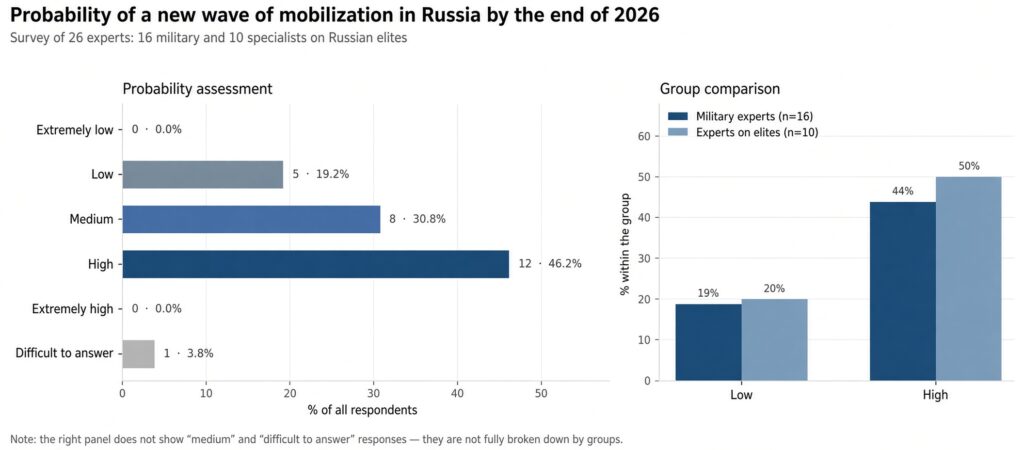
Most experts rated the probability of a new mobilization wave by the end of 2026 as high (12 experts, 46.2%) or medium (8 experts, 30.8%). Five (19.2%) considered it low; one declined to answer. Excluding “don’t know” and converting to a 5-point scale (1 = extremely low probability, 5 = extremely high), the average probability score was 3.28. Elite specialists were slightly more likely than military experts to call the probability high.
There was near unanimity on who makes the final decision on a new mobilization wave: 25 of 26 experts said Vladimir Putin has the last word. Only one respondent named the Presidential Administration; no one cited the security services, the Defense Ministry, or other agencies.
What form a new wave could take
If a new wave does occur, experts predictably do not expect a general call-up. Of 26 respondents, 10 (38.5%) see the most likely scenario as an expansion of the existing 2022 decree. Another seven (26.9%) each chose two other scenarios: “hidden” recruitment without an official mobilization announcement (via pressure on employers, coerced contract signings, and other measures), or a new official partial mobilization. No participant named large-scale or near-universal mobilization as the most likely scenario. Two declined to answer. There were no marked differences between military experts and elite specialists on this question.
Thus, three main scenarios remain in view. Taken together, expanding the current decree and “hidden” top-up recruitment account for 17 of 26 responses (65%). In other words, about two-thirds of respondents consider most likely a scenario the authorities might not label a new mobilization.
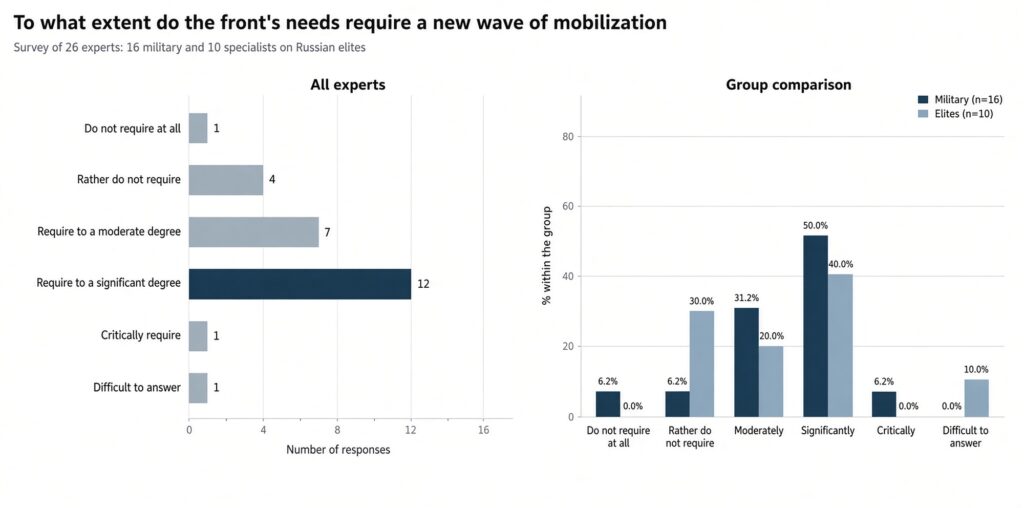
A majority of experts believe the front-line situation already requires new mobilization measures. Thirteen of 26 rate this need as significant or critical; another seven as moderate. Military experts speak of high necessity more often than elite specialists.
How many could be mobilized
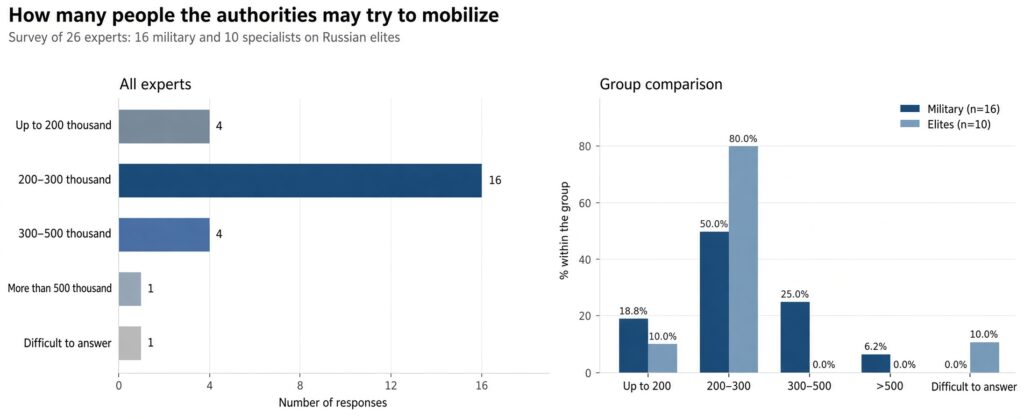
Estimates of the potential scale of a new mobilization wave cluster mainly in the 200,000−300,000 range. Sixteen of 26 panelists hold this view. Four more expect up to 200,000; four allow for 300,000−500,000. Only one forecasts more than 500,000 new mobilized; one declined to answer.
Military specialists offer a wider range: their estimates run from under 200,000 to over 500,000. Half of military experts expect 200,000−300,000; another quarter, 300,000−500,000. Elite experts show greater consensus: eight of ten name 200,000−300,000. They appear to factor in the political cost of mass mobilization and society’s readiness to accept it, whereas military experts are more likely to start from the army’s potential demand and build in a larger margin.
What lowers and raises the probability of a new wave
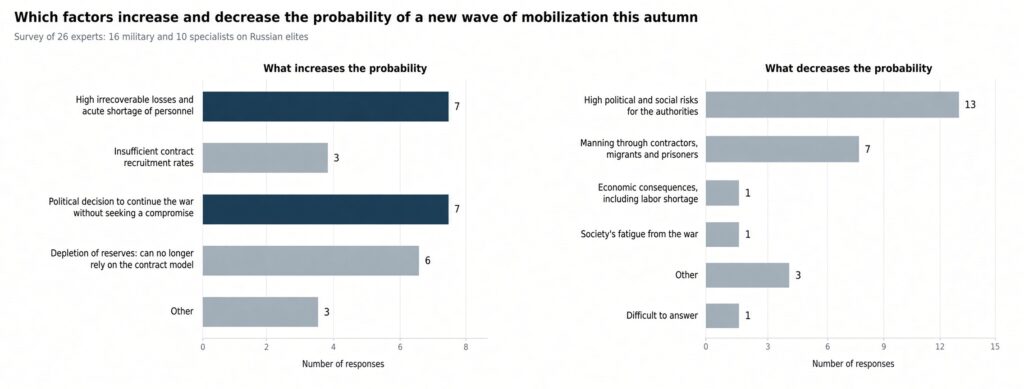
Experts link the probability of a new mobilization not only to manpower shortages but also to the course of the war. Seven believe the factors most increasing the chances of an autumn wave are high casualties and an acute personnel deficit; another seven cite the decision to continue the war without seeking a compromise. Six point to the exhaustion of the contract recruitment model. Open-ended responses also mentioned Ukrainian advances, overly slow Russian offensive progress, possible territorial losses, and the Russian leadership’s decision to expand the war’s territorial objectives.
The main factor likely to restrain mobilization, experts say, is its political and social cost. Thirteen participants—half the panel—chose this option. Seven more noted the possibility of continuing to staff the army via contractors, migrants, and prisoners. Additional arguments lowering the probability of mobilization in 2026 included the Russian leadership’s reluctance to make abrupt changes absent a serious crisis (“Putin’s conservatism”).
In short, assessments pit military necessity against the political price of conscription.
How a potential mobilization would affect regime resilience
A new wave, according to 15 of 26 experts, would weaken regime resilience. Eight expect no noticeable effect; only one allows that mobilization might strengthen the authorities.
At the same time, experts overall do not forecast a noticeable rise in protest activity in response to mobilization. Seventeen of 26 rate the likelihood of mass protests as low; another two as very low. Four call it medium; one, high. The regime retains a wide array of repressive practices to suppress dissatisfaction with mobilization, reducing the chances of an immediate political reaction from Russian society. Elite specialists assess the prospects for protests even lower than military experts do.
In other words, mobilization would add strain to the political system, but on its own is unlikely to trigger a marked increase in protest activity.