Russia’s draft federal budget for 2027−2029 allocates approximately 865.6 billion rubles ($ 10 billion) to a state program for the “restoration and socioeconomic development” of the occupied Donetsk, Luhansk, Zaporizhzhia, and Kherson regions of Ukraine. Submitted to the State Duma on September 30, the draft provides for 293.82 billion rubles in 2027, 290.11 billion in 2028, and 281.65 billion in 2029. The program itself dates to December 2023, when the government planned approximately 653.5 billion rubles for 2024−2026. The new allocations deepen Moscow’s investment in the infrastructure and administrative institutions through which it seeks to consolidate control over internationally recognized Ukrainian territory.
The proposal comes as the Kremlin’s battlefield claims diverge sharply from independent assessments. At the Valdai Discussion Club, Vladimir Putin claimed Russian forces had gained 1,301 square kilometers in September. The Institute for the Study of War (ISW) assessed that Russian forces gained control of 175.54 square kilometers while Ukrainian forces liberated 256.35 square kilometres, producing a net Russian loss of 80.81 square kilometres. After accounting for Ukrainian gains during Operation Vivaldi that became visible only later, ISW calculated a net Russian loss of 293.59 square kilometers since March. Even when Russian infiltration into areas not fully controlled is included, ISW assessed that Russian forces gained a presence in only 174.44 square kilometres over the same period. The distinction matters because assessed territorial control and military presence are not the same: Russian forces may operate in an area without holding it. Delayed public disclosure of Ukrainian operations further complicates efforts to date territorial changes. These figures do not prove that Moscow is substituting financial consolidation for military advances, but they show that Russia is planning for a sustained institutional presence while territorial control remains contested.
A Multiyear Budget for Occupation
The program represents approximately 0.6 per cent of Russia’s planned federal expenditure in 2027. Its significance lies less in its scale than in its continuity. The government proposes spending 48.8 trillion rubles in 2027, including 17.1 trillion on defense, 27 per cent above the original allocation of 13.5 trillion. Meanwhile, federal funding for social policy, education, and healthcare is set to fall by 7, 6, and 6.8 per cent, respectively, compared with the previous budget plan. These reductions concern federal allocations, not total spending across federal, regional, and municipal budgets. The occupied-territories program is therefore not evidence that reconstruction is directly crowding out these services. Rather, it shows that Moscow is preserving a dedicated funding stream while military spending rises and other federal allocations contract.
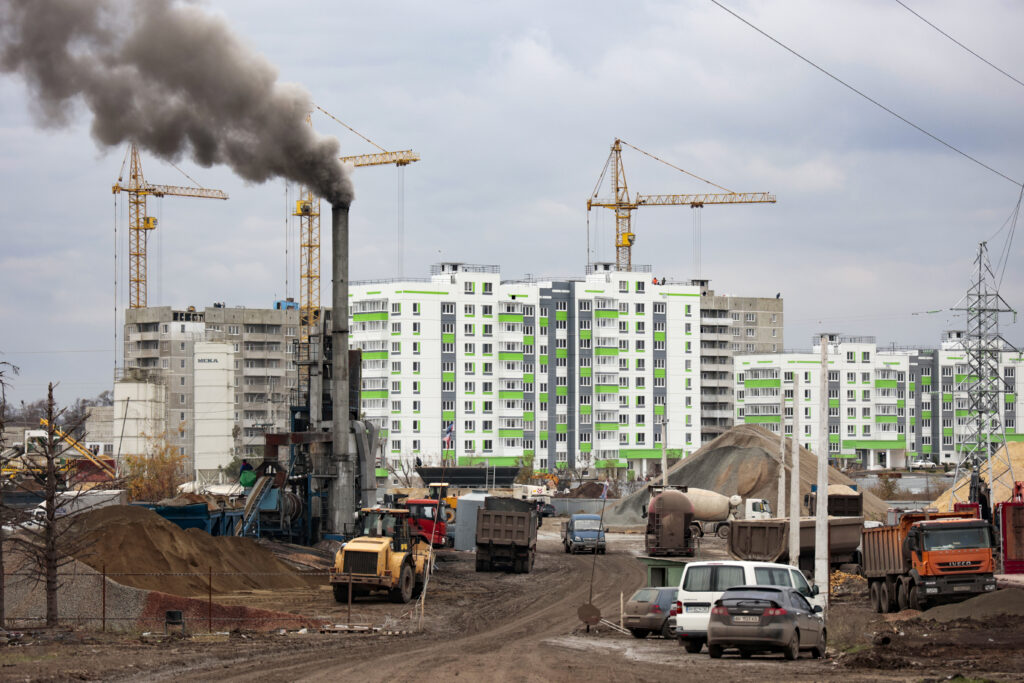
The program’s composition reveals its administrative purpose. The largest construction allocation rises from 107.8 billion rubles in 2027 to 124.1 billion in 2029, covering housing, administrative buildings, social infrastructure, apartment-block repairs, and demolition. The designated recipient is the state-owned Unified Customer in Construction. A further 60 billion rubles annually is proposed for the Territorial Development Fund to restore communal infrastructure, while another 30 billion rubles annually is allocated to the construction and repair of administrative and security-agency buildings. The latter is especially significant: the program funds not only civilian reconstruction but also the physical infrastructure through which Russian civilian authorities and security services operate.
The overall program nevertheless declines from 293.82 billion rubles in 2027 to 281.65 billion in 2029, despite the rising construction allocation. Some lines, including electricity-distribution networks, receive funding only in 2027 and 2028. The decline therefore reflects changes in the composition of planned expenditure rather than the end of the program. The budget documents do not identify the individual projects or contractors for every allocation, so they establish the intended funding channels more clearly than the implementation record.
Emergency transfers illustrate the recurring cost of maintaining essential services under occupation. In June, the government allocated approximately 6.5 billion rubles for third-quarter pension payments in the four regions. On August 20, it approved another 4.139 billion rubles from its reserve fund for utility enterprises in Luhansk and Kherson, covering equipment purchases, network repairs, operating costs, and compensation to heating, water, and wastewater providers. Prime Minister Mikhail Mishustin said the transfer would help prepare utility infrastructure for winter. These payments illustrate the difference between multiyear capital planning and the recurring expenditure needed to keep essential services functioning under occupation.
Banking and Housing as Instruments of Integration
On September 7, Sberbank opened its 32nd full-service office across the occupied parts of Donetsk, Zaporizhzhia, and Kherson regions, in Mariupol. The bank reported more than 340 ATMs and 17,000 payment terminals across the three regions in its announcement of the expansion. These are figures reported by the bank, not independently verified counts. They indicate a substantial reported physical presence, but do not establish how many residents use the network or whether they depend on Russian banks for salaries, pensions, and business transactions. That would require data on account ownership, transaction volumes, and access to alternative providers.
Housing subsidies provide a more direct financial incentive for settlement. Russia’s dedicated preferential mortgage program for the occupied regions allows eligible Russian citizens to borrow at 2 per cent interest, up to 6 million rubles, for qualifying housing purchases. The official program catalogue lists the end of 2030 as the deadline for new loan agreements. By contrast, the comparable program in Kursk and Belgorod regions runs through the end of 2026 and has narrower eligibility for residents whose homes were damaged or destroyed by hostilities. These deadlines concern when loans can be taken, not when they must be repaid. Federal subsidies compensate participating banks for the difference between the preferential rate and their financing costs.
The policy’s settlement objective is explicit. Deputy Prime Minister Marat Khusnullin said in May that the 2 per cent rate would remain while Russia’s “special military operation” continued and that the government wanted more people to live in the occupied regions. In July, the government increased the 2026 mortgage-subsidy allocation for the six regions from 5 billion to approximately 10 billion rubles. The longer deadline and broader eligibility in the occupied regions suggest that Moscow is using housing finance not merely to compensate for wartime damage, but to encourage settlement. However, available sources do not establish the number of loans issued or the proportion of borrowers who are existing residents rather than new arrivals.
The Limits of Financial Integration
Russia’s financial expansion also carries sanctions and legal exposure. The European Union’s 20th sanctions package, adopted on April 23, added 20 Russian banks to its transaction-ban list, bringing the total to 70. These restrictions apply to transactions by EU operators with designated institutions and took effect from May 14; they are not specific to occupied territory, but they constrain financial activity involving designated institutions. Separately, LexCollective, B4Ukraine, and the Ukrainian Legal Advisory Group submitted an Article 15 communication to the International Criminal Court’s prosecutor, alleging that Russian financial officials and bank executives helped entrench the occupation of Kherson Oblast. This is an allegation, not a judicial finding, but illustrates how financial activity connected to occupied territory could attract future legal scrutiny.
The central finding is that Moscow is combining multiyear infrastructure funding with banking expansion and housing incentives to establish a longer-term institutional presence in occupied Ukraine. The budget identifies the intended funding channels; Sberbank’s reported network indicates a physical presence; and preferential mortgages offer a financial incentive to settle. Yet the evidence does not establish that these instruments have made Russian control irreversible or produced widespread financial dependence. Military setbacks, damaged utilities, housing affordability, weak demand, sanctions exposure, and reliance on federal subsidies could all undermine integration. Moscow is funding the institutions through which it intends to sustain control. Whether those investments translate into durable control, however, depends on conditions that spending alone cannot guarantee.