The 2026 State Duma election has already been called the “dirtiest” parliamentary vote in Russia’s modern history. According to the final results announced on September 25, the ruling United Russia party won an unprecedented majority, with turnout just shy of 60 per cent. Achieved through coercion and mass fraud, the result offers little insight into the will of Russian voters. It is more revealing as a measure of how repression works in wartime Russia.
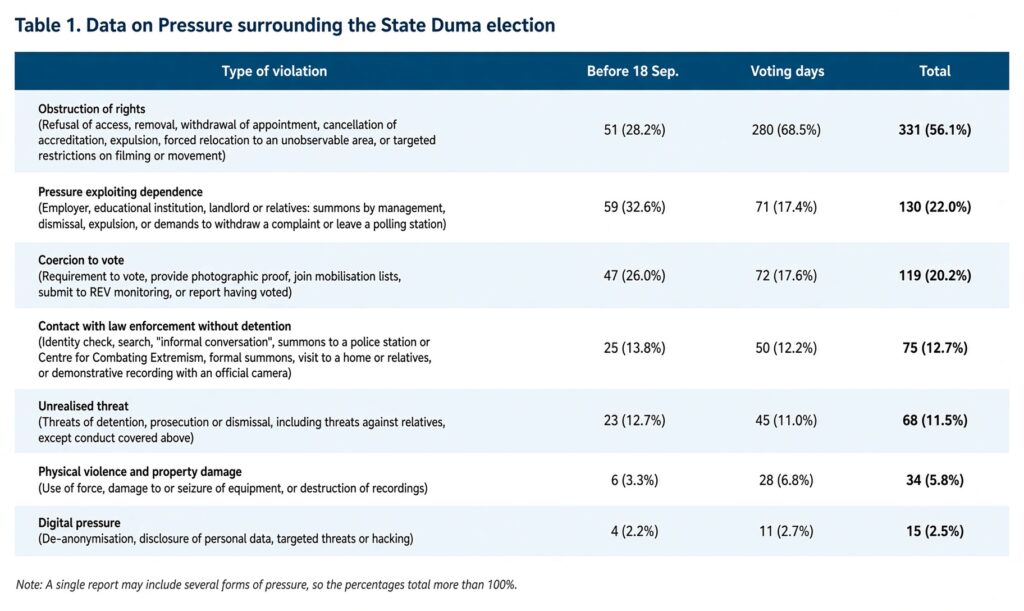
During the main voting days, September 18−20, OVD-Info monitored pressure on voters, election observers and candidates. It supplemented its findings with open data from the independent monitoring platform Elections 2026. The resulting dataset covers the summer campaign and the voting period through September 21. It contains 590 reports of administrative pressure and 18 detentions. The data does not include incidents in occupied areas of Ukraine, where Russian authorities organized voting in violation of international law.
These figures are several times lower than those recorded during previous national elections, even in wartime. During the 2024 presidential vote, OVD-Info documented 135 detentions, including street protests, while the independent monitoring movement Golos recorded 1,876 reported violations.
The figures also reflect a different political climate. The 2024 election followed a wave of protest mobilization after the death of imprisoned opposition politician Alexei Navalny. By 2026, Russia had also lost a major election watchdog: after continuing to work under pressure in 2024, Golos was forced to shut down in 2025. One of its leaders, Grigory Melkonyants, is serving a five-year prison sentence on charges of leading an “undesirable organization”.
The available data shows neither a major surge in protest activity during this year’s voting days nor a dramatic escalation in documented repression. The authorities had already invested heavily in suppressing political participation and excluding opposition forces capable of mobilizing public support, including the anti-war party Yabloko and several independent candidates.
Yet even with the official outcome effectively secured, the Kremlin used the election as a disciplinary tool. Reports described coercion to vote, restrictions on election monitoring and refusals to issue paper ballots. Such measures appeared to serve less to determine the result than to extend everyday control and demonstrate how readily even basic rights can be denied.
A post-election wave of repression remains possible. The authorities appear to have delayed certain proceedings ahead of the vote, including sentencing defendants in the “Baymak case” and bringing criminal prosecutions linked to recent “extremism” designations targeting civil society organizations, including OVD-Info. These unresolved cases and designations leave the authorities with ample means to intensify pressure.
Indeed, the authorities have already opened another high-profile case. On September 25, elections expert Alexander Kynev was charged with major drug offences. A former Golos analyst, he spoke about administrative pressure during the recent vote. Kynev pleaded not guilty and was reportedly held in custody. He is now in a prison hospital with two fractures of the tibia.
Pressure, in numbers
Repression during the voting period was the culmination of a process that began in early summer and peaked in the first half of September. Before the vote, the authorities relied chiefly on administrative and legal proceedings to “sterilize” the ballot: police reports, fines, detentions and court rulings barring “inconvenient” candidates from the race.
Documented reports were concentrated in places with active election monitoring: Dolgoprudny in the Moscow region (49 reports), St Petersburg (36), Perm Krai (29), Ufa and the rest of Bashkortostan (22), Moscow (17) and Krasnodar Krai (14). The same polling stations appeared repeatedly. These figures do not rank regions by the prevalence of violations; they show where incidents could be documented.
Once voting began, pre-election legal pressure was accompanied by less formal and, in some cases, more direct obstruction of voters’ and observers’ rights. Observers were denied access to polling stations or removed from them; appointments and accreditation were cancelled; and filming and movement inside polling stations were restricted. Some reports involved law enforcement officers and detentions, while 34 involved physical violence.
Observers were excluded on a large scale in several regions. In the Leningrad region, 279 were denied access to polling stations; in the Tyumen region, more than 200; and in St Petersburg, more than 260, including around 250 nominated by Yabloko.
These incidents illustrate two modes of repression that the Russian authorities have developed over time. The first is the targeted persecution of opponents through formal legal procedures, such as the Supreme Court ruling removing Yabloko from the election and misdemeanor cases against individual candidates over social media posts from years earlier. The second is the use of physical force, repeatedly seen during the dispersal of peaceful demonstrations in previous years.
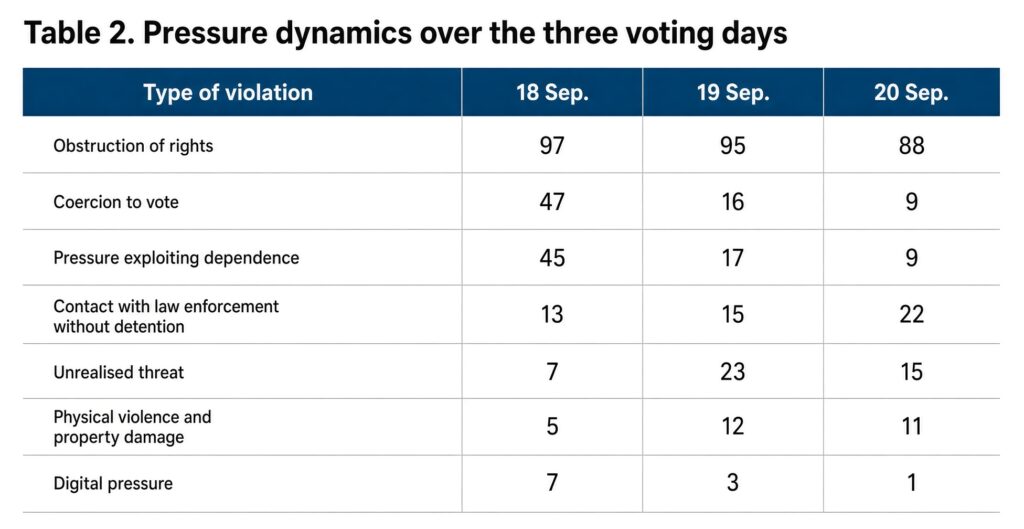
The pattern of pressure also shifted over the three days of voting. Reports of voter coercion peaked on the first day and had fallen fivefold by the third. This is consistent with public-sector employers requiring workers to vote on September 18, enabling the authorities to present high turnout and apparent enthusiasm for the election from the outset.
By contrast, reports of encounters with law enforcement, detentions and physical violence rose each day. Pressure also shifted from voters towards observers, whose work makes electoral violations visible. Disputes over filming at polling stations (36 reports) and the mass exclusion of observers (more than a thousand cases) consequently became central issues during voting.
The disciplinary function of restricting voters’ rights was particularly clear in Moscow, where poll workers directed voters towards electronic voting terminals (EVTs) rather than issuing paper ballots. Paper ballots offer no guarantee of an honest count, but voters who contacted OVD-Info after being refused them expressed even less trust in voting machines. For these voters, the denial of a choice of voting method showed how easily a right could be taken away.
Yet ambiguous rules can sometimes leave room for people to assert their rights. Some voters reported that, after repeated requests and formal complaints, election commissions eventually allowed them to vote on paper. These were small victories, but they showed that Russian citizens remain willing to exercise and defend their rights, however limited the opportunities to do so.
A post-election wave of repression?
The available data does not show a spike in documented repression during Russia’s first State Duma election since the full-scale invasion of Ukraine. Indeed, some ongoing political prosecutions appeared to stall during the summer’s pre-election campaign.
In Orenburg, for example, the trial of ten people accused of organizing the January 2024 protests in Baymak, Bashkortostan, was nearing its end. In July, prosecutors sought sentences of 14 to 15 years for each defendant, but the regional court has yet to issue a final verdict.
The peaceful protests, held in support of imprisoned local activist Fail Alsynov, led to one of Russia’s largest political trials since 2022. OVD-Info knows of at least 81 people facing criminal charges connected to the demonstrations. Two of them, Rifat Dautov and Miniyar Baygushkarov, subsequently died while under investigation. More than 60 defendants have already been sentenced, receiving prison terms ranging from three years and three months to seven and a half years.
Prosecutions targeting blacklisted civil society organizations and rights groups may also follow. In early June, Russia’s Federal Financial Monitoring Service, Rosfinmonitoring, added 36 organizations and initiatives to its registry of alleged terrorists and extremists. The designation creates grounds for prosecution, although related criminal cases have yet to materialize.
The additions followed an April 2026 Supreme Court ruling banning the “International Public Movement Memorial” as an “extremist” organization. No such legal entity exists, but the apparent target was Memorial, the 2022 Nobel Peace Prize laureate known for documenting Soviet-era repression and defending human rights in contemporary Russia. Rosfinmonitoring’s registry now includes several independent projects that have worked with Memorial but were not part of its network, including OVD-Info, the Perm-36 Gulag museum and the Revolt Centre, an independent cultural space.
So far, only one known misdemeanor case allegedly concerns a display of Memorial’s logo, which is now banned in Russia as an “extremist” symbol. But in April, pro-government media reported that the Justice Ministry had identified 196 individuals who had “actively participated” in and received funding from the “International Public Movement Memorial”. These individuals could face felony prosecution.
Kynev’s case has already raised concerns about what may follow the election. Previously labelled a “foreign agent”, he now faces major drug charges carrying a maximum sentence of 20 years in prison. Given the pressure he has faced for his critical analysis and reports that he was severely beaten in custody, a political motive cannot be ruled out.
The apparent pause in some proceedings before the election does not mean those cases have gone away. Existing charges and designations, as well as new prosecutions, remain available to the authorities. The absence of a dramatic clampdown during voting offers no assurance about what comes next.
The authors would like to thank the OVD-Info volunteers who helped collect and analyze data on violations during the election days.