More than four years into Russia’s full-scale invasion of Ukraine, the state of Russia-Georgia relations looks paradoxical. Diplomatic ties remain severed, Russian forces continue to occupy Abkhazia and South Ossetia, and the prospects for resolving Georgia’s territorial integrity have grown no brighter. Yet economic links have gained fresh momentum. Trade flows have expanded, direct air connections have been restored, Russia has consolidated its position as a key market for Georgian wine, mineral water and fruit, and Georgia itself has assumed a new role as a transit and intermediation hub.
For Russia, Georgia has become a convenient neighboring market, a tourist destination and one of several channels of connection with the outside world. For Georgia, Russia’s isolation has generated additional demand for housing, banking and service industries, trade intermediation and logistics. The result is a model of economic normalization without political normalization—pragmatic, asymmetric, contingent on external conditions and therefore inherently fragile.
The Economic Dividend of War
For Georgia, the economic impact of the war has unfolded through four main channels.
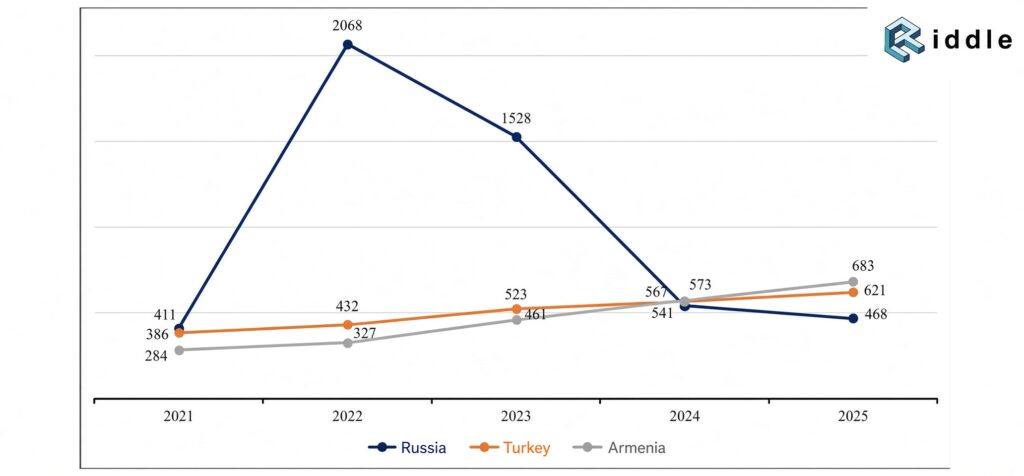
The first was the inflow of people, capital and businesses. As early as spring 2022, tens of thousands of Russian citizens arrived, bringing with them money, professional skills, entrepreneurial energy and extra consumer demand. Remittances surged, as did demand and prices for rental housing and the turnover of banks, restaurants and other service sectors. In 2022, transfers from Russia hit a record $ 2 billion—roughly five times the previous year’s figure. Although the volume later declined, Russia remained one of Georgia’s three largest sources of remittances in 2025 (Fig. 1). Between 2022 and 2024, Russian citizens registered around 30,000 companies across a wide range of sectors of the Georgian economy.
Fig. 1. Money transfers to Georgia from major source countries, $ million
Source: National Bank of Georgia
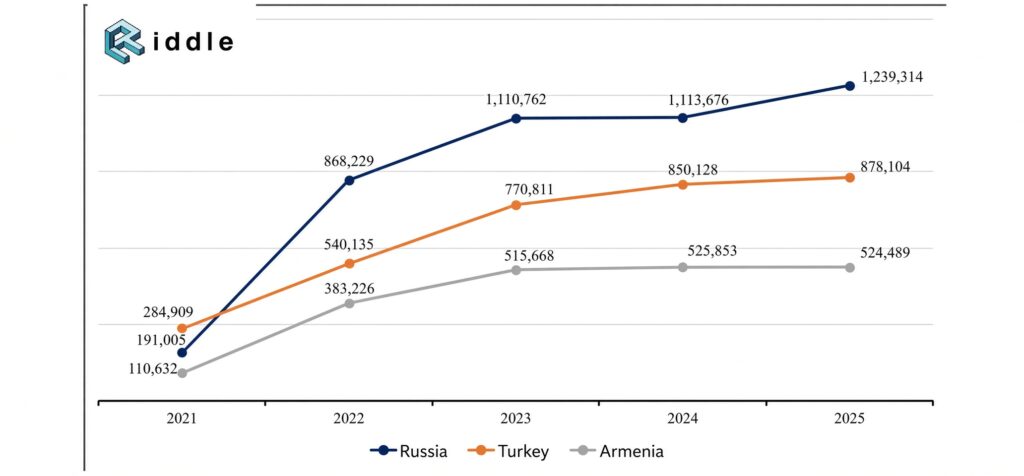
The second channel was tourism. From the low base of the pandemic year 2021, the number of tourist visits by Russian citizens rose from 191,000 to a record 1.24 million in 2025 (Fig. 2). Russia became the single largest source of inbound tourism, and spending by Russian visitors generated more revenue for Georgia than that of any other nationality.
Fig. 2. Tourist visits to Georgia from major countries of origin, number of visits
Source: Georgian National Tourism Administration
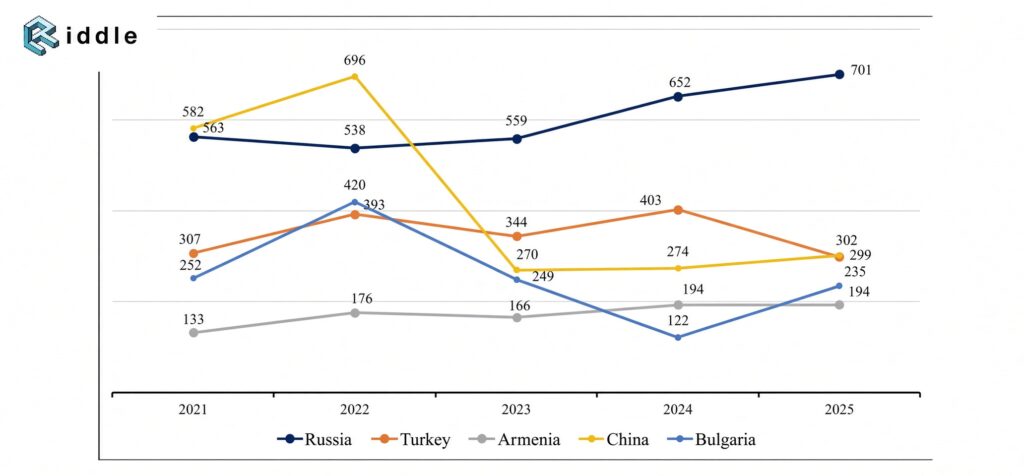
The third channel was the Russian market itself. After a modest dip in 2022, exports of goods of Georgian origin to Russia resumed growth and reached $ 701 million by 2025 (Fig. 3). Concentration in traditional categories remains high: the Russian market accounted for 64 per cent of Georgian grape wine exports, 56 per cent of other alcoholic beverages and 41 per cent of mineral waters. Since 2023, Russia has been Georgia’s largest external market.
Fig. 3. Exports of goods of Georgian origin to major destination countries, $ million
Source: National Statistics Office of Georgia
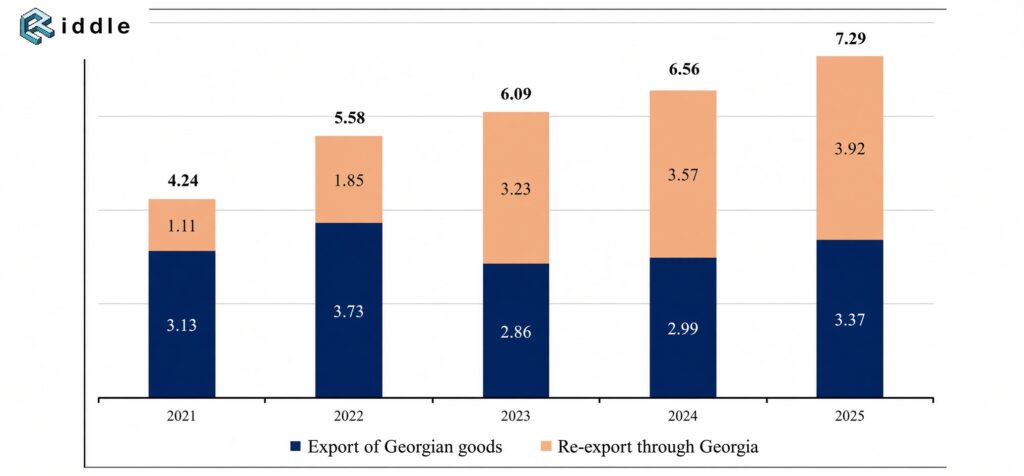
The fourth channel was the expansion of Georgia’s intermediation role. Sanctions disrupted Russia’s established trade routes, raised the cost of payments and logistics, and created demand for third countries through which goods could be procured and supply chains reconfigured. Georgia’s open economy, access to the Black Sea, free-trade regime with the EU, relatively straightforward business registration, developed banking sector and geographical proximity to Russia gave it clear advantages. The country emerged as a major regional re-export hub, including for goods whose direct access to Russia had been constrained by sanctions and the withdrawal of Western companies. Some flows went straight to the Russian market; others entered Eurasian Economic Union (EAEU) states, from where goods could move further within a single customs space. Since 2023, the value of re-exports through Georgia has exceeded that of exports of goods of Georgian origin (Fig. 4).
Of course, the full value of re-exports cannot be equated with income retained in the Georgian economy: a substantial share covers the original cost of the imported goods. Nevertheless, the intermediation model generates earnings for dealers, carriers, ports, banks, customs brokers and other participants in the chain, while supporting foreign-currency inflows, business activity and budget revenues.
Fig. 4. Ratio of exports of goods of Georgian origin to re-exports through Georgia, $ billion
Source: National Statistics Office of Georgia
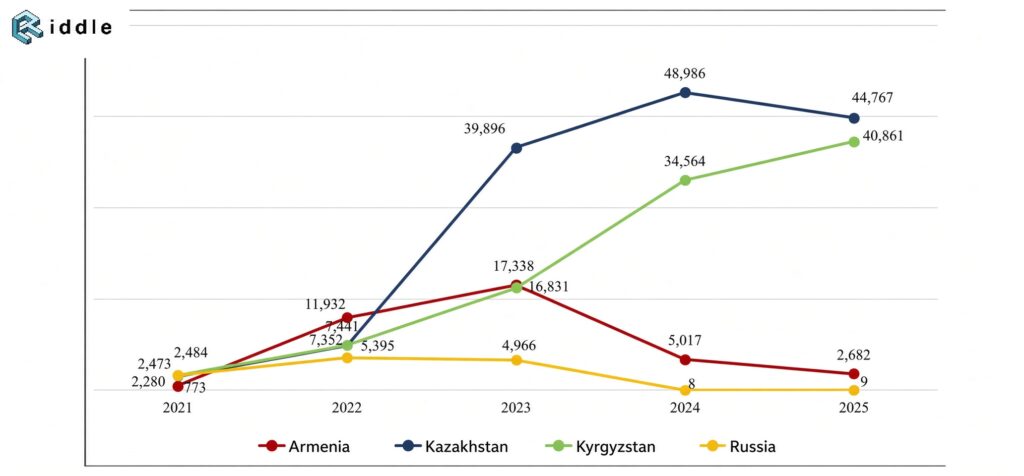
The most visible symbol of the new intermediation economy has been the re-export of automobiles. After sanctions and the departure of Western carmakers from the Russian market, deliveries of vehicles via Georgia to EAEU countries surged. Formally, the end markets were Kyrgyzstan, Kazakhstan and Armenia, yet the scale and dynamics of part of these flows pointed to the possibility of onward movement into Russia.
Once the EU tightened restrictions on car supplies to Russia in summer 2023, direct re-exports of vehicles from Georgia to the Russian market virtually ceased, while shipments to Kazakhstan and Kyrgyzstan multiplied many times over (Fig. 5). The resilience of the channel stems from the uneven nature of sanctions enforcement. European regulators focus primarily on dual-use goods, microelectronics and other items critical to Russia’s military-industrial complex. Passenger cars fall outside the EU’s current list of economically critical goods and proving that a Georgian intermediary knowingly facilitated their subsequent transfer from Kazakhstan or Kyrgyzstan into Russia is considerably harder in practice. Sanctions risks for this channel are therefore lower than for dual-use products, though they have not disappeared entirely.
In 2025, the value of passenger-car re-exports reached $ 2.8 billion and accounted for nearly 39 per cent of the country’s total exports. It was this trade that propelled Kyrgyzstan and Kazakhstan to the top of Georgia’s re-export destinations.
Fig. 5. Re-export of passenger cars from Georgia to EAEU countries, units
Source: National Statistics Office of Georgia
All of this coincided with rapid growth in the Georgian economy and rising living standards. Between 2021 and 2025, nominal GDP increased by 102 per cent, average monthly wages by 75 per cent and state budget revenues by 88 per cent. Unemployment fell from 21 per cent to 13.9 per cent, while annual inflation declined from 9.6 per cent to 3.9 per cent. Real GDP grew 9.7 per cent in 2024 and a further 7.5 per cent in 2025. GDP per capita exceeded $ 10,000, placing Georgia firmly in the upper-middle-income group of countries.
The Russian factor, of course, does not explain the entire expansion: construction, domestic consumption, government spending, financial and information services, tourism from other countries and the growth of regional trade all contributed. Yet the war acted as one of the principal catalysts, sharply raising Georgia’s economic value as a market, service platform and intermediary between Russia and the outside world.
This dividend has a reverse side. The same linkages that supported growth have increased the dependence of certain sectors on the Russian market, supplies and capital. For individual product categories—buckwheat, sunflower oil, wheat or flour—Russia’s share of Georgian imports reaches 80−100 per cent. Between 2021 and 2025, total imports from Russia rose from $ 1.03 billion to $ 1.94 billion; in January-May 2026 they grew a further 21.4 per cent year-on-year. In the energy sector, the Russian presence extends beyond current deliveries of gas, oil and petroleum products to ownership of major infrastructure assets. The new vulnerability has been especially visible in the oil sector.
Oil Dependence
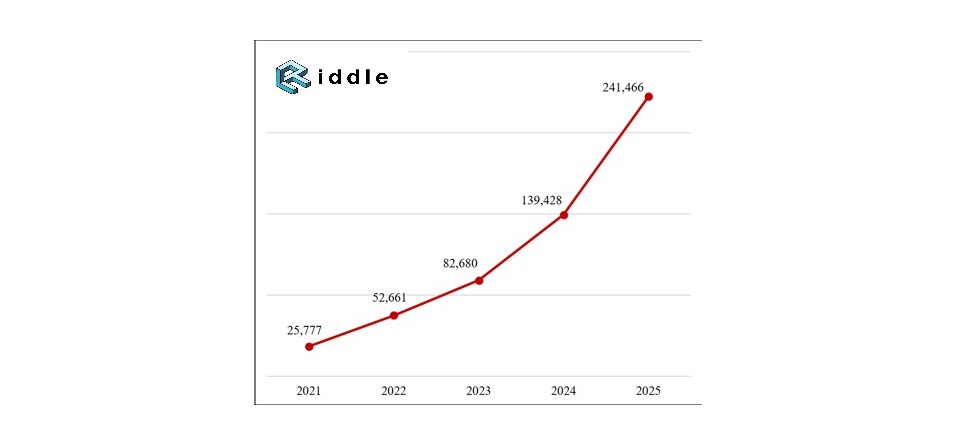
Until recently, Georgia mainly imported petroleum products for domestic consumption and re-exported far smaller volumes. After the full-scale invasion, supplies from Russia rose from 225,000 tons in 2021 to 694,000 tons in 2025, while Georgia’s exports of petroleum products climbed from 26,000 to 242,000 tons (Figs. 6 and 7).
Fig. 6. Imports of Russian petroleum products into Georgia, thousand tons
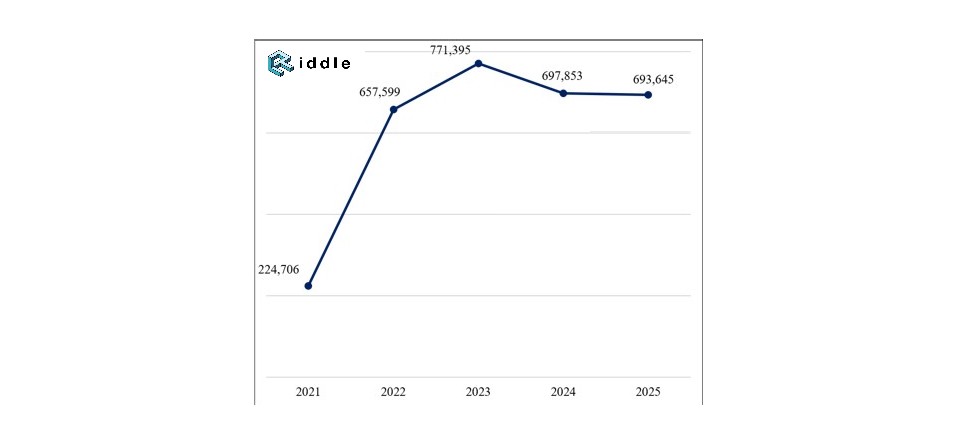
Fig. 7. Exports of petroleum products from Georgia, thousand tons
Source: National Statistics Office of Georgia
Because Georgia still lacked significant refining capacity at that time, the simultaneous rise in imports of Russian energy products and exports of goods recorded as being of Georgian origin prompted journalistic investigations and analytical reports about the possible re-export of Russian fuel via Georgia to European markets. The volumes involved remained relatively modest, however, and the operations generated almost no industrial value-added inside the country.
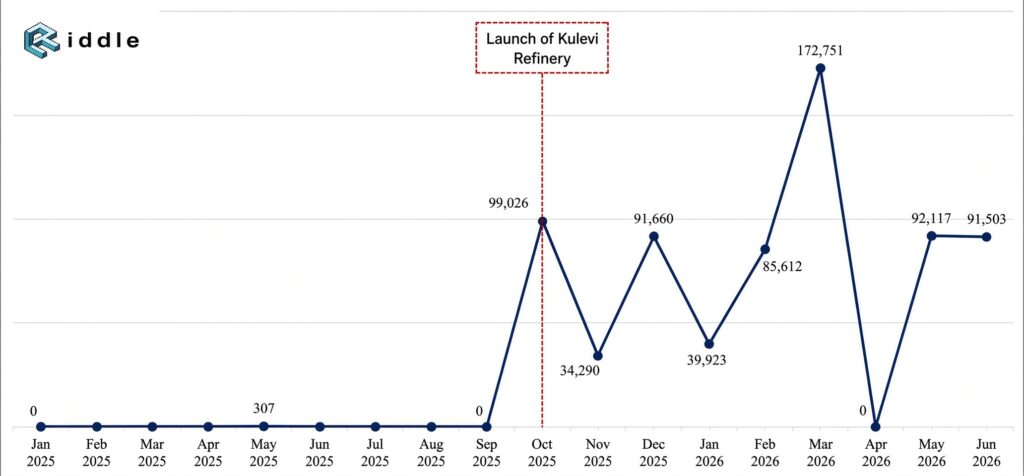
The situation changed with the launch of Georgia’s first large oil refinery at Kulevi at the end of 2025. The country began shifting from the transit of finished petroleum products to the processing of imported crude. Already in October, Russia’s Russneft delivered around 100,000 tons to the plant; over the following months, imports of Russian crude reached approximately 707,000 tons (Fig. 8). Previously such shipments had been sporadic.
Fig. 8. Imports of Russian crude oil into Georgia, thousand tons
Source: National Statistics Office of Georgia
The economic logic of the project mirrored the model actively used after 2022 by India, China and Turkey. Those countries bought discounted Russian crude, refined it at their own plants and exported the finished fuel, including to the European market. Substantial industrial processing changed the country of origin, so products made from Russian oil formally became Indian, Chinese or Turkish and fell outside the European embargo then in force. The Kulevi refinery allowed Georgia to insert itself into the same model—no longer merely as a transit node but as a producer of higher-value-added goods.
Early results illustrated the scale of the transformation. From November 2025 to January 2026, Georgia exported around 270,000 tons of domestically produced petroleum products. Roughly 103,000 tons went to Malta, Cyprus and Gibraltar, signaling an initial orientation that included European destinations.
Yet the project gathered pace precisely as the old model was closing. In July 2025 the European Union banned imports of petroleum products refined in third countries from Russian crude. The restriction took effect on 21 January 2026. Formal Georgian origin was no longer sufficient: products made from Russian feedstock could no longer enter the EU market.
In February 2026, the nearby port of Kulevi was proposed for inclusion in the EU’s 20th sanctions package because of its role in shipping Russian oil and the calls of shadow-fleet tankers. The restrictions were dropped after the Georgian authorities and the port’s operator—Azerbaijan’s SOCAR—undertook not to service sanctioned vessels and to comply with European prohibitions. The port was not listed, although its activities remain under European scrutiny.
The refinery itself did not escape. In the 21st sanctions package adopted in July 2026, the plant was added to the list of third-country refineries with which European persons and companies are prohibited from dealing. For Kulevi the measure was deferred by six months, giving a transitional period in which to diversify supplies and abandon Russian crude. After an assessment by the European Commission, the Council of the EU will decide whether to keep the plant on the list. Importantly, the restrictions apply specifically to the refinery, not to the adjacent port and oil terminal.
To avoid the ban, retain access to European financial and insurance services and eventually return to the EU market, the plant must switch to non-Russian feedstock and ensure transparency throughout the supply chain. Alternatives could include oil from Kazakhstan, Turkmenistan, Azerbaijan or other countries, but more complex and costly logistics, differences in price and feedstock quality risk eroding the plant’s competitive advantages and raising production costs.
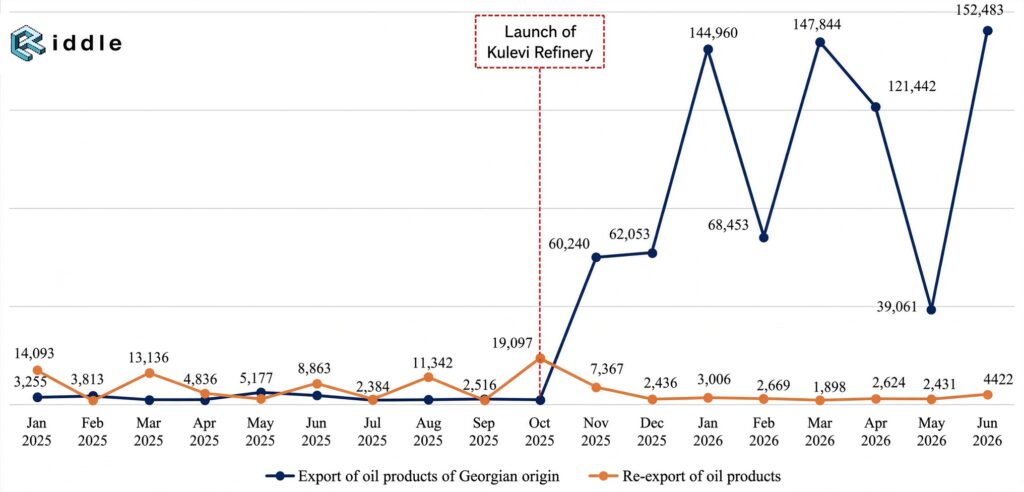
In the first half of 2026 the refinery continued to process Russian crude, although its management announced plans to switch to alternative supplies from August-September. With the EU market closed to products derived from Russian oil, Georgian petroleum products were redirected mainly to China, Singapore, Togo, Morocco and Turkey. In the first half of the year their exports reached 674,000 tons worth $ 467 million (Fig. 9). Petroleum products became Georgia’s second-largest export item after re-exported cars, accounting for 12.6 per cent of total exports.
Fig. 9. Exports of petroleum products of Georgian origin and re-exports of petroleum products through Georgia, thousand tons
Source: National Statistics Office of Georgia
Unlike the simple resale of cars, oil refining creates industrial value-added inside the country, utilizes infrastructure, generates jobs and contributes to budget revenues. Yet it also creates additional dependence: the future of the Kulevi refinery now hinges on its ability to switch suppliers rapidly, maintain acceptable costs and persuade the EU of the transparency of the new supply chain. Even if the Council of the EU ultimately decides not to apply the ban, the need to reconfigure feedstock supplies for a major new industrial project at short notice starkly illustrates the risks inherent in the intermediation model.
The Limits of the Intermediation Model
The economic model of relations with Russia that took shape after February 2022 rests less on new durable advantages than on rents generated by war and sanctions. It expanded because Russia’s previous links with the outside world were disrupted and demand for intermediary jurisdictions rose. Such rents are by definition time-limited: they shrink as routes adapt, the sanctions regime tightens and Russian demand weakens. The IMF has noted that a peaceful settlement could reverse part of the gains Georgia has derived from migration, financial flows and transit trade.
The first half of 2026 does not show a simultaneous collapse of all channels, but it does signal the end of their period of rapid expansion and a rise in Georgia’s vulnerability. The Russian economy is entering a phase of near-zero growth: the Bank of Russia has cut its 2026 forecast to 0−1 per cent, while the federal budget deficit for the first half of the year reached 5.73 trillion rubles, or 2.5 per cent of GDP. Repeated strikes on oil infrastructure are reducing refining capacity, intensifying fuel shortages, driving up prices and complicating domestic logistics. Russia retains the ability to sustain economic ties with its neighbors, yet servicing those ties is becoming more expensive and the flows themselves less predictable.
Remittances have so far remained resilient: in the first half of 2026, $ 250 million arrived from Russia—14 per cent more than a year earlier. Yet the channel’s importance is well below its 2022 peak, and sanctions can disrupt it quickly. After the operator of the Zolotaya Korona system was added to the 21st sanctions package, the service stopped processing transfers to Georgia. A similar picture is visible in tourism: the number of Russian visits rose 5.1 per cent to 611,000, but revenues barely changed, indicating diminishing marginal financial returns.
The limits of the model are even clearer in trade. In the first half of 2026, Georgian exports to Russia remained roughly at the previous year’s level, while imports rose 26 per cent to $ 1.2 billion and the bilateral deficit widened to $ 868 million. Wine shipments fell 4 per cent, other alcoholic beverages almost 20 per cent and fruit 3.2 per cent. This asymmetry is particularly hazardous because access to the Russian market depends not only on consumer demand but also on administrative decisions in Moscow, which has repeatedly used trade restrictions as an instrument of political pressure.
Car re-exports are also contracting. In January-June 2026 their value declined 23 per cent to $ 938 million, while the number of vehicles shipped fell 35 per cent to Kazakhstan and 46 per cent to Kyrgyzstan. The reasons lie simultaneously in the crisis of the Russian automotive industry, a falling market and the reconfiguration of routes. Higher Russian recycling fees have raised the cost of imported cars, weaker demand has limited sales, and some parallel imports are now entering Russia via China. Georgia retains a role as an automotive hub, but it can no longer count on a continuation of the explosive growth of previous years.
Finally, the story of the Kulevi refinery shows that the more Georgia invests in exploiting the trade and economic gaps between Russia and the West, the greater the likelihood that the next sanctions package will close precisely that gap and force an urgent reconfiguration of supplies, financing and sales markets. The lifespan of such models is shortening, while transaction costs and sanctions risks are rising.
In this structure the asymmetry is especially pronounced. For Russia the Georgian market remains small and relatively easy to replace, whereas for certain Georgian sectors Russian demand, feedstock or transit flows carry systemic importance. Moscow can therefore restrict access to its market at relatively modest cost to itself but with tangible consequences for Georgian companies. At the same time, access to European finance and markets depends on EU rules. Tbilisi’s attempt to extract benefits from both directions expands its room for maneuvers only for as long as the interests and requirements of the two external centers do not come into direct conflict.
Intermediation rents can be useful only as a temporary resource for the transition to a more sustainable model: development of the Middle Corridor, diversification of markets and feedstock sources, creation of production capacities that do not depend on sanctions exemptions, and the strengthening of institutions required by international business. Intermediation itself is not the problem: for a small open economy, transit and trade services can remain an important source of income. The risk arises when temporary geopolitical conditions are converted into a long-term strategy, and the attempt to become an indispensable bridge substitute for the need to build durable competitive advantages. In the end, Georgia may find that the war delivered rapid growth but failed to create reliable foundations for lasting prosperity.


