The election campaign for the State Duma, which officially began on June 16, is unfolding against a backdrop of serious problems: a fuel crisis, internet blackouts, and regular strikes on Russian cities.
Media reports have indicated that the Presidential Administration has lowered its targets for voter turnout and United Russia’s results. Back in February, the benchmarks were 50% turnout and 55% support for the ruling party. The campaign is clearly proving far more difficult for the authorities than they anticipated just six months ago.
This situation creates real openings for the legal opposition to improve its showing, provided it campaigns actively and criticizes the current state of affairs. Yet what is actually happening in the information space?
The Role of Television in the 2026 Elections
The Atlas of Elections project has been monitoring election coverage on federal television channels and social media since day one of the campaign. Its television monitoring covers the six federal channels in the first multiplex: Channel One, Russia 1, NTV, TV Center, OTR, and Channel Five. All news programs aired during each week are analyzed.
Television remains one of Russians’ primary news sources. According to HSE University data from autumn 2025, more than 61% of citizens still get their information from TV. It is also the most tightly controlled segment of the media and the state’s main propaganda tool. Even many people who say they get news online are actually visiting the websites of the same federal channels, so TV’s real influence is probably even greater.
The blatant favoritism shown by major state-aligned media toward the ruling party is well known. One example is telling. In the first three weeks of the campaign, all eleven parties that registered to run held congresses that were virtually identical in format. The law requires equal coverage of all participants. One might have expected at least formal compliance in such a straightforward case. Instead, United Russia’s congress received 1.3 times more airtime than the congresses of the other ten parties combined. Six parties received no coverage whatsoever on federal television.
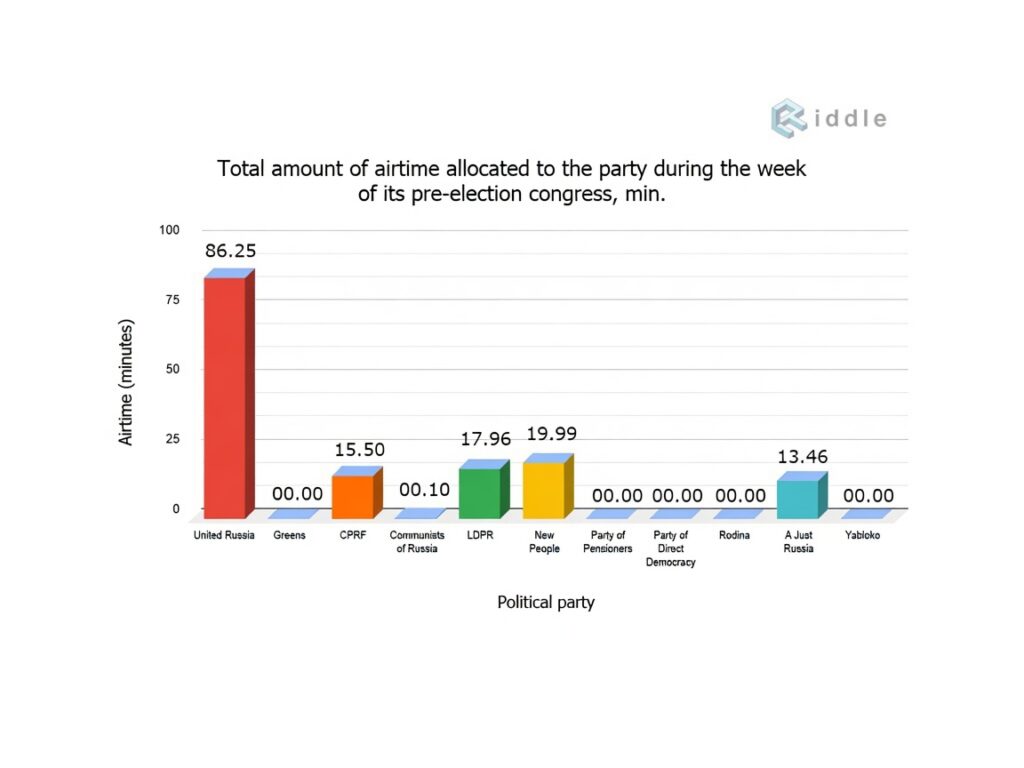
The bigger problem, however, is not the bias itself but the near-total silence. In the first six days of the campaign, all six main federal channels devoted a combined total of less than 17 minutes to the elections. Coverage rose to 105 minutes in the second week (when United Russia held its congress) but then dropped again to just 65 minutes in the third week. In 80% of news broadcasts, the elections were not mentioned at all — as if they simply did not exist. The channels applied the same approach to other major stories, including the start of the fuel crisis between June 22 and 28.
On the third week of the campaign (June 29-July 5), stories about most parties lasted anywhere from a few seconds to one minute. Only United Russia received close to two minutes on average. New People and A Just Russia received slightly more — between 1.5 and 2 minutes. In such brief segments it is impossible to convey anything meaningful about a party’s program, ideas, or activities. Mentions remain empty: viewers have no chance to learn about the parties or form an opinion about them.
This is a deliberate strategy. Federal television is making the election campaign almost invisible to ordinary Russians. The goal is clear: to “dry out” the elections, suppress public interest, and reduce turnout among protest-minded voters.
The authorities want only reliably controlled voters at the polling stations. Their share of the population is very large and long ago ceased to be limited to state employees. Even formally private companies are now integrated into the electoral vertical. According to the Federal Antimonopoly Service, the state already accounted for roughly 70% of value added in 2019 (before the full-scale war and the subsequent wave of nationalizations). RANEPA estimates put the state sector’s share of GDP at 56.23% by 2021.
The Battle for Social Media
Social networks have long been an important part of the information landscape alongside television. The Russian state has fought hard to control them: all major foreign platforms and messengers are blocked, while the key domestic services — VKontakte, Odnoklassniki, and the Max messenger — belong to the VK ecosystem, whose CEO is Vladimir Kiriyenko, son of the First Deputy Head of the Presidential Administration and the Kremlin’s domestic politics “curator”.
The agenda on social media differs from television. Fuel shortages and controversial party initiatives are discussed far more actively online. However, almost all major public pages operate under pre-moderation: nothing can be published without the approval of moderators closely tied to the authorities at various levels.
In the week of June 30-July 6, the single biggest story linked to political parties was a statement by United Russia Duma deputy Oleg Matveychev claiming that voting for any party other than United Russia was the same as voting for Volodymyr Zelensky. The item received explosive reach not only in political channels but also in entertainment communities, including the “Podslushano” network, which appears to be involved in centralized distribution of United Russia agitation.
United Russia’s dominance on social media and messengers (including blocked Telegram) is further strengthened by the vast network of official accounts belonging to government bodies, local administrations, and state-funded institutions. Even kindergarten accounts have been pulled into the effort.
For several years now, accounts of budgetary institutions — including schools and kindergartens — have been centrally managed by staff from district or city administrations. These employees post political content even without the knowledge of the institutions’ own leadership. As a result, tens of thousands of posts per week promoting United Russia appear on behalf of bodies that are legally prohibited from engaging in election campaigning.
The visibility of United Russia on social media therefore closely mirrors its dominance on federal television.
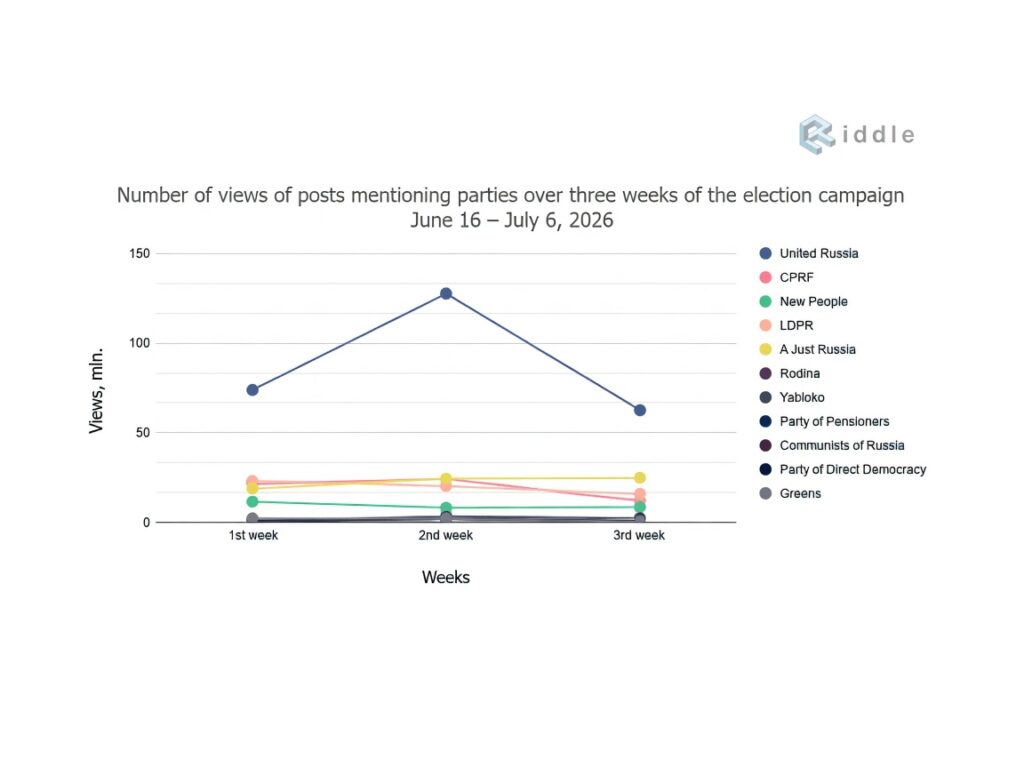
Users, however, react weakly to these posts. Most receive only a handful of likes; comments and reposts are rare. During the week of June 30-July 6, researchers found 52,605 posts mentioning United Russia across VKontakte, Max, Telegram, and YouTube. These posts generated just over 1 million reactions in total — an average of fewer than 20 reactions per post. By comparison, CPRF posts achieved roughly twice the average engagement.
The single most popular item mentioning the ruling party was a YouTube video by “foreign agent” Alexander Shtefanov titled “What platforms are the parties running on in the State Duma elections?” Despite access difficulties, the video gained over 700,000 views, 19,000 likes, and more than 3,000 comments in five days.
This creates a paradox: roughly 90% of posts mentioning United Russia come from authority-controlled VK pages, yet the strongest audience response is generated by opposition accounts on platforms blocked inside Russia.
First Weeks of the Campaign: Summary
Russia’s largest media outlets and authority-controlled social media pages are pursuing two goals at once: deliberately lowering voter interest in the elections while ensuring United Russia’s overwhelming presence in the information space.
So far, the “drying out” strategy appears effective. There is very little information about the elections in the public domain, and official publications generate minimal interest. United Russia’s dominance is more complicated: the party receives far more mentions and reach, but materials from more independent and openly critical voices elicit stronger reactions.
The campaign has only just begun, and mid-summer is traditionally a low point for political interest. The situation could shift noticeably by autumn, with the main changes likely occurring in the independent and opposition-oriented segments of the internet — primarily on platforms blocked for Russian users. (By early May 2026, VPNs were already installed on roughly half of all Russian devices.)
A key variable will be whether any political force (or forces) appears on the ballot capable of channeling accumulated discontent and mobilizing protest voters. It remains unclear whether such a force will emerge: candidate registration is still ongoing, and some parties, such as Yabloko, are proceeding with extreme caution to avoid disqualification. The intentions of the part of the opposition that cannot run officially are also unknown.
As past elections have shown, July is a “dead season.” Real mobilization usually begins only in the final three or four weeks of the campaign. In 2021, for example, the Golos movement recorded a sharp spike in reactions to posts about Smart Voting only in the last five weeks of the race.