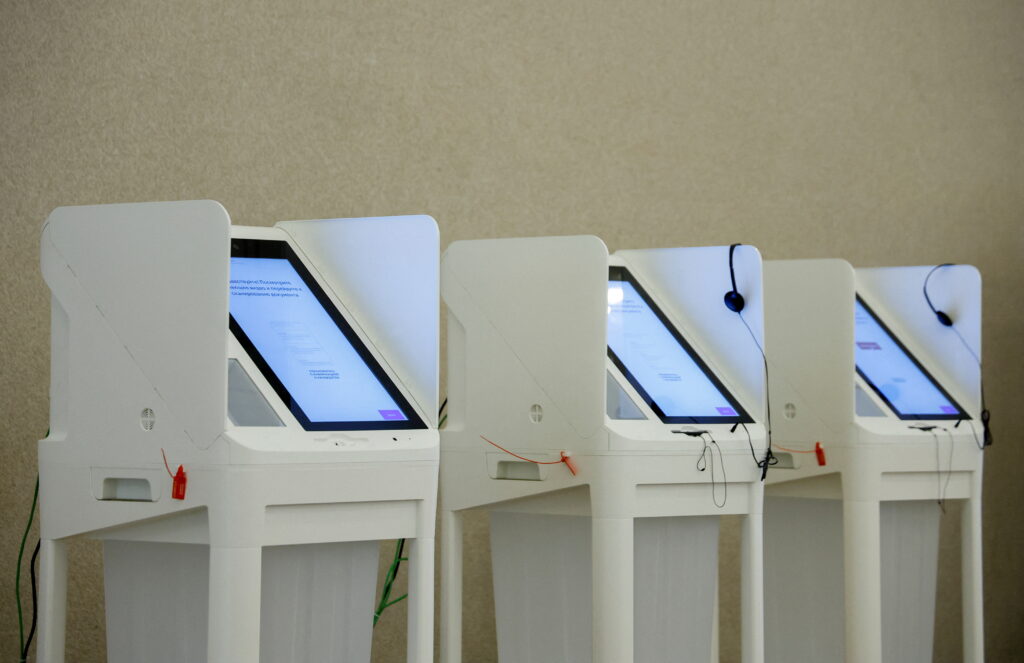
In the upcoming September 20 elections for the State Duma, millions of Russians will vote using the remote electronic voting system (DEG). The exact list of participating regions will be approved once the campaign officially begins. Roughly half of Russia’s federal subjects have already used the technology in previous elections, and most are expected to do so again.
Three years ago, ahead of the gubernatorial elections in the Moscow Region, every resident received a personalized video message from Governor Andrei Vorobyov through the Gosuslugi portal. Each of roughly six million voters was sent a short clip in which the governor addressed them by name and described what had been achieved in their specific municipality over the previous years. The videos were generated by artificial intelligence.
A decade earlier, this would have seemed almost impossible. Half a century ago, when modern party systems and electoral procedures were taking shape in developed democracies, no one imagined voters communicating directly with politicians while bypassing traditional media and receiving near-instant feedback.
Democracy is not a static institution but a daily practice involving hundreds of millions of people. Radical shifts in everyday life inevitably create new expectations in politics. When citizens grow accustomed to direct interaction with the authorities and demand greater involvement in decision-making, online voting can appear to be a natural next step. Yet this tool carries serious risks — risks that exist not only in authoritarian states like Russia but also in established democracies.
Russia’s experience with remote electronic voting is simultaneously the largest-scale and the most problematic in the world. That makes it especially valuable for understanding the risks and vulnerabilities inherent in such systems.
How Russia’s DEG Systems Work
Russia effectively operates two parallel DEG systems that differ significantly in design.
The first is the Moscow system, launched in 2019. In the autumn 2024 elections, more than 95 percent of Muscovites who voted did so electronically. This high share stems from the system’s default setting: even voters who went to a polling station voted on an electronic terminal unless they had specifically requested a paper ballot in advance.
The second is the federal system. Its reach is far more limited. About half of Russia’s regions still have not adopted it, and where it operates, online voting rarely accounts for more than one-third of total turnout. Unlike Moscow’s model, which treats every registered voter as an electronic participant by default, the federal system requires voters to submit an application in advance.
The Moscow DEG platform is developed and run by the Moscow city government’s Department of Information Technologies (DIT). Voter authentication and the actual casting of votes occur on its infrastructure. The Moscow City Election Commission merely signs the final protocol it receives from the mayor’s office. The federal system is managed by the state-controlled company Rostelecom.
In both cases, the systems have been removed from the effective control of the election commissions that are formally responsible for running elections. This violates international standards, which require an independent specialized body to organize and oversee voting. Election commission members generally lack the technical knowledge to understand or monitor the systems, so real control has passed to entities subordinate to the executive branch — one of the main political players in the process.
Neither the public nor political parties have a clear picture of how these systems actually function. The authors of the Moscow platform once published its source code, but there is no assurance that the published version matched what was actually deployed. After 2021, the code stopped being released altogether.
As early as 2019, independent programmers found a line in the published code that allowed voting results to be overwritten. Moscow’s DIT claimed the code was not used in live elections. Later analysis showed it did not correspond to official documentation and ran in a modified form. Yandex programmer Petr Zhizhin also identified a second, non-public blockchain ledger. Its existence was later confirmed by DIT’s own technical team. Zhizhin further discovered an unprotected table containing recorded votes along with their encryption logs — data that would have allowed organizers to determine exactly how each individual voter had cast their ballot.
DEG organizers routinely point to blockchain as proof of integrity and security. In practice, however, all nodes are controlled by executive authorities. The Moscow case demonstrated that a second, entirely hidden blockchain can exist without any public disclosure.
Consequently, Russia’s DEG systems contain no genuine safeguard against data substitution or manipulation.
DEG as a Tool of Voter Coercion
The minute-by-minute chart of electronic ballot issuance in Belgorod Region during the September 2025 elections shows a clear pattern: a large share of online votes were cast in the first three hours (visible as the sharp peak on the left side of the graph).
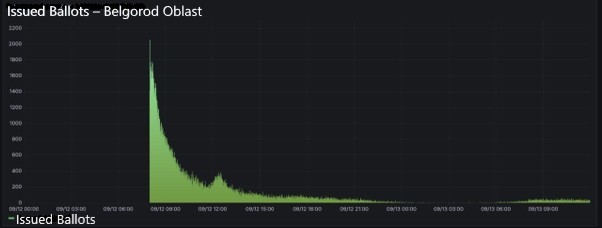
Figure 1. Minute-by-minute dynamics of electronic ballot issuance in the Belgorod Region elections, September 2025. Source: Telegram channel “Nevybory” by Ivan Shukshin.
Electoral analyst Ivan Shukshin calculated that in 2025, in most regions, the first three to four hours of the three-day voting period were enough to reach 50 percent turnout among DEG participants. In Belgorod, Lipetsk, and Magadan regions the threshold was crossed even faster. In other words, more than half of those who voted electronically did so at the start of the working day on Friday — most likely from work computers under managerial supervision.
In the Moscow suburb of Fryazino, Yabloko party observers identified at least eight makeshift “polling stations” set up in shopping centers, sports schools, and other rented premises. Access was restricted to pre-approved lists, and the rooms were equipped specifically for supervised remote electronic voting.
Such elaborate arrangements are often unnecessary. Voters who understand that executive authorities can see how they voted simply comply with instructions to avoid potential repercussions.
Remote electronic voting, combined with multi-day voting, has therefore created highly favorable conditions for administrative pressure on voters.
Signs of Possible Manipulation
The same graph reveals the characteristic early-morning spike in DEG voting in Belgorod Region at 8 a.m. on Friday, September 2025. Comparable spikes, adjusted for time zones, appeared across other regions.
An investigation by Alisa Sokolova and Alexander Bogachev for Novaya Gazeta Europe into the 2024 presidential election uncovered an even more striking anomaly. After the usual early surge in each region, something unprecedented occurred at 9:30 a.m. Moscow time: every time zone across Russia showed a simultaneous sharp increase in electronic voting. In a country spanning eleven time zones, such perfect synchronization is highly unnatural. The only plausible explanation is a centralized, one-time injection of a large volume of votes into the system.
In 2024, leading Russian expert on electronic voting systems Viktor Tolstoguzov documented a major discrepancy between the number of DEG participants recorded in the distributed blockchain database accessible to observers and the official figures published in election commission protocols. The gap was substantial: final territorial commission protocols for the presidential election listed 211,300 more DEG participants than appeared in the blockchain data downloaded by observers. In Kamchatka, for example, the official protocol recorded 44,042 electronic voters, while the node data showed only 5,125.
DEG observer Petr Losev has suggested the discrepancy may be a technical glitch rather than deliberate fraud, noting that the system does not maintain a direct link between individual voters and their ballots. Yet this very feature creates serious vulnerabilities: the architecture allows any number of “dead souls” to be added without detection by observers. Even if the mismatch was unintentional, the system’s design inherently enables covert distortion of results.
In 2023, Viktor Tolstoguzov uncovered another case in which Rostelecom had altered records of how voters had cast their ballots across 494 protocols during remote electronic voting (DEG). Every hour, a dedicated portal published reports—signed with the qualified electronic signature of territorial election commissions—showing the number of ballots issued and how voters had expressed their preferences. These documents were supposed to serve as an immutable, verifiable record of activity for each hour. In practice, however, the results were changed after the fact. Under the same links and file names on the Central Election Commission’s portal, entirely different documents suddenly appeared. As a result, data was retroactively corrected for at least 494 protocols covering ten hours of voting. In the elections to the eighth convocation of the Yekaterinburg City Duma, for example, the number of electronic ballots more than doubled. Across all the elections held that day, the total number of ballots increased by 109,724.
This incident was not isolated. Russia’s DEG system has displayed numerous other technical anomalies. While some of these irregularities can be attributed to the specific way the Russian authorities have implemented the technology, there are strong reasons to be skeptical of remote electronic voting even in well-established democracies governed by the rule of law.
Institutional problems with remote electronic voting
In a 2013 ruling, Russia’s Constitutional Court emphasized that citizens’ right to participate in the governance of the state is not limited to the act of casting a vote. Because the interests of citizens and the state body organizing elections may diverge, voters must have a genuine opportunity to verify the process. Without the ability to confirm that votes have been counted honestly, the right to vote remains purely formal. Effective observation is therefore a necessary condition for electoral legitimacy. This principle is fully consistent with international standards for democratic elections.
Remote electronic voting, however, makes meaningful observation practically impossible for any individual. It requires specialized expertise across multiple technical fields, sophisticated equipment, and substantial time—resources no single observer possesses. Traditional methods of monitoring and statistical analysis also cease to function. The system provides no breakdown by polling station; all remote votes are aggregated into a single pool and reported only as regional or national totals. This eliminates even basic statistical tools for detecting anomalies.
Consequently, remote electronic voting systems are placed entirely under the control of the executive branch, while election commissions are effectively sidelined. Commission members have no access to voter rolls, do not verify identities, do not issue ballots, and play no role in counting votes. Their function is reduced to formally accepting results delivered by the executive. Under these conditions, it is impossible to guarantee the secrecy of the ballot, the absence of coercion, or protection against the falsification of votes. Even if the central system itself were technically secure, the risk of compromise on the devices from which voters actually cast their ballots—personal computers or smartphones—cannot be eliminated.
Internet voting therefore remains an inherently insecure method of expressing political will. No existing or foreseeable technology appears capable of making it genuinely safe.
When this issue is raised with European electoral experts, the response is often that Russia’s experience is irrelevant because its traditional elections are already deeply flawed. This view is mistaken. Even in long-established democracies, electronic voting systems have repeatedly revealed serious vulnerabilities. One well-documented case occurred during the 2006 U.S. congressional elections in Miami, where votes on touchscreen machines were observed to “jump” from one candidate to another, and in some instances the ballot field remained blank despite the voter’s attempt to cast a vote.
The problem runs deeper than isolated technical failures. Remote electronic voting represents a fundamentally new instrument whose effects on democratic procedures, established standards, and public confidence in elections have yet to be properly understood. We have already seen instances in developed democracies where losing candidates allege fraud, triggering widespread unrest—including, in one case, the storming of the Capitol. With online voting, even conscientious election authorities have almost no practical means of convincingly demonstrating that the process was free of irregularities.
To assess the risks properly, negative experiences must be examined with particular care and treated as a baseline when developing new voting standards. This is all the more important because, despite the evident dangers, there appears to be no realistic long-term alternative to the steadily expanding use of remote electronic voting around the world.