
Immediately after the Supreme Court cancelled the registration of Yabloko’s State Duma candidate list, we wrote that the party’s initial registration — and the surge of support that followed — had already broken the Kremlin’s baseline scenario for these elections.
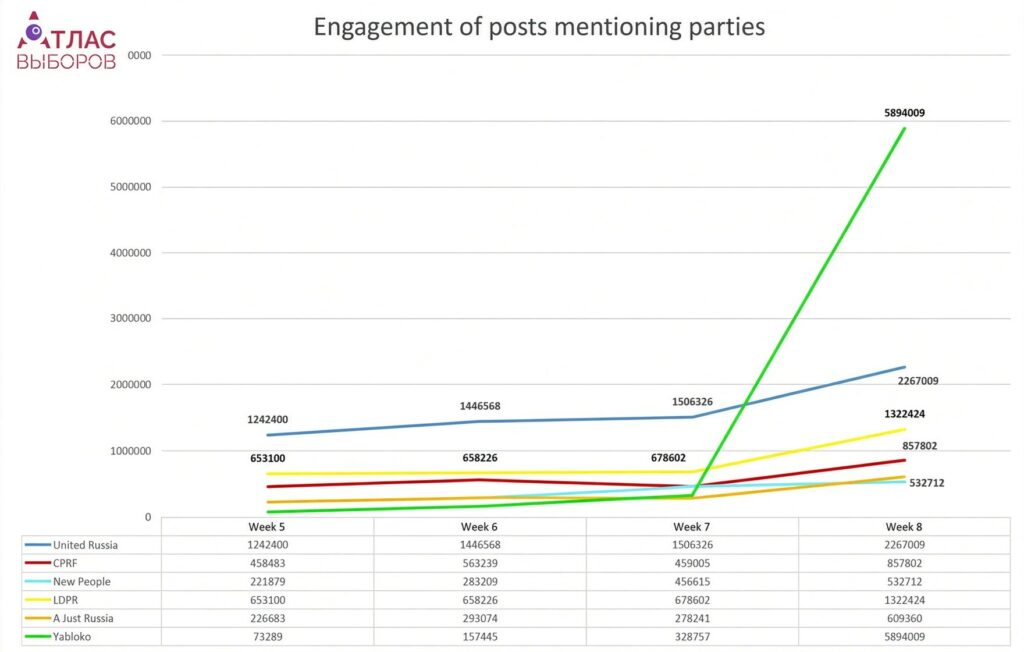
At that point we had two weeks of social-media monitoring from the Atlas of Elections project. Over that period, posts mentioning Yabloko attracted 4.5 times more reactions than they had before the list was registered. By that measure the party moved into fourth place, overtaking A Just Russia and closing in on the CPRF and New People. New People, for their part, were also rapidly accumulating reactions as Russsians’ compared them with Yabloko.
The nature of our sample matters. The monitoring draws on only four platforms: VKontakte, the MAX messenger, Telegram and YouTube. The first two are state-controlled and sit under the direct management of the son of Sergei Kiriyenko, first deputy head of the presidential administration. Telegram and YouTube are blocked in Russia. Other platforms popular with Russians — Instagram, X and TikTok — are absent from the monitoring for technical reasons. A full harvest of material from those sites would require working with companies that have contracts with Meta, X and TikTok. Under present conditions, both Russian and European firms are wary of anything connected with Russian elections. Our sample is therefore tilted toward a “statist” view of politics.
That limitation is what gives the findings extra analytical weight. The fact that a demand for open political discussion and more active participation is visible even in a segment of the digital space already skewed toward pro-government positions suggests that such attitudes are more widely distributed in society.
Yabloko’s registration — and its cancellation — as the campaign’s defining events
New data have appeared since our previous piece. In the week when it became known that Rodina had filed a lawsuit to cancel Yabloko’s federal list and that the Supreme Court had granted the claim, the story rose to first place across Russian social media. By engagement — likes, comments and shares combined — Yabloko became the clear leader. Its reaction count rose another eighteenfold in a single week (and eightyfold over a month).
Television, which remains Russians’ main source of news, constructs a fundamentally different and distorted reality. On the six leading federal channels, Yabloko was barely mentioned from the start of the campaign. The party received its largest allocation of airtime precisely in the days when its list was cancelled: a little over six minutes across all channels for the week. At no point in the campaign did viewers hear a single representative of the party speaking in their own voice.
Meanwhile, at the end of August every party still in the race received free airtime on television and radio, as well as space in major print outlets. Had Yabloko been allowed to stay on the ballot, it could have bought paid advertising, including in prime time, and television audiences would have heard its position for the first time in the campaign. That fact is essential both to the overall picture and to an understanding of why the party was removed.
The campaign as a story about shrinking competition
After the party was forced out of the race, attention and interest in it began to fall sharply. Even so, two weeks later — by the end of August — Yabloko still ranked among the top four parties by social-media metrics, despite a comparatively small number of posts mentioning it.
Russians’ attention then started to shift toward other candidates and parties facing similar treatment. In the second half of August, in the week of 18−24 August, several events produced a telling reaction online. Vladimir Putin delivered a keynote speech at the United Russia congress; the CPRF lost one of its most visible regional candidates, former State Duma deputy and popular YouTube blogger Nikolai Bondarenko. At the same time, Yabloko lists continued to be struck from regional ballots, and pressure on candidates from other parties persisted.
In that week, posts about United Russia devoted to Putin’s speech gathered 1.16 million reactions (likes, comments and shares). Content about Bondarenko’s removal gathered 1.48 million — 22 percent more. The comparison is not about the volume of mentions, which is always inflated by a substantial share of artificial activity, but about reactions to posts. At this scale, in our experience, that metric already tracks real audience interest reasonably well.
The gap is especially striking given the media resources mobilized to cover the United Russia congress and the president’s appearance. The entire spectrum of state-controlled media was involved — from television, where United Russia received ten times more airtime than the CPRF, down to the community pages and accounts of small rural administrations.
If one adds up all posts about the removal of other candidates and parties, their combined views double those of posts mentioning Vladimir Putin over the same period. More than a quarter of social-media users who that week read material about political parties opened news and commentary specifically about candidates being taken off the ballot. (The sample excluded posts mentioning Yabloko, which by then had already been eliminated from the race.)
People do not want to be talked at. They want to talk
In effect, throughout August — from the moment the campaign began to stir from its slumber — voters discussed most intensively not party programs and not the head of state’s statements, even on days when oil refineries and warehouses were exploding inside the country, but the authorities’ attempts to tighten still further the already meagre competition in a fully managed election. The original plan of those running the vote, it seems, was to conduct the balloting as quietly, routinely and predictably as possible under conditions of socio-political overstrain. The public agitation around the restriction of competition broke that strategy.
The barring of candidates, and the authorities’ fear of a genuine public conversation about politics, became the campaign’s central theme. Both the authorities and the parties themselves prefer to ignore it. For now, perhaps only CPRF is trying to use pressure on its candidates to energize and mobilize supporters. Yet people continue to follow events and to react sharply to the Kremlin’s moves — and it no longer much matters who exactly is being removed. The decisions themselves generate strong emotion. Something similar, though perhaps in an even more concentrated form, was visible when candidates were denied registration for the 2019 Moscow City Duma elections. Protest voting then produced victories for a number of “technical” candidates who had run no campaign at all.
Judging by social-media reactions, society again appears to want a discussion of what is happening in the country and a more active form of political participation. The political system, however, is moving in the opposite direction: toward the maximum constriction of that conversation. Similar processes were already visible in 2011−2013, only to be interrupted by the annexation of Crimea. They gathered force again in 2017−2019 and were then halted once more — first by the pandemic and constitutional reform, then by a new war.


