Russia’s occupation of Ukrainian territory is often measured in military terms: towns captured, borders shifted, and front lines advanced. Yet occupation is not solely a military or administrative process. It also involves reshaping how people understand the past, their collective identity, and their place within broader political communities. Russia has used historical narratives as a tool of governance in occupied Crimea and the self-proclaimed Donetsk and Luhansk “people’s republics” since 2014. Following the full-scale invasion in 2022, however, these efforts expanded significantly in both scale and institutional reach. Across the newly occupied territories, Russian authorities invested heavily in monuments, memorial complexes, educational programs, youth initiatives, and commemorative events, seeking to embed the occupation within a broader historical narrative.
One of the key institutions carrying out this agenda is the Russian Military Historical Society (RVIO). Established by presidential decree in 2012, RVIO is a state-run organization tasked with promoting patriotic education and a unified interpretation of Russian history. After the 2022 invasion, it significantly expanded its operations into the newly occupied regions of Ukraine. It has overseen memorial restoration projects, organized educational forums, distributed textbooks, and developed youth programs. Across these initiatives, RVIO consistently promotes a narrative of historical restoration, presenting the occupied territories not as newly conquered spaces but as regions returning to their rightful place within a larger Russian historical community.
Monuments, Memory, and Reunification
One of the most visible ways RVIO advances this vision is through the transformation of public space. After the full-scale invasion, the organization expanded its program of monument construction and memorial restoration across the occupied territories. By mid-2024, according to RVIO, it had opened 19 memorial sites in the occupied regions of Donetsk, Luhansk, Kherson, and Zaporizhzhia, while continuing to develop new military memorial complexes and monuments. Although these projects vary in subject matter, they consistently advance a single narrative: contemporary Russian authority is portrayed as part of a continuous historical struggle that links the Second World War, Soviet memory, and the current war in Ukraine.
The strategic logic behind these efforts was outlined in May 2023, when RVIO Deputy Chairman Nikolai Ovsienko announced plans for a large-scale campaign of monument restoration and construction in the occupied territories. In addition to rebuilding Soviet war memorials, the organization proposed new monuments dedicated to the “miners-defenders of Donbas” and stressed the preservation of what it called the historical heritage of “Novorossiya.” Restoration projects were framed as a response to alleged Ukrainian attacks on historical memory and as a way to connect generations through a shared struggle against Nazism.
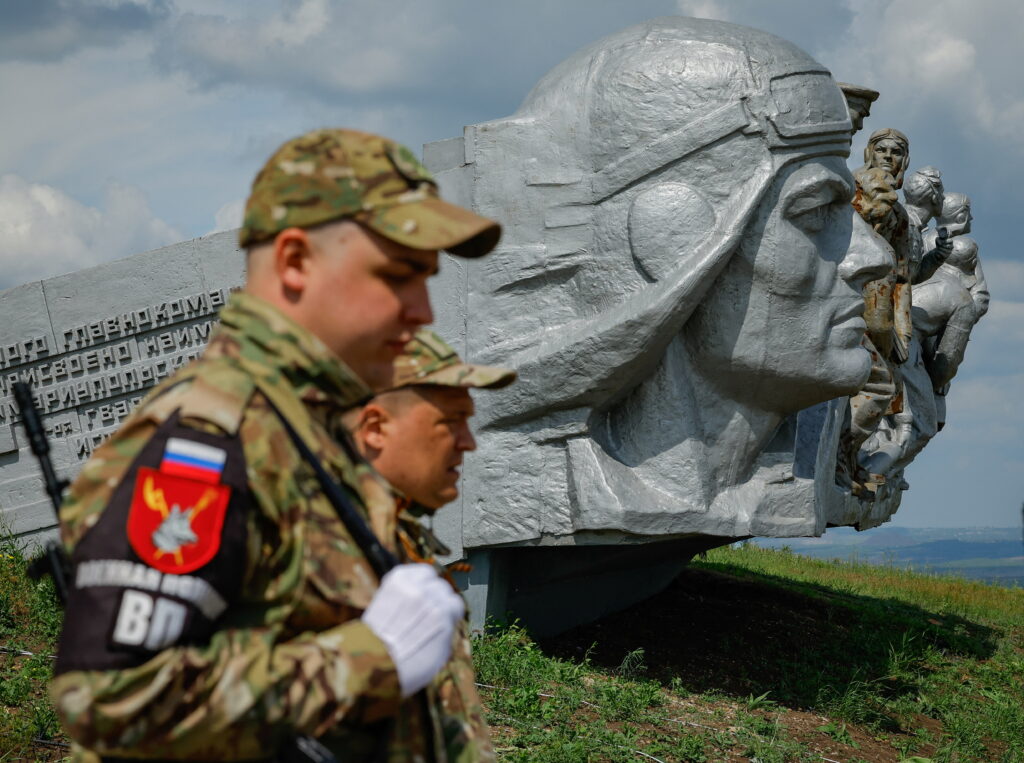
The reconstruction of the Saur-Mohyla memorial complex illustrates this approach clearly. Originally opened in 1967 to commemorate the Soviet liberation of Donbas during the Second World War, the memorial was heavily damaged in 2014. When RVIO, together with the Russian Ministry of Defense, reconstructed it in 2022, the project went beyond simply restoring the original monument. Alongside the rebuilt Soviet elements, RVIO added three new reliefs honoring the “heroes” of the Donbas militias, Russian servicemen, and participants in what Moscow calls the “special military operation.” Ovsienko explained that the new reliefs would ensure “the heroes of our time” were commemorated alongside those of the Second World War, while the preserved shell damage on the original reliefs would serve as evidence of both the 2014 fighting and the sacrifices of those who defended Donbas. In this way, the memorial physically merges the memory of the Great Patriotic War with the contemporary war against Ukraine, presenting both conflicts as chapters of a single struggle against “Nazism.”
A similar pattern appears at the Shurf Mine 4/4-bis memorial complex in Donetsk, which commemorates tens of thousands of civilians killed during the Nazi occupation of Donbas. At the reopening ceremony in March 2024, Russian officials repeatedly connected remembrance of wartime atrocities to current military operations. Sergei Kiriyenko, First Deputy Chief of Staff of the Presidential Administration and the Kremlin official overseeing domestic policy in the occupied territories, described the preservation of historical memory as essential to achieving “victory over Nazism and fascism forever.” Local officials added that the memorial carried important lessons for future generations. The reconstruction thus functioned not merely as preservation but as a deliberate link between the Second World War and the present conflict.
RVIO’s memorial projects have also begun incorporating the current war into official commemorative culture. In November 2025, the organization opened the military memorial complex “Donetsk Sea” in occupied Donetsk. Built on direct instructions from President Vladimir Putin, the site honors participants in the war against Ukraine. Officials emphasized that the complex would educate future generations and encourage school visits. Ovsienko argued that students should come to the site to learn history through the stories of those commemorated there, thereby integrating contemporary combatants into the same historical narrative as earlier generations of Soviet and Russian soldiers.
The same language of restoration appears in occupied Kherson Oblast. In July 2023, RVIO unveiled a monument to Soviet actor Yevgeny Matveyev in his native village of Novoukrainka. Officials presented the project as part of a broader effort to recover historical figures whose memory had allegedly been neglected or erased after 2014. A similar narrative accompanied the February 2024 unveiling of a monument to Russian explorer Pyotr Kozlov at the Askania-Nova nature reserve. Occupation governor Vladimir Saldo described it as an effort to “return historical achievements and facts” that had supposedly been taken away from local residents.
Underlying these initiatives is a remarkably consistent political vocabulary. Across monument unveilings, memorial restorations, educational forums, and public statements, Russian officials repeatedly invoke terms such as “historical justice,” “historical memory,” “historical territories,” “reunification,” “return,” “restoration,” “Novorossiya,” and “historical homeland.” They rarely describe their activities as creating a new political order. Instead, they portray themselves as restoring one that already existed. At the 2024 forum “History for the Future. Russian Spring” in Luhansk, President Putin described the occupied territories as “historical lands” that had returned to their “large native family.” Speakers throughout the forum framed the incorporation of these territories into Russia as reunification rather than annexation.
Similar themes were prominent at the 2025 “History for the Future” forum in Kherson Oblast. Presenting new textbooks on the history of Donbas and Novorossiya, Ovsienko described the struggle for historical understanding as one of the most important fronts in contemporary Russia. Participants portrayed Novorossiya as a historical space naturally connected to Russia and presented historical education as essential to the long-term integration of the occupied territories into the Russian state.
By framing Russian authority as the restoration of historical continuity rather than the result of military occupation, RVIO transforms political claims into historical ones. Russia is depicted not as arriving, but as returning. These projects do more than commemorate the past; they embed contemporary Russian rule within a historical narrative that links imperial expansion into southern Ukraine, the Soviet victory in the Second World War, and Russia’s current war against Ukraine into a single story of continuity. In this framework, occupation appears not as rupture but as restoration.
The Battle for Minds: Teaching Historical Loyalty
The effort to reshape historical consciousness extends beyond monuments into education. While memorial projects transform physical space, educational initiatives aim to shape future generations. Since the full-scale invasion, RVIO has built a multi-layered educational infrastructure across the occupied territories. Its activities include annual forums, dedicated classrooms, regional history textbooks, museum initiatives, exhibitions, youth competitions, commemorative projects, and extracurricular programs for schoolchildren.
RVIO Chairman Vladimir Medinsky articulated the organization’s approach at the 2024 “History for the Future: Russian Spring” forum in occupied Luhansk, describing history as a “battlefield for minds and souls.” The forum brought together more than 3,000 participants and focused on historical memory, patriotic education, and the defense of what organizers called historical truth.
Educational programming is closely tied to curriculum development. At the 2025 forum in Genichesk, RVIO introduced new textbooks on the history of “Donbas and Novorossiya for students in grades 5 through 7”. Ovsienko described schools as a crucial front in the struggle for young people’s minds and argued that success in this area was essential to broader political objectives. The textbooks supplement Russia’s unified state history curriculum with a regional narrative aligned with official interpretations of the occupied territories.
RVIO has also established dedicated institutional structures inside the occupied territories. In September 2024, it opened a dedicated RVIO classroom at a lyceum in occupied Luhansk and announced plans for additional classrooms elsewhere. Students in the program study history alongside topics such as information warfare and patriotic education. Ovsienko described the “information front” as a struggle for the minds and hearts of young people.
Other initiatives follow the same pattern. RVIO-sponsored exhibitions such as “Heroes and Feats” and “Heroes with Eternally Russian Hearts” place participants in Russia’s war against Ukraine alongside heroes of the Second World War. Educational games such as “Code of the Fatherland” ask students questions about both the Great Patriotic War and the “Special Military Operation,” collapsing the historical distance between the two conflicts. Museums receive Soviet-era artifacts recovered and transferred by RVIO activists, while youth camps emphasize the “historical ties” connecting Donbas, Novorossiya, and Russia. In April 2026, the organization installed twelve commemorative plaques honoring local Heroes of the Soviet Union in schools across occupied Makiivka, integrating official narratives directly into students’ daily environment.
Conclusion
These initiatives show that RVIO is not simply teaching history. Through classrooms, textbooks, museums, youth camps, and public events, the organization promotes a single interpretation of the past in which Donbas and so-caled Novorossiya are portrayed as historically inseparable from Russia. The Great Patriotic War and the current war against Ukraine are presented as parts of the same struggle, while Russian rule is framed as the restoration of historical unity rather than the result of military conquest. Historical education thus becomes another instrument for normalizing and legitimizing the occupation.
What distinguishes RVIO’s approach is its consistent use of the language of historical restoration. Across the occupied territories, monuments are presented as recovered heritage, educational reforms as the defense of historical truth, and territorial incorporation as reunification rather than annexation. In this framework, history is not merely invoked to justify political decisions after the fact; it becomes the mechanism through which those decisions are made to appear natural, inevitable, and historically legitimate.


