In August 2023, the film The Witness premiered, marketed as “the first feature film about the war in Ukraine.” Formally, the claim was untrue. Back in October 2022, the action film The Best in Hell, financed by Yevgeny Prigozhin, had been released, and in spring 2023 the web series Mobilization premiered. Over the following years, the number of projects about the war with Ukraine rose to more than a dozen.
Many of them addressed the events of 2014−2022. These include the series Take Her Across the Maidan, Militia Romance, Our Own: A Ballad of War, and Ten Days Before Spring, as well as the film Call Sign “Passenger.” Others dealt with the full-scale war: the series Mobilization, 20/22, Reservists, and Lilies of the Valley; the films The Best in Hell, Aldan, and The Kid; and, in October 2026, the premiere of the series The Other Side of the Coin.
Within just a few years, a distinctive canon took shape, bringing together projects of very different scale and production conditions—from Mobilization, made on an almost nonexistent budget, to Call Sign “Passenger,” which cost 351 million rubles ($ 4,33 million) to produce.
The Primary Task: Explaining Why the War Began
Channel One’s series 20/22 opens in the first half of February 2022. “DNR militiamen” study the positions of Ukrainian forces and conclude that the enemy will soon launch a major attack on Donetsk. Within this logic, Russia’s subsequent decision to launch the “special military operation” appears as a response to Ukraine’s actions.
Nearly every film and series offer an explanation for why Russia launched the full-scale war. The screenwriters, however, can draw on different propaganda narratives.
20/22, Mobilization, and The Kid explain the war by claiming that Ukraine was preparing an attack on the DNR. In this version, the Russian army appears as the protector of the civilian population of Donbas. Notably, the region’s residents themselves do not always understand why Russian intervention is necessary: at the beginning of the story, they fear mobilization more than Ukrainian troops—a motif repeated in The Kid and Mobilization. Only gradually do the characters come to believe that Russia has come to save them.
The rescue motif is one of the clearest and most convenient for cinema: it allows for a relatively straightforward plot. At times, however, the causal logic is distorted to such an extent that what unfolds on screen becomes farcical. In The Witness, Russia attacks Ukraine, after which Azov Battalion fighters take Ukrainian civilians prisoner. According to the plot, only the Russian army can save them. Thus, Azov’s conduct after the war has begun becomes the explanation for why the war supposedly had to be started. Yet, following the film’s logic, Azov had done nothing wrong before the Russian invasion.
Russian cinema offers other explanations as well. In Take Her Across the Maidan and Call Sign “Passenger,” the war appears as the result of a geopolitical game initiated by the United States. Ukrainian soldiers, in this framing, become puppets of external forces. In The Best in Hell, the need to fight is explained by a “contract with the Motherland”; in Lilies of the Valley, by a sense of duty. In Aldan, the central motive is revenge: the characters lose loved ones in Ukrainian attacks.
A substantial portion of screen time is devoted to explaining the causes of the war. This is done not only through archival footage and voice-over narration, but also through monologues delivered by different characters. This very urge to spell out why Russia started the war distinguishes contemporary Russian cinema from its Soviet predecessor. The characters of The Cranes Are Flying (1957) do not need to parse the geopolitical context or explain events through ideological constructs: they are defending their home. In Call Sign “Passenger” or Militia Romance, no such self-evidence exists. The audience must be told separately why people are dying.
“The Liberal Must Become a Patriot”
The repertoire of archetypes used in pro-war Russian cinema is rather limited.
One popular character is the “liberal”: the music producer in The Kid, the “trendy writer” in Call Sign “Passenger,” the spoiled rich girl in Lilies of the Valley, and the journalist in Militia Romance. In 20/22, the role of the “liberal” is assigned to an entire student community.
The liberal’s natural habitat is Moscow. Spacious apartments and modern offices look conspicuously out of place against the trenches and destroyed houses. The implication is clear: a person with anti-war views earns good money and is detached from “the people.”
Yet the liberal’s anti-war position invariably proves untenable. Such a character cannot coherently explain why they oppose the war and resorts to slogans. They look especially weak next to the seasoned field commander, who can explain any political phenomenon in plain language.
The liberal’s principal task in pro-war cinema is to travel the path to patriotism. In 20/22, the protagonist’s girlfriend, an anti-war student, goes to the front to find her boyfriend. She begins revising her views even before encountering the horrors of war. At one point, she even says she would not mind becoming the wife of a “hero”—although, barely a scene earlier, she mentions crimes committed by the Russian army.
In Aldan, a programmer becomes a volunteer after his daughter is killed in a Ukrainian shelling. In Militia Romance, a Moscow journalist who travels to Donbas to prepare a report for a German publication gradually absorbs the ideas of the “militiamen.” The writer in Call Sign “Passenger” follows a similar path. Since Russian soldiers are invariably portrayed as heroes and Ukrainians as villains, even a brief stint at the front is enough to transform the character’s former convictions.
The plot of re-educating the liberal is popular in Russian propaganda journalism as well. A telling example is the famous “IT specialist’s letter,” published by Komsomolskaya Pravda in 2023. In its dramaturgy, it differs little from the script of a pro-war series.
“I’m an IT guy, I’m 35. When the SMO began, I left, like many of my colleagues—I was scared. Why hide it now: I held ‘liberal’ views, I didn’t understand, and there was no one around to enlighten me, while all my life I’d been pressing keys on a keyboard and watching YouTube. And that’s how I lived, without thinking much about the fact that for years YouTube and ‘documentary’ programs had been implanting in my brain the idea that everything in your Homeland is bad, and that you yourself are defective. And then came the SMO,” propagandist Alexander Kots paraphrased the “letter.”
Transformation by Template
The transformation of an apolitical person into a brave fighter follows a fairly simple scheme. First, the character clashes with a field commander who has no use for a civilian at the front. Gradually, the protagonist immerses themselves in an unfamiliar world, begins to sympathize with local residents, and develops respect for the military. The next stage is military training. Notably, in most projects this episode is played for comedy. Then comes a battle in which the hero shows cowardice and jeopardizes their continued presence at the front. Still, they are given a second chance—and make full use of it. By displaying courage in the next battle, the hero completes the final stage of personal transformation.
The series Lilies of the Valley applies a similar template to a female character, far from the front: the spoiled rich girl enters the world of a contract soldier and gradually embraces patriotism.
A formula has also emerged for how the hero ends up at war. Most often, the trigger is a family circumstance: searching for a brother (Call Sign “Passenger,” 20/22), saving a mother (The Kid), or avenging a killed daughter (Aldan). In Lilies of the Valley, the heroine travels to the line of contact to find her missing husband. In 20/22, the motif is used twice: first a student goes to the front to find his brother, and then his girlfriend follows him, abandoning her anti-war views along the way.
The reasons why pro-war cinema turns out so schematic are obvious: rushed production schedules and filmmakers’ lack of experience. The screenplay for Call Sign “Passenger,” for instance, was written by Ilya Kazankov, who also directed it. It was his ninth screenplay—or his third, counting only feature films, after the comedy Call Mishkin and the melodrama Games of Children of Mature Age. Kazankov wrote all three screenplays for his own projects. The industry, in the broad sense—from the Cinema Fund to daytime series on NTV—has not recognized him as a sought-after screenwriter. But few people want to work on films about the war (if Zakhar Prilepin is to be believed, about 70 percent of actors refuse because of the subject matter), which is why figures like Kazankov get their chance.
How the Image of the Enemy Is Constructed
If the positive heroes of pro-war projects are fairly alike, the negative ones differ dramatically.
In The Witness, the main enemy is the “Nazis,” embodied by Azov Battalion fighters. They worship Adolf Hitler and perform rituals to German music—while denying that they are “Nazis.”
“Nazis” also appear in The Kid, though the emphasis there is on the veneration of Stepan Bandera. Russian units, by contrast, are ostentatiously multinational: fighting alongside Russians are Black American volunteers who have gone to the front because “Russians are capable of the impossible.”
In 20/22, the enemy is demonized through pagan rituals and human sacrifice. In one scene, Ukrainian soldiers perform a rite in which they gouge out the eyes of a portrait of Gogol and then begin to howl.
In Aldan, the enemy appears as a cynical structure interested solely in making money.
The portrayals of military command differ as well. The Russian commander cares for his men; the Ukrainian commander, by contrast, is prepared to sacrifice them—so readily, in fact, that he may send his own son into a deadly battle. In The Kid, this storyline is developed in particular detail. Ukrainian command is also said to be indifferent to civilians. In The Witness, it is Ukrainian forces who carry out the missile strike on the Kramatorsk railway station in order to blame Russia. In The Kid, Ukrainian fighters allegedly hold civilians inside the Azovstal compound to use them as human shields.
The difference between the two sides is underscored by the reasons characters switch sides. A Russian may fight for Ukraine only out of self-interest; a Ukrainian joins Russia after an epiphany.
The exception is The Best in Hell, commissioned by Yevgeny Prigozhin. Ukrainian soldiers there are portrayed as professional fighters who differ from the Russians only by the flag on their uniforms. One scene even emphasizes the Orthodox faith shared by soldiers on both sides of the front. Ultimately, however, the “contract with the Motherland” compels the Russian fighters to destroy their Ukrainian counterparts.
The Investment Does Not Pay Off
The main source of funding for projects about the war is state institutions.
The Ministry of Culture regularly designates priority themes for film production. Since 2022, the war with Ukraine has consistently appeared among them—sometimes directly (“popularizing the heroism and self-sacrifice of Russian soldiers during the special military operation”), sometimes indirectly (“popularizing service in the Russian Armed Forces”). Yet there is no information suggesting that even one film about the war in Ukraine has recouped its costs.
The Witness, the first film made with a state subsidy, cost 180−200 million rubles ($ 2,2−2,5 million). Its box office takings amounted to just 14.5 million rubles ($ 179 thousand). Notably, in the first days of its release, an average of only five spectators attended each screening.
Call Sign “Passenger” cost 351 million rubles ($ 4.33 million). Of that sum, the Ministry of Culture allocated 246 million rubles on a non-repayable basis through the Cinema Fund. The film grossed less than 150 million rubles ($ 1.85 million) in theaters.
The budget of Aldan is unknown; one can only rely on the director’s statement that, by Russian standards, it was modest. But its total box office—just over 11 million rubles ($ 136,000)—nonetheless marks a resounding failure (even with severe cost-cutting, a feature film starring Dmitry Dyuzhev and Ivan Okhlobystin would cost tens of millions). This did not prevent state media from reporting success: they emphasized, for example, that the film had grossed 7.5 million rubles ($ 92,600) in its first four days alone.
The Kid, which took part in several Cinema Fund pitch sessions and likely received additional state funding, grossed about 242 million rubles ($ 2.99 million)-the best result among pro-war films. Yet this sum is unlikely to match its budget: the film hardly looks cheaper than Call Sign “Passenger,” which cost 351 million rubles ($ 4.33 million).
The process continues. In July 2026, the Cinema Fund reported on applicants for funding. The Bright Life studio requested support for Aiza-17, a war drama about a nurse who travels to the war in Ukraine to follow her husband. It is unknown how much the studio is asking the state for, but the production budget of the drama is estimated at 440 million rubles ($ 5.43 million).
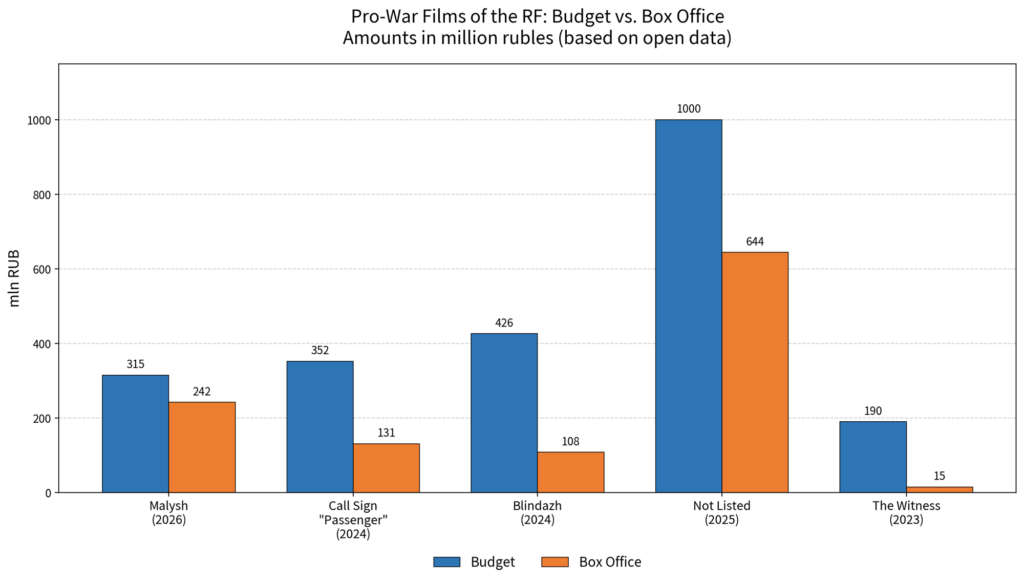
Compared with other segments of Russian cinema, the funding gap for pro-war films is striking. Sarik Andreasyan’s Onegin cost up to 750 million rubles($ 9.26 million), Cheburashka 850 million($ 10.5 million), the fairy tale The Wizard of the Emerald City: The Road of Yellow Brick nearly reached one billion, while The Last Warrior: Kolobok and Kraken both surpassed it(over $ 12.3 million each). One Kolobok, in other words, is worth at least five Witnesses.
Assessing the profitability of the series is nearly impossible. The problem is not only the absence of reliable data on viewership and advertising revenue, but also the production business model itself. Funding comes not only from television channels and streaming platforms, but also from state structures. In particular, patriotic series are supported by the Institute for Internet Development (IRI), which helped finance Militia Romance, among others.
But IRI is far from the only source of budget money. The production of the series 10 Stories of Love and Death was funded not only by IRI, but also by the Ministry of Defense and the Amadeus Foundation, which receives grants from the Ministry of Education. 20/22 was made with the participation of Channel One; the Autonomous Nonprofit Organization “Fund for the Support of Military-Patriotic Cinema,” established by the Ministry of Defense; and the administration of the so-called “DNR.”
Television channels and streaming services act here not merely as conventional commissioning broadcasters, but as platforms for content the state deems socially significant. This sprawling funding system—from IRI to nonprofits attached to various state bodies—allows costs to be spread across several sources, reducing the financial burden on any single participant in production.
Nor do these series become major events. Premier, the streaming service that carried Militia Romance, published only two posts about the series on its Telegram channel ahead of the premiere: a trailer and an announcement of the first two episodes. Overheard in Rybinsk, which launched slightly earlier, was receiving about five posts a week.
The ratings are equally unimpressive. In its premiere week, 20/22 drew fewer viewers in major cities than Psychics: Revenge. Take Her Across the Maidan attracted fewer viewers to Channel One than Field of Wonders.
A Conveyor-Belt Canon
Films about the war flop at the box office, while the series are lost among entertainment programming. Yet the conveyor belt now in motion gives formerly irrelevant figures a chance to return to work. Gleb Aleinikov had not made a film since 1998 until he took on Take Her Across the Maidan. After the failure of Pain Threshold (2019), Andrei Simonov made 20/22, The Kid, and the spy drama Centuria. War correspondents Rinat Esenaliev and Semyon Pegov debuted in cinema not only as actors but as screenwriters.
In 2025, the writer Zakhar Prilepin complained that too few films about the war had been made, and that a canon had therefore failed to emerge. He is wrong. The re-education of the liberal amid a rotating cast of two or three stock characters is precisely the canon of the new pro-war cinema. And explaining why one must fight has become an artistic device that would not have taken root in another era. For Soviet war cinema, the motive of defending one’s country was self-evident and required no further explanation. Today, without such an explanation, the characters’ motivations remain unclear: why does a Yakut businessman go to kill people in Zaporizhzhia, or a Moscow student take part in the assault on Mariupol? The answer to these questions has become part of the plot itself.