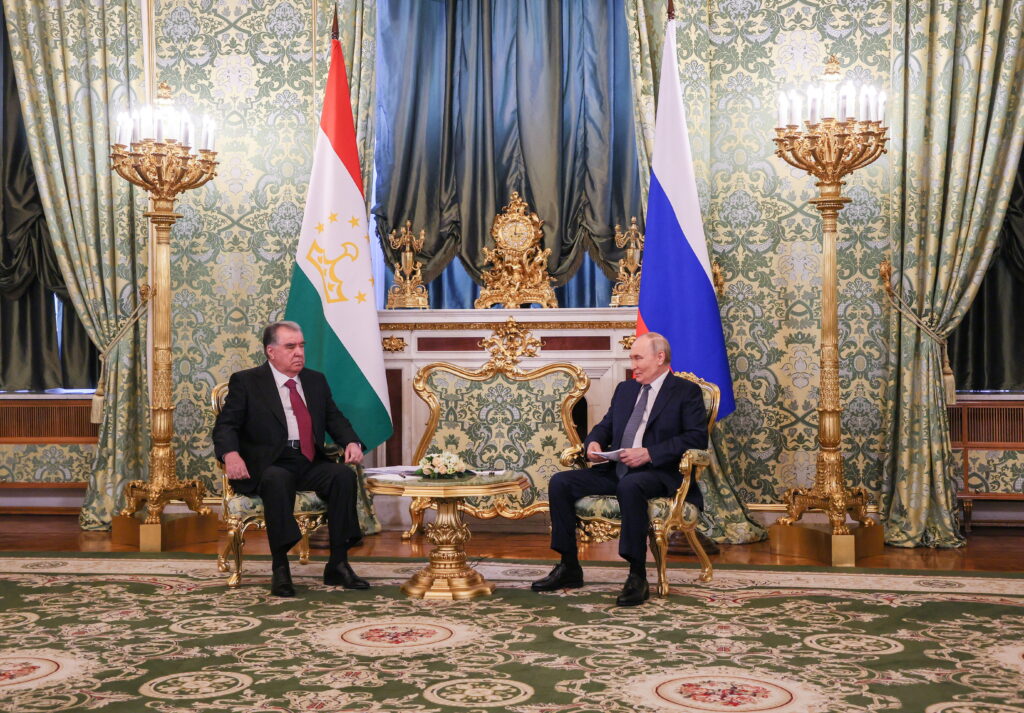
Russia’s relations with the states of Central Asia today look fundamentally different from how they did five years ago. It is tempting to treat the war in Ukraine as the principal driver of that change. In part, that is true: Russia’s full-scale invasion created both unprecedented risks for the region and new leverage in dealings with Moscow. The deeper source of the transformation, however, lies less in the war itself than in processes unfolding inside Central Asia. Given the personalist nature of the region’s political regimes, the decisive factor has been elite transition — a process already completed in almost every country: Uzbekistan in 2016, Kazakhstan in 2019, Kyrgyzstan in 2020, Turkmenistan in 2022.
Political time in Central Asia does not move at the same speed, and Tajikistan remains the last part of the region where the clock appears to have stopped. Emomali Rahmon, officially styled the “Founder of Peace and National Unity”, is the last president in Central Asia — and, together with Aleksandr Lukashenka, one of only two across the post-Soviet space — to have held power continuously since the beginning of his country’s independent history.
The constitutionally legitimized permanence of Rahmon’s rule shapes not only Tajikistan’s domestic politics but also the way the country deals with external partners. That is why Russian-Tajik relations remained predictable, and largely unsurprising, for years — until 2022. The past four years have been harder for Dushanbe. The Tajik leadership has neither contained the risks generated by Russia’s aggression against Ukraine nor fully monetized the new economic opportunities — unlike its neighbors, which have done so with far greater success. Dushanbe is left either to adapt to conditions set by Moscow or to diversify its foreign policy.
The missed-opportunity syndrome
On the eve of the full-scale war, Russian-Tajik relations looked stable and, in some respects, were at a peak of diplomatic closeness. 2021 was a year of post-pandemic recovery. Labor migration, Tajikistan’s most important economic driver — more than 80 per cent of it traditionally directed to Russia — recovered from the Covid slump. By the end of the year, remittances equivalent to 34 per cent of GDP were flowing into the country.
The period also carried symbolic weight. At the 9 May parade in 2021, Rahmon was the only foreign leader invited to Moscow. Against the backdrop of an escalating armed territorial conflict between Tajikistan and Kyrgyzstan, that invitation was read as a clear signal that the Kremlin’s sympathies lay with Dushanbe.
Moscow and Dushanbe also tightened security coordination after the withdrawal of US forces from Afghanistan and the Taliban’s return to power. Russia launched a series of large-scale exercises — bilateral and under the CSTO — rehearsing scenarios of a border breach, while reinforcing its 201st military base, then numbering around 7,500 troops.
After 24 February 2022, no one expected a sharp démarche from Dushanbe. Tajikistan did not publicly refuse to recognize the so-called “DNR” and “LNR”, as Kazakhstan’s president, Kassym-Jomart Tokayev, and Uzbekistan’s then foreign minister, Abdulaziz Kamilov, did. Nor, however, did it offer “understanding” of Russia’s actions — the kind of language that appeared in statements by Kyrgyzstan’s Sadyr Japarov.
In public remarks, Rahmon confined himself to vague complaints about the “intensifying clash of geopolitical interests in the contemporary world”. Tajikistan is institutionally more dependent on Russia than its neighbors, and the Western political presence in the republic is minimal. Dushanbe’s pointed neutrality was therefore entirely predictable.
That did not mean Dushanbe made no effort to distance itself from Moscow’s toxicity. The country’s most important flows of infrastructure and social financing came from the Asian Development Bank (which has invested around $ 3 billion in Tajikistan since 1998), the World Bank (almost as much) and UN institutions — none of whose sanctions-compliance requirements the republic could ignore. Moreover, as the only country to continue supporting what remained of Afghanistan’s National Resistance Front under Ahmad Massoud Jr (the son of the legendary mujahideen commander Ahmad Shah Massoud), Dushanbe attracted the attention of Western capitals — first of all Paris, which invited Rahmon on an official visit not tied to a multilateral format.
As the fighting in Ukraine dragged on, new contours of regional cooperation took shape, closely bound up with economic risk. Russian migrants began moving to Central Asia, driving a sharp rise in property prices. Cut off from global markets, Russia made more intensive use of the region’s financial infrastructure for cross-border transactions — raising the threat of secondary sanctions, which were eventually imposed on three Tajik banks: Dushanbe City Bank, Spitamen Bank and Commercebank of Tajikistan. At the same time, Russia’s military-industrial complex began looking for grey-import channels.
Tajikistan’s neighbors needed considerable political agility to extract benefits without falling under secondary sanctions. Against that backdrop, Dushanbe lagged noticeably. Highly skilled Russian migrants preferred Kazakhstan and Kyrgyzstan and all but ignored Tajikistan. The same was true of business relocation. According to national statistics agencies, the number of newly registered companies with Russian capital in Kazakhstan rose from 7,900 to 19,400 between 2022 and 2024; in Uzbekistan, from 2,800 to 3,400. Tajikistan remains on the margins of this process: only about 340 such enterprises operate there.
All of this produced, among the Tajik leadership, a political syndrome of missed opportunity — one that surfaced openly at the first Russia-Central Asia summit in Astana in the autumn of 2022.
The attention-deficit syndrome
“Yes, we are small nations. We are not 100 million, not 200 million. But we have a history, a culture. We love, we want to be respected. (…) Therefore, Vladimir Vladimirovich, our request is that there should be no policy towards Central Asia as if it were the former Soviet Union. Each of our countries has its own problems, its own questions, its own traditions and customs. A golden mean must be found. One has to work with each republic separately.” Those were the words Rahmon addressed to Vladimir Putin at the Astana summit in 2022.
For a Tajik leader known for his old-fashioned, Soviet-style, extremely cautious manner of speaking to the Kremlin, such transparent criticism was a genuine sensation. Although the emotional appeal invoked respect for the region as a whole, the core message was that Moscow was short-changing poor Tajikistan in particular. Rahmon was drawing on a Soviet experience he understood well: the Tajik SSR had been financed on a residual basis, unlike, for example, the Uzbek SSR.
Behind the public gesture lay a structural problem that became obvious after February 2022. Set against Kazakhstan and Uzbekistan, which were turning into potential trade and logistics hubs for an isolated Russia, Tajikistan was objectively losing economic significance. Official doctrines of the Russian Foreign Ministry still list the entire region among Moscow’s priorities. In practice, a rigid hierarchy has taken shape in which Dushanbe has been assigned the role of a second-tier partner.
The Tajik leadership concluded that its strategic contribution — supplying demographic resources for migration, hosting the 201st base, and controlling the Afghan borderlands — was undervalued by the Kremlin. With his démarche, Rahmon in effect demanded a revision of the symbolic and political terms of the bilateral relationship, calculating that the turbulence of 2022 had given him a chance to rewrite the rules.
That chance was itself a product of the war. Confronted with a shortage of weapons — drones above all — Russia was forced to turn to foreign suppliers. Here Dushanbe proved useful. In May 2022, a plant producing Iranian Ababil-2 tactical drones officially opened in Tajikistan — the first such facility outside Iran. Later came unconfirmed reports of possible assembly or transit of Shahed-series drones through the republic, though the absence of reliable data makes the claim almost impossible to confirm or refute. Dushanbe itself regularly uses drones against militants and drug traffickers crossing from Afghanistan.
An additional factor was the recruitment of Tajik migrants who speak Farsi and Dari to work at Russian defense-industry plants. Tajik companies through which Russia obtained access to sanctioned goods and services also became more active: Kafolati Komil, for example, was sanctioned for supplying Russia with foreign-made aviation spare parts via the UAE. These were isolated cases rather than mass practice. For such assistance, some Tajik financial and legal entities ended up under Western secondary sanctions — though not immediately, and largely only by the time of the EU’s 19th sanctions package.
Tajik diplomacy nonetheless showed considerable adaptability. Dushanbe achieved something many of its neighbors could not: the lifting of some sanctions restrictions. According to the National Bank of Tajikistan, major Tajik banks affiliated with the country’s political elite succeeded in having themselves removed from the European Commission’s sanctions lists. Dushanbe also learned to defuse Western complaints about the transit of dual-use goods.
It never managed, however, to adapt to the transformation of Russia’s migration policy.
The migration crisis
In recent years, Russian society has grown used to the idea that the country’s major emergencies — from drone attacks to an armed mutiny — are directly or indirectly linked to the war in Ukraine. Official propaganda tried to fit the March 2024 terrorist attack at Crocus City Hall into the same logic. The state narrative held that Western intelligence services, operating through Ukraine, had used Tajik citizens as executors. Formally, that construction lifted political responsibility from the Tajik leadership. In practice, it was the “strategic ally”, not the mythical “NATO handlers”, that absorbed the shock of a radically altered migration climate.
Russian security agencies and state media energetically amplified a threat discourse tightly bound to migrants from Central Asia. A wave of mass entry refusals, hours-long airport checks, aggressive hostel raids and deportations swept the country. Senior Tajik officials, including Prime Minister Kokhir Rasulzoda at a meeting of the intergovernmental commission with his Russian counterparts, expressed concern.
In parallel, the State Duma launched a sweeping overhaul of migration legislation. In a short period, some two dozen federal laws were adopted, significantly complicating the legalization of foreigners and introducing an extrajudicial expulsion regime. Naturally, the security services and legislators were guided by domestic political KPIs and paid no attention to the diplomatic consequences for relations with Dushanbe. When a state’s migration policy turns 180 degrees, the foundations of a strategic partnership inevitably take a hit.
For Tajikistan, Russia’s new migration policy became a serious challenge. The export of labor is a basic pillar of the regime’s macroeconomic and social stability. Half of Tajik households — more than 70 per cent of the population — depend critically on remittances. According to World Bank estimates for 2024, the poverty rate in Tajikistan still hovers around 20 per cent, the highest in the region.
Moscow’s tighter approach put Dushanbe at risk of a social explosion. According to monitoring by the International Organization for Migration, a third of migrants forced to return to Tajikistan joined the ranks of the unemployed. The average income of those who did find work fell threefold — from $ 943 abroad to $ 309 at home.
Even so, the episode did not produce a political rupture. Rahmon offered full assistance in the Crocus City Hall investigation and allowed Russian security officers to question relatives of the accused on Tajik territory.
The institutional framework of cooperation between the two countries’ security agencies is probably the densest in the post-Soviet space. Its roots go back to the 1990s. A joint collegium of the interior ministries has functioned since 1999; an operational FSB border group works on Tajik territory in coordination with the State Committee for National Security (GKNB); exercises are held regularly under the CSTO and the SCO’s Regional Anti-Terrorist Structure. The diplomatic scaffolding rests on more than 320 bilateral agreements and on Russia’s 201st military base — the largest Russian land force facility outside the country’s own territory. In practice, cooperation takes the form of constant intelligence sharing, database integration and joint training.
Transit at home and abroad
Given the personalist nature of authoritarian states, informal ties among elites often matter more than signed documents. Trust is reinforced by personal acquaintance between leaders and by shared business interests at the top. “Bridge people” play a significant role in such an ecosystem. If Alisher Usmanov has traditionally performed that function in Russian-Uzbek relations, and Ilan Shor is increasingly visible in Russian-Kyrgyz ones, the role of key lobbyist vis-à-vis Dushanbe has settled on the Russian sports official Umar Kremlev, who has access to high offices in both capitals.
Fundamental security questions, however, are settled exclusively at the level of the principals. The main constraint here is political biology. Unlike the Kremlin, the Tajik regime is actively preparing for succession. Rahmon is deliberately and openly grooming his heir — his eldest son, Rustam, speaker of the Senate and mayor of the capital. Last year Rustam Emomali held his first official one-on-one meeting with Putin in the Kremlin, fully in line with the region’s unofficial “inspection” practice, without which no transfer of power takes place. The meeting demonstrated that, when it comes to preserving the regime, Russia remains Dushanbe’s irreplaceable guarantor.
On other questions, Tajikistan does not consider itself obliged to preserve a Russian monopoly of influence and is quite consciously trying to diversify its partners. Dushanbe is drawing closer first of all to the other Central Asian states, while developing relations with Iran, the Arab countries and the West, and seeking to insert itself into the current US administration’s growing interest in the region and its mineral resources.
A separate vector of Tajik foreign policy points towards China. Beijing is already Tajikistan’s main trading partner, its principal investor, its largest creditor and an important security partner. In the Gorno-Badakhshan Autonomous Region, the only bases of China’s People’s Armed Police in the country operate, securing the Tajik-Afghan border.
Against that backdrop, some of Dushanbe’s foreign-policy choices in 2026 look especially telling. 9 May is a sacred holiday that the Russian leadership has made the foundation not only of the war but of state ideology. Rahmon had not usually missed these celebrations; in 2021 he was the only foreign guest at the parade. In 2026, however, he not only skipped the event in Moscow — to which, according to Yury Ushakov, the Russian president’s aide for international affairs, no one had been officially invited, but which the leaders of Kazakhstan and Uzbekistan attended — he travelled to China on a state visit at the invitation of Xi Jinping.
The gesture showed that Tajikistan, too, has room for maneuver and that Dushanbe is not doomed to depend on Moscow in every respect. During Rahmon’s visit to Beijing the two sides signed more than 80 cooperation documents, and China pledged to invest around $ 8 billion in the Tajik economy. Sums of that order were not discussed even after visits to Moscow in the fat years of the Russian economy.
All this can create the impression that Russia is losing influence in Tajikistan to China — a concern shared, in part, even inside the Russian government. The Kremlin understands, however, that its principal attraction for allies in Central Asia is its ability to offer security guarantees to local regimes. Neither China nor any other country can provide that, given the insufficient level of trust among the region’s political elites.
Unlike the rest of Central Asia, Tajikistan failed to exploit the opportunities that the war in Ukraine opened across the Eurasian space. Nor did Dushanbe succeed in dodging the new crises. Moscow did not revise its attitude to Tajikistan even after Rahmon’s public appeal, understanding that, in Russia’s present economic circumstances, it cannot offer anything comparable to what China or Dushanbe’s other alternative partners can. Moreover, Russia’s strategic interests in Tajikistan do not include the development of economic cooperation or partnership in advanced fields such as technology.
What matters far more to the current Russian leadership is the geopolitical and reputational component of its presence in the republic, grounded in the inheritance received from the USSR. That inheritance is so substantial that the Russian state can retain influence in Tajikistan by doing almost nothing. It is necessary to understand, however, that historical influence will sooner or later fade, and that it will be replaced by alliances and partnerships oriented towards the future rather than a shared past. The Russian political regime, though, rarely thinks in terms of the future — in foreign policy no less than at home — and change on this front should not be expected from Moscow.


