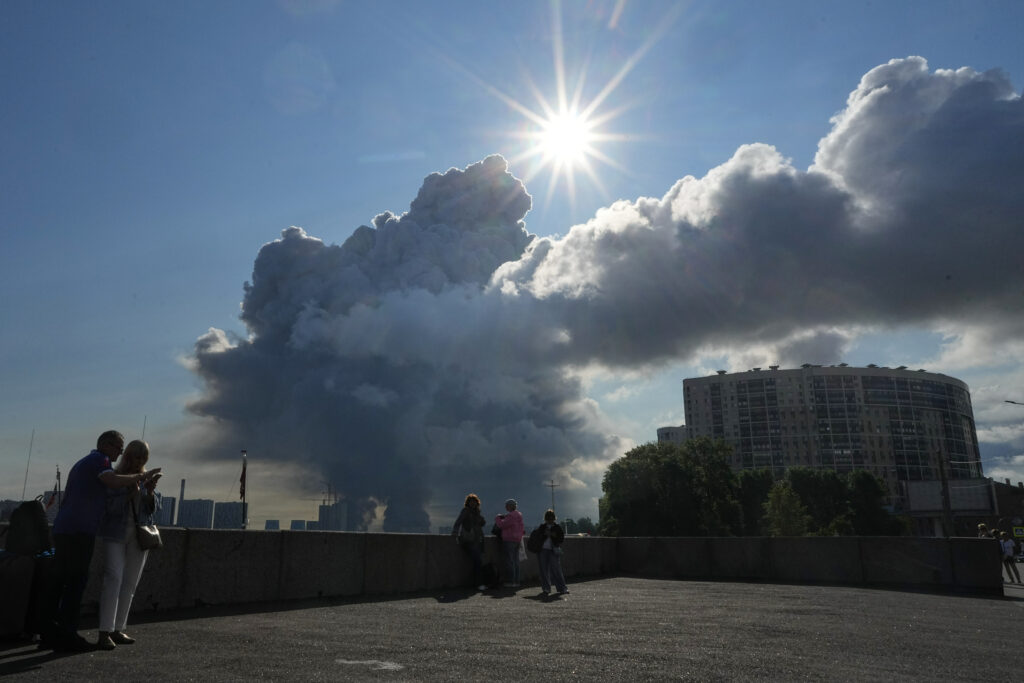
Ukrainian forces continue to target facilities operated by Wildberries, Russia’s “answer to Amazon”. Drone strikes are mounting in intensity. Almost all key logistics hubs have come under attack, with several key warehouses damaged beyond repair.
Ukrainian President Volodymyr Zelensky claims the campaign aims to disrupt Russian military supply lines. Wildberries does list dual-use goods—including drones and tactical gear—ordered by both volunteers and military personnel. However, burning every warehouse to the ground will not cut off supplies to the front line.
Disrupting military logistics is merely a pretext. Ukrainian presidential adviser Mykhailo Podolyak virtually confirmed this in a recent interview, stating that the primary objective is to damage the Russian economy. The end goal is to trigger a “severe defiscalization”—effectively a public finance crisis.
Could a collapse of Wildberries actually deliver such a blow?
How Kyiv Frames the Wildberries Attacks
The plan outlined by Mykhailo Podolyak is straightforward: forcing a financial collapse of the retailer—which generates more than 6 trillion rubles ($ 68 billion) in turnover—is meant to trigger a chain reaction. Hundreds of thousands of sellers will take a hit: “a vast number of ‘apolitical’ people who are just making a living.” More importantly, major Russian lenders with massive loans to the e-commerce giant will face steep losses. Volodymyr Zelensky’s adviser specifically named Sberbank, VTB, Alfa-Bank, and PSB.
Denis Shtilerman, co-owner of a top Ukrainian drone and missile manufacturer, Fire Point, echoed the strategy: “We need to finish off Wildberries and Ozon. That will crash the banking system because they are among the biggest corporate borrowers. VTB was already struggling, and now trillions of rubles in loans will be lost for good. This could bring down Russia’s second-largest bank.”
It is clear why the Ukrainian president avoids such rhetoric. Under international law, strikes on Wildberries logistics hubs sit on shaky legal ground—even if one accepts Zelensky’s claim that they are “used by the aggressor to deliver sanctioned components for drone production and navigation systems.”
The Geneva Conventions prohibit attacks on civilian infrastructure. While oil refineries can be considered legitimate military targets—depriving an adversary of fuel yields a clear tactical advantage—Wildberries hubs cannot. They would qualify as legitimate targets only if storing military supplies were their primary function, which is not the case. In ambiguous situations, international law requires treating inherently civilian facilities as civilian.
This is about optics, not legal exposure. The International Criminal Court in The Hague is unlikely to investigate strikes on Wildberries, if only because Russia has not ratified the Rome Statute that governs its mandate.
The Scale of Wildberries
Unlike its main rival, the publicly traded Ozon, Wildberries offers only limited financial disclosures. The numbers available fail to provide a complete picture of its true size or financial stability.
RWB Group, which includes Wildberries, reported 2025 turnover across Russia and international markets of 6.1 trillion rubles ($ 67 billion), with net income reaching 175 billion rubles. Turnover here refers to Gross Merchandise Value (GMV), combining sales from Wildberries and other group assets, including outdoor advertising operator Russ following their 2024 merger. Assessing the marketplace’s actual footprint requires revenue figures—the commissions and fees it actually earns versus total transaction volume. RWB does not disclose revenue.
The true turnover of Wildberries and RWB Group may be lower than reported, according to Data Insight, a leading Russian e-commerce research firm. Either way, the totals run into trillions of rubles. By comparison, Ozon reported 2025 turnover of 4.16 trillion rubles. Wildberries commands an estimated 45% of the Russian e-commerce market, compared with Ozon’s 32%.
Both platforms have surged in recent years, heavily outperforming the broader market. Wildberries’ sales have jumped 7.2-fold since 2021, according to company data, while the overall e-commerce market expanded just 3.2-fold over the same period.
How War Fueled the Growth of Wildberries and Ozon
Russia’s marketplaces emerged as clear winners from the “structural transformation” triggered by the full-scale invasion of Ukraine. To avert widespread shortages following the exit of major Western brands, Moscow legalized parallel imports—effectively greenlighting contraband. Marketplaces quickly became the primary distribution channels for grey-market and counterfeit goods.
While Western media often label Wildberries as “Russia’s Amazon,” inside the country it has earned a different moniker: a “digital Cherkizon“—a nod to Moscow’s infamous post-Soviet contraband market. The primary conduit for illicit Chinese imports is “cargo” shipping. Logistics providers consolidate goods from dozens of suppliers into a single truck, clearing customs under a single declaration in a low-tariff category. The cargo then transits Kazakhstan and Kyrgyzstan before entering Russia as duty-free Eurasian Economic Union (EAEU) goods. Analysts estimate that “cargo” shipments accounted for roughly $ 50 billion of the $ 230 billion in Russian-Chinese trade in 2025.
Dmitry Alekseev, co-owner of major electronics retailer DNS—ranked fourth in online sales behind Wildberries, Ozon, and Yandex Market—has documented these practices extensively. Alongside “cargo” schemes, grey-market importers rely heavily on tax-optimization tactics. Many route sales through sole proprietorships under simplified tax regimes, bypassing VAT entirely. Alekseev estimates Russia’s shadow and semi-legal retail market exceeds 10 trillion rubles ($ 110 billion), or 4.7% of GDP.
For consumers, legalizing contraband proved a relief. Parallel imports cushioned the market against shortages and held back inflation—which would have surged had sellers paid full customs duties and taxes. This helped preserve social stability, giving authorities reason to appreciate how marketplaces created an illusion of normalcy during wartime. The platforms also serve a vital social function by providing income for hundreds of thousands of people. Data Insight estimates that active marketplace sellers number between 500,000 and 700,000—a significant chunk of Russia’s 5 million registered sole proprietors.
By 2025, however, the government pivoted toward a crackdown. Escalating military spending forced a push for higher tax revenues. Late that year, Moscow rolled out SPOT—a national tracking system designed to block Chinese goods mislabelled as EAEU imports. In 2026, authorities expanded mandatory “Honest Sign” digital labelling, which requires proof of origin, while requiring sellers under simplified tax regimes with revenues over 20 million rubles to pay standard VAT rates. Meanwhile, Beijing has begun tightening its own export controls.
What Is Known About Wildberries’ Debt Load
The sales surge of 2022−2025 went hand in hand with massive investments in logistics infrastructure—the very assets Ukrainian drones have been targeting for the past two weeks. Wildberries reported capital expenditure (capex) of 28.3 billion rubles in 2022, rising to 52.6 billion in 2023, 150 billion in 2024, and 310 billion in 2025. This aggressive expansion pushed debt levels significantly higher.
Financial filings for 2025 from the company’s main operating entity, RWB LLC, reveal the scale of the debt. Short-term borrowings jumped nearly eightfold in a single year, rising from 104 billion to 802 billion rubles ($ 8.8 billion), alongside 28 billion rubles in long-term liabilities. In notes to the financial statements, the company acknowledged covenant breaches, though lenders refrained from enforcing penalties. Wildberries’ actual debt may be even higher—topping 1.3 trillion rubles ($ 14.3 billion) in total. Of that, 500 billion rubles is owed to a single lender: state-backed VTB Bank. These appear to be the exact figures Mykhailo Podolyak and Denis Shtilerman cited in their recent interviews.
By comparison, Ozon carries a far lighter debt load of 291.6 billion rubles at year-end 2025, with minimal short-term obligations. While public disclosures remain too limited for a comprehensive head-to-head comparison, one conclusion is clear: given its paper-thin operating margins, Wildberries lacks the financial buffer to weather a major crisis without external support.
Wildberries faced a test of resilience in 2024, following a catastrophic fire at a major warehouse near Saint Petersburg. Direct damages reached an estimated 10 billion rubles, with an additional 35 billion owed in seller compensation. The fallout reshaped the company’s ownership. Co-founder Tatyana Kim turned to billionaire Suleiman Kerimov for backing, leading to an equity tie-up with his outdoor advertising firm, Russ, and the creation of RWB Group. The 35% stake Russ secured in the marketplace far exceeded the relative size of its own assets.
The restructuring effectively ousted co-founder Vladislav Bakalchuk, Kim’s now ex-husband, stripping his firm, WB Development, of lucrative construction contracts. Bakalchuk resisted, enlisting Chechen leader Ramzan Kadyrov, but failed to halt the takeover. The bitter feud culminated in a deadly shootout at the Romanov Dvor business centre in central Moscow.
In the summer of 2026, a new stakeholder emerged. VTB acquired a 5% stake in Wildberries’ financial arm, WB Bank, pledging fresh capital under a “strategic partnership.” To fund the move, VTB executed a record-breaking 314-billion-ruble secondary share offering (SPO). Analysts suspect part of those funds may go toward bolstering the bank’s own balance sheet rather than supporting Wildberries. VTB Chief Executive Andrey Kostin previously noted that the bank needs up to 700 billion rubles in additional capital by 2027−2028 to satisfy central-bank regulatory requirements. Rumours of a deal between VTB and Wildberries had circulated for months beforehand, though both parties denied them at the time.
What Damage Have Drone Attacks Already Caused Wildberries?
The 2024 fire now looks minor compared with today’s destruction. As of August 3, drone strikes have hit nearly all of Wildberries’ core logistics hubs. Over 15% of its floor space—860,000 square meters—is lost beyond repair. The company’s largest hub, located in Elektrostal near Moscow, was completely destroyed. Beyond serving the country’s prime consumer market, the facility acted as the central gateway for Chinese imports.
Rebuilding costs average roughly 100,000 rubles (around 1,100 euro) per square meter, excluding equipment. That puts total direct damage close to 90 billion rubles. Sellers face hundreds of billions of rubles in losses, though Wildberries bears no formal liability. The company revised its terms of service in advance to shield itself from force-majeure damages. Had Wildberries been required to compensate sellers—or forced to do so by authorities—it would not have survived. The platform limits itself to “support payments,” which recipients describe as token gestures. Major banks have also promised relief to sellers, primarily through loan restructurings.
Damage estimates quickly become obsolete as strikes continue. Nearly two weeks in, it is clear that drones are systematically targeting the largest sites. If an attack fails to trigger a massive blaze initially, follow-up strikes occur days later. CEO Tatyana Kim insists warehouses are “equipped with all available defence systems” that “successfully intercept most attacks.” That may be true, but the few that breach defences are enough. Eliminating risk entirely is impossible: Wildberries facilities are massive—spanning up to 300,000 square meters—and highly flammable.
These mega-hubs are a signature of Wildberries’ business model. They allow intake, storage, and sorting under one roof before goods are dispatched to pickup points. Competitor Ozon uses smaller, specialized facilities with higher inventory turnover. This operational model partly explains why Ozon’s supply chain has escaped targeting—its decentralized system is harder to disrupt. While Wildberries’ model was cheaper to operate—aided by local governments offering subsidized land, utility connections, and infrastructure to attract a major employer and taxpayer—that competitive edge has abruptly turned into a primary vulnerability.
Kim claims she has “dozens of rental offers for logistics space, with several contracts already signed.” Yet even if attacks ceased today, replacing the lost capacity without external bailouts appears impossible, given that a single warehouse fire two years ago triggered a severe corporate crisis. Wildberries has already frozen its investment program and turned to the state for financial aid.
Could a Wildberries Collapse Trigger a Banking Crisis in Russia?
Wildberries is fundamentally “too big to fail.” Its dominant market position guarantees a bailout if needed. Moreover, relentless drone strikes will not bring the company down overnight. Wildberries will adapt its supply chain—already scouting warehouse space in Kazakhstan—and allow sellers to fulfil orders directly, a practice marketplaces typically resist.
Quantifying the required aid remains impossible as the crisis deepens, with the second week of attacks proving even more intense than the first. Nor can anyone predict when Wildberries might default on its massive debt load. Sberbank, however, is already bracing for impact. Chief Financial Officer Taras Skvortsov noted a “decline in the credit quality of marketplaces”—financial shorthand for rising default risks—and confirmed the bank is weighing higher provisions, signalling it expects to absorb losses.
Could a financial meltdown at Wildberries spark a systemic banking crisis, as Kyiv claims? Strictly speaking, Russia’s banking sector has been in crisis since early this year, according to TsMAKP, a think tank close to the Russian government. The IMF defines a banking crisis by three criteria: non-performing assets exceeding 10%, a surge in deposit withdrawals, or widespread bank restructurings. Meeting just one condition is enough.
In Russia’s banking system, non-performing assets crossed the 10% threshold back in February. Deposit outflows also began early in the year, culminating in a record 620-billion-ruble ($ 6.8 billion) withdrawal in July. Yet TsMAKP analysts note the crisis remains “latent,” masked by “aggressive loan restructurings and the dominance of state-owned lenders, which prevents insolvencies and bank runs.”
In a normal market, bankruptcies would have already begun. But Russia’s state-dominated financial industry keeps distressed borrowers afloat. Lenders, however, cannot hide trouble indefinitely; eventually, losses must be recognized. If the state lacks the fiscal room to absorb those losses, the latent crisis could quickly turn acute.
Moscow is clearly betting that the banking system has enough room to manoeuvre until the Central Bank can cut its key interest rate, allowing corporate borrowers to refinance on easier terms. But having to absorb a fallout at Wildberries and its seller network erodes that remaining financial buffer.