For years after independence, Azerbaijan carefully balanced between regional powers—chiefly Russia and Turkey—avoiding any unambiguous alignment and steering clear of military alliances.
Russia’s full-scale invasion of Ukraine weakened Moscow’s position in the South Caucasus and enabled Baku to resolve the Karabakh conflict decisively in its own favor, a conflict the Kremlin had long treated as a lever of influence. After restoring full control over Karabakh and securing the withdrawal of Russian peacekeepers, Baku initially sought to preserve close ties with Moscow. The December 2024 disaster involving an Azerbaijani passenger aircraft, shot down by Russian air defenses near Grozny, produced a sharp cooling in bilateral relations and then an unprecedented confrontation.
Both sides still have interests in one another, yet unresolved disputes and the broader erosion of Kremlin authority have accelerated a process of “separation.” Azerbaijan now acts with growing independence and no longer feels compelled to maintain the old equilibrium.
The Sovereignty Question
On 22 February 2022, two days before Russia’s full-scale assault on Ukraine, Azerbaijani President Ilham Aliyev met Vladimir Putin in the Kremlin. The talks were far from routine. The two leaders signed a Declaration on Allied Interaction designed to deepen cooperation across the board.
For Baku the document was another exercise in careful balancing: six months earlier Aliyev and Recep Tayyip Erdoğan had signed the Shusha Declaration on allied relations with Turkey.
Russia’s aggression against Ukraine initially left the Moscow-Baku balance largely intact. Azerbaijani officials avoided direct condemnation of the Russian army’s criminal conduct while consistently upholding Ukraine’s territorial integrity—a matter of principle for a country that had itself long battled separatism. Unlike Turkey, Baku recognizes neither Kosovo nor the Turkish Republic of Northern Cyprus.
Azerbaijan’s delegation was absent from the UN General Assembly vote on 2 March 2022 condemning the aggression against Ukraine and from the 7 April vote suspending Russia’s membership of the Human Rights Council. Baku preferred not to be associated with open criticism of the Kremlin on the international stage.
Its stance on the legal status of occupied Ukrainian territory was firmer. In October 2022 Baku offered Kyiv unconditional support after the so-called referendums; in September 2023 the Azerbaijani Foreign Ministry condemned Moscow’s regional “elections” in the four occupied oblasts.
Ilham Aliyev remained for a long time the only CIS head of state to meet Ukrainian President Volodymyr Zelensky after 24 February 2022. Azerbaijan also made no secret of supplying transformers and generators to Ukraine as humanitarian aid—and regularly drew Moscow’s criticism for doing so.
“It Was Armenia, Not Russia, That Abandoned Karabakh”
When the leaders of Azerbaijan, Russia and Armenia signed the trilateral statement on the night of 10 November 2020 that ended the 44-day war, the Kremlin appeared the principal beneficiary. Russia reaffirmed its role as the key arbiter of the Armenian-Azerbaijani conflict and of the South Caucasus more broadly. The deployment of Russian peacekeepers to the Lachin corridor gave Moscow a military foothold. The mandate ran for five years with the option of renewal; Russian planners clearly expected a long-term presence. The war in Ukraine forced a reassessment.
The constant drain of resources—diplomatic as well as material—on the Ukrainian front weakened Moscow’s regional position and allowed Azerbaijan to settle the Karabakh question on its own terms. In April 2023 Baku established its own checkpoint on the Lachin corridor, the sole road linking Armenia to Nagorno-Karabakh. Aliyev repeatedly told Karabakh residents they faced only two choices: accept Azerbaijani citizenship or leave.
Azerbaijan’s September 2023 military operation to reclaim the remaining territories met no Russian opposition. Against the background of growing friction with Yerevan, the Kremlin may even have viewed the outcome with quiet approval.
Nikol Pashinyan had come to power in Armenia in spring 2018 through street protests and a “velvet revolution.” Putin’s well-known hostility to “color revolutions” made relations difficult from the outset.
Tensions peaked in 2023. In January Armenia refused to host CSTO exercises; in May Pashinyan threatened to leave the organization if it proved “incapable.” A particular affront to Putin was the Armenian government’s early-September draft ratification of the Rome Statute, obliging Yerevan to implement International Criminal Court decisions—and therefore to arrest and surrender Putin should he set foot in the country.
Moscow was also angered by Armenia’s October 2022 decision, brokered by the European Union, to recognize Azerbaijan’s territorial integrity within the 1991 borders and thereby renounce claims to Karabakh. “It was not Russia that abandoned Karabakh, but Armenia itself—proactively and without informing Moscow,” Putin later emphasized.
The exodus of tens of thousands of Karabakh Armenians in autumn 2023 might have destabilized Armenia—an outcome the Kremlin appears to have anticipated. It did not materialize. Recent parliamentary elections confirmed that Pashinyan’s Civil Contract party, with roughly 50 percent of the vote, remains the country’s dominant political force.
With Turkish support, Azerbaijan secured the departure of the last Russian peacekeepers in June 2024. By then the war in Ukraine was in its third year, and the shift in the South Caucasus balance no longer carried the same urgency for Moscow that it once would have done.
Special Relations
Under Western sanctions Azerbaijan has become one of Russia’s most important economic partners. Trade turnover rose nearly 25 percent in 2022 to $ 3.7 billion. Joint projects include the International North-South Transport Corridor, intended to link the Baltic to the Indian Ocean.
Personal ties between Putin and Aliyev have always mattered. Both have ruled for more than two decades (Putin since 2000, Aliyev since 2003) and share similar authoritarian instincts; neither lectures the other on democracy, human rights or free speech. Elite connections run deeper still: Heydar Aliyev, like Putin, emerged from the KGB, and the personal contacts of the early 2000s helped cement the relationship.
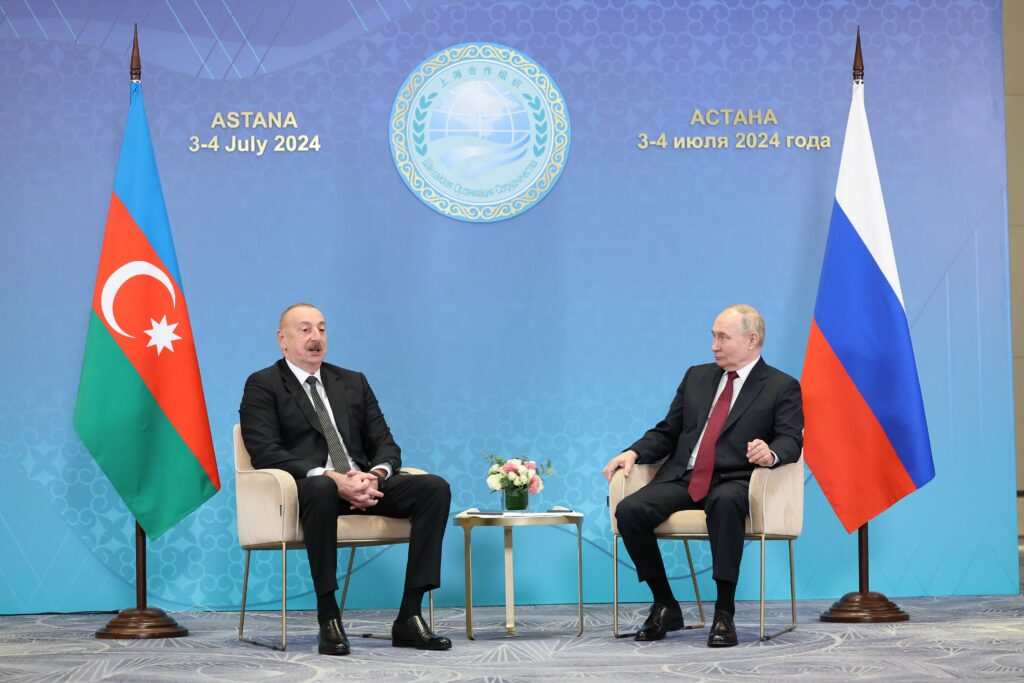
That trust enabled Putin’s August 2024 visit to Baku—an event of some significance for a cautious Russian president facing an ICC arrest warrant, even though Azerbaijan is not a party to the Rome Statute. “This visit is of historic importance and will make a major contribution to strengthening friendly partnership relations,” Aliyev declared afterwards.
SOCAR and Gazprom signed an agreement deepening strategic cooperation. Within four months the relationship had been transformed beyond recognition.
The Battle of the Towers
On 25 December 2024 an Azerbaijan Airlines flight from Baku to Grozny crashed near Aktau in Kazakhstan after being hit by Russian air-defense systems. Thirty-eight people died. The drama was heightened by the fact that Aliyev’s own aircraft, en route to a CIS summit in St Petersburg, experienced GPS disruptions; the president ordered it to turn back to Baku.
Baku responded firmly, demanding that Moscow admit responsibility and apologies, pay compensation to the victims’ families, and punish those responsible. Putin confined himself to an apology that the “tragic incident had occurred in Russian airspace.” Gestures such as a Heydar Aliyev monument in Moscow and the Order of Friendship for parliamentary speaker Sahiba Gafarova proved insufficient.
Relations cooled sharply. In February 2025 the Russian House in Baku was closed, ostensibly for lack of proper legal registration. Aliyev cancelled his participation in the Victory Day parade marking the 80th anniversary of the end of the Great Patriotic War at the last moment.
In Baku the prevailing view is that one of the Kremlin’s hardline “towers” seized on the incident to escalate pressure. In June 2025 roughly fifty Azerbaijanis were demonstratively detained in Yekaterinburg; two died from police violence. Similar incidents had occurred before, but never before had Baku reacted so forcefully.
Azerbaijan cancelled all major Russia-related cultural events, detained two Sputnik employees on suspicion of FSB links, and arrested eleven Russian citizens on charges of drug smuggling from Iran.
Tensions eased only when Aliyev and Putin met on the sidelines of the CIS summit in Dushanbe in October 2025. For the first time Putin acknowledged that a Russian air-defense missile had damaged the aircraft, though he still blamed a Ukrainian drone as the principal cause. Baku treated the partial admission as a diplomatic victory after months of strain—yet an incomplete one.
At a year-end press conference Foreign Minister Jeyhun Bayramov noted that Russia had closed the criminal investigation. “Such a step naturally raises very serious questions for us,” he said. Baku was especially angered that charges against the main suspect had been dropped in September—before Putin’s Dushanbe statements.
An international technical report is still awaited, but the Kremlin shows no willingness to prosecute those responsible. Moscow’s stance is influenced by the precedent of September 2023, when six Russian peacekeepers were killed by Azerbaijani fire in Karabakh: Baku accepted responsibility and dismissed the officers involved yet never put them on trial. Russia appears determined to reserve the same latitude for itself.
Moscow and Baku’s Ukrainian Front
The diplomatic conflict between Azerbaijan and Russia remains far from resolved. A clear indicator came in March 2026 with the sentences handed down to leaders of the Azerbaijani diaspora in Yekaterinburg: seven defendants, charged with murders and attempted murders committed in 2001, received prison terms ranging from 10 to 22 years. Baku responded in kind in May and June, when 11 Russian citizens were sentenced to three to four years for drug trafficking and distribution as well as cyber fraud.
Officials in Baku acknowledge that a prisoner exchange is among the more likely paths to de-escalation. For now, however, both sides are moving in the opposite direction—escalating while carefully avoiding a direct collision and operating through proxies. One of the indirect arenas of this confrontation has become Ukraine.
Unlike in the early years of the Russia-Ukraine war, Ilham Aliyev now openly voices support for Kyiv. In July last year he accepted Ukrainian Armed Forces chevrons from a Ukrainian journalist and repeatedly urged Ukrainians “never to accept occupation.” In September it emerged that Azerbaijan had supplied Ukraine with MiG-29 fighters.
Moscow, visibly displeased by Baku’s pro-Ukrainian gestures, has answered by striking Azerbaijani assets on Ukrainian soil. During a Russian bombardment of Kyiv last November, a missile landed directly on the territory of the Azerbaijani embassy. In early July the Russian ambassador in Baku was summoned to the Azerbaijani Foreign Ministry after a Russian drone attacked a SOCAR petrol station in Mykolaiv region.
No longer looking over its shoulder at Moscow
Another new instrument Azerbaijan has begun wielding against Russia is anti-colonial rhetoric—something previously absent from official Baku discourse. In August 2025 Aliyev described Azerbaijan’s incorporation into the Soviet Union as an occupation. In July of this year a conference was held whose participants demanded that Russia “stop forcibly sending representatives of ethnic minorities to the front in Ukraine” and to recognize the Circassian genocide.
The continuing confrontation has narrowed Russia’s room for maneuver as a mediator and as a key external player in the South Caucasus more broadly. The declaration on establishing peace between Azerbaijan and Armenia, signed in Washington in August 2025 under the mediation of Donald Trump, inter alia opened the way to the unblocking of communications between the two countries.
The Trump Route for International Peace and Prosperity (TRIPP), which will cross southern Armenia (Syunik province) and link mainland Azerbaijan with its Nakhchivan exclave, excludes any Russian role. Should the project materialize, Turkey will gain direct access to Azerbaijan and, beyond it, to the Caspian and the markets of Central Asia—an outcome that will clearly diminish Moscow’s economic influence in the region.
Yet relations between Russia and Azerbaijan are still far from a complete rupture. The two countries remain economically interdependent and retain an interest in previously agreed projects. A telling indicator of mutual interest is the volume of bilateral trade: in 2025, despite the conflict, it did not contract but grew by roughly 2.5 percent.
In any event, over the past four years Baku has clearly concluded that it can now deal with Moscow as an equal—and, when necessary, dictate terms.