Over the past quarter century, Russia Day has undergone a profound transformation in its meaning. What began as a holiday meant to legitimize the post-Soviet transition, the new Russian statehood, and the democratic institutions of the 1990s has evolved into a symbol of “civilizational uniqueness” and “national cohesion” in the context of confrontation with the outside world.
The occasion for the holiday itself is unusual. On June 12, 1990, within the framework of the still formally united Soviet Union, the Declaration on the State Sovereignty of the RSFSR was adopted. For Boris Yeltsin, the date carried a clear pragmatic purpose: consolidating his own power and escaping control of the Union leadership under Mikhail Gorbachev. A year later, on June 12, 1991, its significance grew further when Yeltsin secured a decisive victory in Russia’s first presidential election.
Attitudes toward the holiday, however, have always been ambivalent. While it represented a personal triumph for Yeltsin, for a large part of society and the elite it symbolized the beginning of the USSR’s collapse. Amid rising nostalgia for the Soviet past, the holiday struggled to gain traction and never competed successfully with the growing prestige of Victory Day.
Still, June 12, 1990, marks the conventional starting point of modern Russia within its internationally recognized borders. The Russian elite of the 1990s gained access to the highest levers of power precisely because Russia left the Soviet Union. That is why the holiday endured, even if its meaning long remained ambiguous.
Putin’s First Two Terms (2000−2008)
When Vladimir Putin became president in 2000, June 12 no longer carried the same personal or political weight it had for Yeltsin. Russia Day nevertheless remained an official state holiday, marked by ceremonial receptions in the Kremlin, the awarding of state honors, and the president’s traditional address.
The content of those annual speeches clearly tracks the changing official interpretation of the holiday.
During Putin’s first term (2000−2004), Russia Day was framed mainly through the lens of the post-Soviet transition and the building of a new Russian state. In 2000 the emphasis fell on sovereignty, multiparty politics, media freedom, federalism, and reflection on the painful reforms of the 1990s. In 2001 the focus shifted to the relationship between a strong state, democracy, and civil society, presenting effective government as essential for protecting rights and freedoms, and civic organizations and culture as tools of national consolidation. By 2002 the accent moved to the practical results of reform: democracy, the market, and new institutions were expected to deliver economic growth, jobs, business development, and social stability. In 2003 a notable shift occurred. Putin began moving away from treating the post-Soviet period as a rupture and toward the theme of historical continuity. Russia Day started to be presented not only as a holiday of the new Russia but of all its historical forms — a country with a thousand-year culture, a multitude of peoples, regions, and traditions.
Thus, over Putin’s first term, the meaning of Russia Day gradually evolved from explaining and justifying the post-Soviet transition of the 1990s toward affirming the idea of a strong, unified, and socially oriented state. Democracy, federalism, culture, and civic engagement were folded into the broader project of societal consolidation.
In the second term (2004−2008) the emphasis shifted again. The holiday was increasingly used to promote modernization, the development of human capital, science, culture, technological progress, and the strengthening of sovereignty. In 2004 Russia Day was portrayed as a celebration of already consolidated statehood: Russia was described as a free democratic power that had significantly increased its economic potential and international standing.
In 2005 the narrative of a completed transition was reinforced. The democratic choice of the early 1990s, the Constitution, citizens’ rights, and federalism were presented as a stable foundation on which to tackle the next set of tasks: modernizing the economy and developing science, education, infrastructure, business, and the social sphere.
By 2006 the focus turned to putting accumulated resources to work — demographic policy, investment in human capital, high-tech sectors, and Russia’s integration into the global economy. In 2007 this line acquired a sovereign-competitive dimension: the country’s future was tied to the nation’s intellectual and creative potential, the Russian language, medicine, science, culture, defense capability, and global prestige.
The second term thus reflected a move from consolidating earlier gains to a rhetoric of active development, modernization, and global competitiveness. Sovereignty was no longer viewed solely as an attribute of strong power but was increasingly linked to the quality of human, technological, cultural, and military potential.
Medvedev’s Thaw (2008−2011)
In Dmitry Medvedev’s Russia Day speeches from 2008 to 2011, the holiday was framed above all as a celebration of democratic choice, freedom, human rights, openness, and modernization-driven development.
The central message was that the free development of the individual, the realization of human potential, and support for science, education, culture, innovation, and youth constituted Russia’s main resource for the future. Compared with the more statist and consolidation-focused rhetoric of early Putin, Medvedev placed noticeably greater stress on modernization, technological leadership, competitiveness, intellectual capital, and Russia’s integration into the global arena.
Medvedev still connected Russia Day to the early 1990s, describing that period as difficult and contradictory yet fundamentally important because it was then that the people chose an open, free, and democratic country. He devoted far less attention than Putin to justifying the post-Soviet transition or the need to strengthen the state.
While Putin’s line in the 2000s ran from explaining the new statehood and strong power toward modernization and human capital, Medvedev developed the modernization agenda in a different register. He spoke more about freedom, human rights, openness, the rule of law, initiative, talent, education, youth, innovation, and creative self-realization.
The key difference was not in the themes themselves but in their framing. For Putin, modernization was primarily a tool for strengthening the state, sovereignty, and Russia’s international position. For Medvedev, it was presented as a path toward a modern, progressive society that is more comfortable for the individual.
Putin’s Return: From Democracy to Empire (2012−2021)
In 2012−2013, Putin’s Russia Day speeches still operated within a framework of democratic and institutional development. The holiday was linked to the reforms of the early 1990s, human rights, the rule of law, federalism, modernization, and the social results of change. A new nuance appeared, however: development had to be evolutionary and stable, and must not lead to societal division or a weakening of the state. Russia was described as free and democratic, yet also strong — reforms were meaningful only insofar as they genuinely improved people’s lives.
A clear semantic break occurred after the annexation of Crimea in 2014. Russia Day became less associated with the post-Soviet democratic transition and increasingly functioned as a symbol of centuries-old Russian statehood. Themes of historical continuity, patriotism, spiritual roots, cultural uniqueness, sovereignty, and national consolidation moved to the center.
The 2014 references to Crimea and Sevastopol introduced new categories: “historical reunification,” “justice,” “national dignity,” and “truth.” In the following years this framework solidified. The emphasis shifted to the impossibility of “recoding” Russia, the defense of its independence, the resilience of the state, and a reassessment of the 1990s not merely as a time of renewal but also as a period of weakened Russian statehood.
Between 2015 and 2021 the post-Crimea rhetorical framework expanded further. Russia Day was now described primarily through historical rootedness, civilizational uniqueness, sovereignty, national interests, patriotism, and societal consolidation. The idea of Russia as a country inseparable from its historical roots was reinforced, while democracy and openness were increasingly subordinated to the goals of state stability and societal unity.
In 2020−2021, constitutional, family, labor, and scientific-technological themes were added. Historical memory, the family, volunteerism, and scientific achievements were incorporated into the image of a strong, cohesive, and socially responsible Russia.
Russia Day in Wartime
In 2022, Russia Day took on a distinctly mobilization-oriented tone. Cohesion, patriotism, historical continuity, traditional values, a strong power, and readiness to defend Russia’s place in the world became central. Invoking Peter the Great, Putin presented contemporary Russia as continuing a long tradition of large-scale state transformation — strengthening the army, navy, science, industry, and international standing.
In 2023 the military theme received institutional expression. Russia Day was linked not only to history, labor, and culture but also to support for participants in the “special military operation”, the “new regions,” doctors, volunteers, social workers, and children from Donbas. The format of the day itself was significant: alongside the traditional awards ceremony, Putin visited a military hospital, where war participants were presented as heroes faithful to their oath and the Motherland, while the state publicly committed to supporting the wounded, families of servicemen, and the fallen.
By 2024 the historical-civilizational dimension of Russia Day had become even more pronounced. Putin described Russia as possessing a continuous thousand-year history of statehood, connecting Ancient Rus, the Muscovite Tsardom, the Russian Empire, the USSR, and today’s Russian Federation. The military context was integrated into this narrative as the defense of the country in “difficult times,” while support for participants in the “special military operation” and their families became a key element of the state’s patriotic duty. The defense-technological and scientific agenda also gained prominence: the nuclear triad, missile technology, the nuclear fuel cycle, medicine, cancer vaccines, transplantology, agricultural self-sufficiency, and industry were presented as the material foundations of sovereignty.
In 2025 logic acquired a personnel and political dimension. Russia Day united the thousand-year history of statehood, sovereignty, truth, justice, traditional values, and support for Donbas with the task of forming a new managerial elite. On that day Putin met with participants in the “Time of Heroes” program, stressing that combat experience should serve as the basis for future work in government bodies, municipal administration, and public life. War participants were positioned as the future personnel reserve of the state.
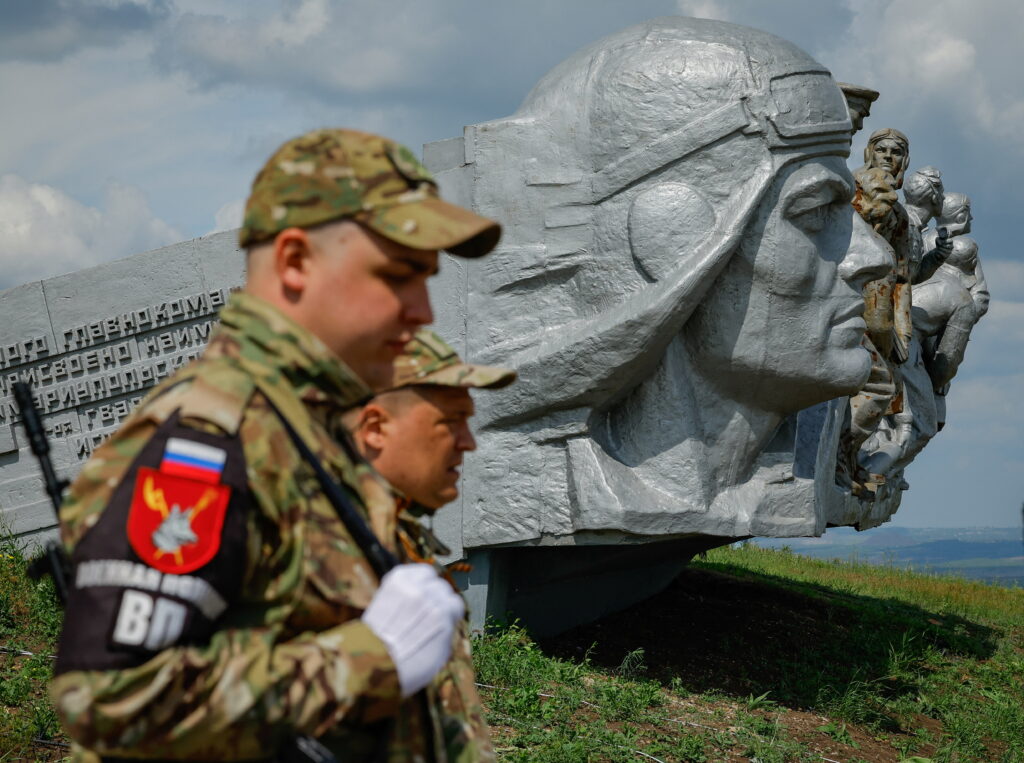
By 2026, Russia Day in Putin’s rhetoric had acquired a fully military-mobilization character. At the morning awards ceremony the holiday was presented as a symbol of the country’s unified thousand-year path, in which all historical epochs form a single continuous line and cohesion, patriotism, and both labor and military achievements were declared the defining qualities of the people. The central event of the day, however, was a separate meeting with participants in the war against Ukraine. Putin stated directly that Russia Day is “their day,” because they are “directly engaged in the defense of the Motherland.”
Today, therefore, Russia Day is no longer primarily the birthday of the Russia that emerged in the 1990s. It has become a day of affirmation for a Russia at war.