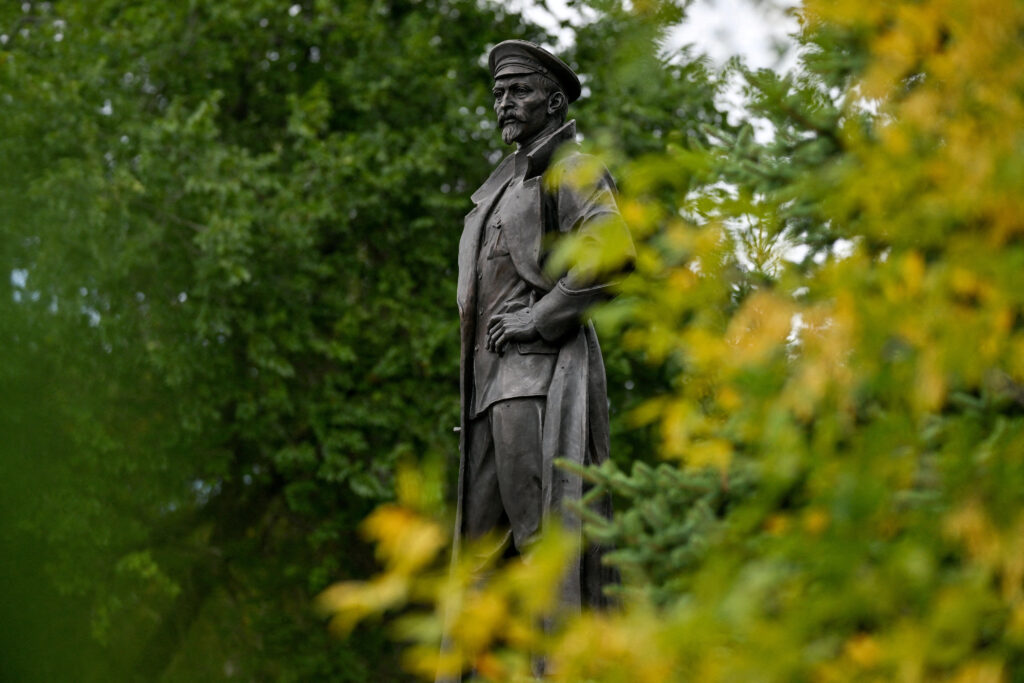
The dismantling of the Dzerzhinsky monument on Lubyanka Square in Moscow on 22 August 1991 became one of the defining symbols of the Soviet party-state security system’s defeat following the failure of the August Coup. That day, a large crowd gathered outside the KGB headquarters. Calls rang out to storm the building and spontaneously topple the statue. Attempts were made to pull the monument from its pedestal, but city authorities feared that the 11-ton sculpture could damage the underlying metro station and underground utilities if it fell.
Sergei Stankevich and other democratic politicians persuaded the crowd not to storm the KGB building or demolish the monument themselves. Instead, the Presidium of the Moscow City Council issued a formal decision to remove it. The statue was lifted from its plinth by cranes, loaded onto a platform, and taken to the Krymskaya Embankment beside the Central House of Artists. Later, it became one of the main exhibits in the Muzeon Park of Arts.
At the time, it seemed that both Dzerzhinsky and the Soviet KGB were being consigned to history once and for all. However, on 22 April 2026, Vladimir Putin restored the name of Felix Dzerzhinsky to the FSB Academy (its predecessor, the Higher School of the KGB of the USSR, had borne his name from 1962 to 1992). The decree specifically highlighted Dzerzhinsky’s «outstanding contribution to ensuring state security.»
Was enough done after the collapse of the USSR to prevent former KGB personnel from returning to power? Clearly not. Yet in the immediate aftermath of the fall of the communist regime, voices within the democratic opposition — including the Memorial movement — were divided on the question of lustration, with arguments both for and against.
Nevertheless, between 1991 and 1992, Russia took some steps aimed at defining the new state’s attitude toward the Soviet past, particularly the political repressions. On 18 October 1991, the Supreme Soviet of the RSFSR passed the Law «On the Rehabilitation of Victims of Political Repression.» Its preamble was unequivocal: «Over the years of Soviet power, millions of people became victims of the arbitrariness of the totalitarian state and were subjected to repression for their political and religious beliefs, as well as on social, national, and other grounds.» It explicitly stated that political repression had begun on 25 October (7 November) 1917 — that is, from the very first day after the Bolsheviks seized power — and condemned the «long-term terror and mass persecution of its own people.»
This law remains in force in today’s Russia. Assessments of the total number of victims and the required scale of rehabilitation, however, vary widely. Historians from Memorial, drawing on years of research, have spoken of no fewer than 12 million victims of political repression. Between 1992 and 2014, Russia’s prosecutorial and Interior Ministry bodies rehabilitated more than 3.5 million people.
In 2024, the Prosecutor General’s Office announced the possibility of revoking certain rehabilitation decisions regarding individuals convicted of espionage or treason. Yet in Stalin’s USSR, such charges were overwhelmingly fabricated. A striking example is the case of Marshal Vasily Blyukher, repressed in 1938 on charges of spying for Japan. His case was reviewed and he was rehabilitated as early as 1955.
On 30 November 1992, the Constitutional Court of Russia issued a ruling in the so-called «CPSU Case.» It stated plainly that «for a prolonged period, the country was ruled by a regime of unlimited power exercised by a narrow group of Communist functionaries and based on violence.» The Court further noted that «the leading bodies of the CPSU were the initiators, and local structures often the executors, of a policy of repression against millions of Soviet citizens, including deported peoples.»
It might have seemed that such assessments, issued by key institutions of the new Russia, could have laid the foundation for a consistent legal and historical evaluation of the Party and the KGB’s role. This did not happen. For a time, however, Dzerzhinsky’s name did partially disappear from public view. When the KGB Higher School was transformed into the Academy of the Ministry of Security of the Russian Federation in 1992, his name was removed from the title. In 1997, the Dzerzhinsky Military Academy was renamed the Peter the Great Military Academy of Strategic Missile Forces. In 1998, the Dzerzhinsky Higher Naval Engineering School became the Naval Engineering Institute.
Particularly telling was the fate of the elite Internal Troops unit — the Red Banner Operational Designation Division named after Felix Dzerzhinsky. This formation, which had existed since 1924, was among the first to be deployed to Moscow during political crises: for instance, during Beria’s arrest in 1953 and the August 1991 putsch. The irony of history is that this very division became one of President Boris Yeltsin’s most reliable pillars during the October 1993 crisis. Its troops defended the Ostankino television center on the night of 3 October against supporters of the Supreme Soviet and the following day took part in the assault on the House of Soviets. Shortly afterward, in 1994, Dzerzhinsky’s name was removed from the unit’s title — only temporarily, as it later turned out.
Who Are We and Where Does Our History Begin? From Yeltsin to Putin
The symbolism of Russia’s security service — the successor to the Soviet KGB — also underwent partial changes. In 1992−1993, on the ruins of the once-powerful Soviet agency, the Ministry of Security of the Russian Federation was created. It was soon transformed into the Federal Counterintelligence Service (1993−1995) and then into the Federal Security Service of Russia. The new organization abandoned the red star, hammer, and sickle on its emblem, but the central elements remained unchanged: the shield and sword. These are a direct reference to the «avenging sword of the Revolution» — the role performed by the first Soviet security agency, the Cheka, established on 20 December 1917.
Notably, despite partial de-communization and the temporary removal of Dzerzhinsky’s name, the service’s professional holiday remained the same: 20 December. This was the day in 1917 when the «All-Russian Extraordinary Commission for Combating Counter-Revolution and Sabotage» was founded — an organization that became one of the main instruments of mass terror during the Civil War of 1918−1922. According to the most conservative historical estimates, the Red Terror claimed at least 50,000 lives. Other researchers put the figure at 140,000 or higher.
Regarding the personal responsibility of Dzerzhinsky and his associates, it is enough to quote his closest collaborator, the Chekist Martyn Latsis. Shortly after the official launch of the Red Terror, he declared: «We are not waging war against individual persons. We are exterminating the bourgeoisie as a class. Do not look for evidence or proof during the investigation that the accused acted against Soviet power in deed or word. The first question we must ask is: to which class does he belong? What is his origin, education, or profession? These questions should determine the accused’s fate. This is the meaning and essence of the Red Terror.»
And yet, even under Boris Yeltsin, the professional holiday for security service personnel continued to be observed on the same date. Only the name changed: instead of «Chekist Day,» it became «Day of the Worker of the Security Organs of the Russian Federation.»
When Vladimir Putin served as FSB director from July 1998 to August 1999, he decided to restore a memorial plaque to KGB chief Yuri Andropov on the FSB building on Lubyanka Square. The plaque had been removed by the KGB staff themselves in August 1991. On 20 December 1999, Putin, then prime minister, solemnly unveiled it once again.
His subsequent actions — particularly the restoration of the melody of the Soviet anthem in 2000 — clearly signaled his affinity for the Soviet period and his intention to draw at least partially upon it in Russia’s new symbolic politics. That said, Putin’s entire policy from 2000 onward cannot be described as a full-scale restoration of the USSR in all its manifestations. Still, periodic expressions of sympathy for the Soviet era appeared in his actions and statements: the return of the red star to military insignia in 2002, his description of the Soviet collapse as the «greatest geopolitical catastrophe» in 2005, calls for a «balanced assessment» of Stalin in 2009, and the reintroduction of the Soviet Hero of Labour award in 2013. Against this backdrop, Putin’s 2014 decision to restore the name of Felix Dzerzhinsky to the Operational Designation Division of the Internal Troops — exactly twenty years after it was dropped in 1994 — appears entirely logical.
Dzerzhinsky in Wartime
Public discussion about returning the Dzerzhinsky monument to Lubyanka Square flared up again in February 2021, but Putin did not engage at the time, and the issue was temporarily taken off the agenda. However, by April 2021, an important step was taken toward Dzerzhinsky’s rehabilitation: the «Officers of Russia» organization announced that the Moscow Prosecutor’s Office had declared the 1991 removal of the monument illegal. While this statement had no immediate practical consequences, after February 2022, individual security service representatives began promoting the idea of restoring Dzerzhinsky with far greater confidence.
On 11 September 2023, a scaled-down replica of the 1991-dismantled Dzerzhinsky monument was unveiled at the SVR headquarters in Yasenevo. The symbolic significance of this gesture is hard to overstate: representatives of Russia’s foreign intelligence service — the direct successor to the KGB — openly positioned themselves against August 1991, the moment when party and KGB power collapsed. It is worth noting that August 1991 not only marked the fall of the Soviet system but also the birth of modern Russian statehood. The same Vladimir Putin resigned from the KGB during those days and supported Anatoly Sobchak, an opponent of the GKChP. Nevertheless, today the figure of the founder of the Soviet security services — the man responsible for organizing mass terror — remains the guiding symbol for Russia’s foreign intelligence.
The statue at SVR headquarters was far from the only Dzerzhinsky monument unveiled in recent years. It is important to note that the majority of Felix Dzerzhinsky monuments erected in Soviet times were not dismantled after 1991. The exceptions were the «main» statue on Lubyanka Square in Moscow, the bust outside the Interior Ministry building on Petrovka 38 (removed in 1991 and returned in 2005), and the monument in St. Petersburg near the Admiralty (dismantled in 1992). Across the country, dozens of «Iron Felix» statues remained standing, including in central St. Petersburg. Even during the Yeltsin era (1991−1999), Russia never undertook systematic de-communization. Consequently, Putin’s Russia never suffered from a shortage of Dzerzhinsky monuments. And now new ones are appearing.
In June 2022, at the initiative of FSB veterans and active officers, Dzerzhinsky monuments were unveiled in Izhevsk and Balashikha near Moscow. In 2023, one appeared in the Trans-Baikal region. In 2024, again on the initiative of FSB veterans and officers, a monument was erected in Borisoglebsk, Voronezh Region — a precise copy of the Lubyanka statue, just like the one at SVR headquarters. That same year, a monument was opened in Khabarovsk.
2025 proved particularly bountiful for Dzerzhinsky monuments. In September, a statue of the Cheka founder, torn down in 1991, was restored in central Vladivostok. A few days later, on 11 September, a Dzerzhinsky monument was unveiled in Nakhodka to the soundtrack of Jesus Christ Superstar. On the same day, a large monument was installed in central Omsk. The ceremony was attended by the presidential envoy to the Siberian Federal District, the governor of Omsk Region, and the head of the regional FSB directorate.
In all the cases described above, the initiative came from FSB representatives and was supported by regional authorities. The only exception was a small bust of Dzerzhinsky installed in a park in Nizhny Tagil in 2025 at the initiative of a local United Russia deputy.
The justifications offered for these unveilings are also noteworthy. There is never any mention of Communist ideology or the Party. The arguments heard in Omsk, for example, were: «Within three months he organized assistance and food collections for the starving Volga region, established local executive bodies to combat homelessness, oversaw the activities of the Cheka, and served as honorary chairman of the Dynamo society.» The head of the Primorye FSB directorate, Denis Simonov, who unveiled the Vladivostok monument, called Dzerzhinsky «a unique individual who could quickly and deeply immerse himself in any problem.» In Borisoglebsk, the head of the Voronezh Region FSB directorate, Sergei Leshin, spoke of Dzerzhinsky as «an example of a man who was utterly devoted to his cause and his state, and who laid down his life in service to the Fatherland.» The ceremonies frequently emphasized the high duty of Chekists to combat crime, banditry, and treason, along with the patriotism of strong and courageous individuals.
The Security Services’ Revenge
Vladimir Putin’s April 2026 decision to name the FSB Academy after Dzerzhinsky was preceded by a large-scale symbolic offensive by the FSB and SVR in the public sphere. The fact that in most cases the monuments are not merely new statues but exact replicas of the Lubyanka sculpture removed in August 1991 speaks volumes.
This is not so much nostalgia for the Soviet Union (Putin has repeatedly described Russia as the successor not only to the USSR but also to the Russian Empire and has used imperial history to justify his actions, including arguments about the «artificiality of the Ukrainian state»). For Russia’s security services, August 1991 remains painful above all as a moment of their own humiliation and weakness: the crowd outside the Lubyanka building, ready to storm it, left the siloviki with a lasting sense of utter powerlessness after decades of «glorious history.»
Beyond the symbolic restoration of Chekist names and monuments, the FSB has been actively expanding its real political power within the country in recent years. Its Second Service oversees internet blockades and is gradually stripping powers from the Ministry of Digital Development. It conducts surveillance of the opposition, is taking over pre-trial detention centers from the Federal Penitentiary Service, oversees artificial intelligence development projects, and is penetrating ever deeper into Russia’s economic life.
In this context, the return of Dzerzhinsky statues should be seen less as an act of re-communization and more as part of the security services’ strategy to consolidate their power and eliminate any possibility of a repeat of the events of August 1991.