Alexander Kharichev, head of the Kremlin’s Social Monitoring Directorate, spoke at the congress of the Russian Association of Political Consultants and laid out the presidential administration’s political bloc’s view of the recent State Duma election campaign and its results. The official dropped a transparent hint that the Pensioners’ Party and the Rodina party «might just try to get close to the barrier that exists» — meaning the 5 percent threshold for entering the Duma. Given that Kharichev himself will be managing the next campaign, his words can safely be treated as an instruction. The signal is clear: A Just Russia — For Truth has very serious problems with the prospect of making it into the next parliament at all.
Neither the Pensioners nor Rodina can currently boast ratings anywhere near 5 percent, nor do they have a consistent record of local victories. The Pensioners’ Party occasionally picks up regional legislative seats, usually either because the party’s name resonates with an ageing electorate in a particular area or because some well-resourced local politician effectively buys the franchise. Rodina has not had even that level of success for years. Kharichev’s remark therefore means that the Kremlin is prepared to pump serious federal-level resources into both projects: rebranding, new funding, and the recruitment of recognizable faces. Without that kind of push, any talk of either party approaching the 5 percent mark is fantasy.
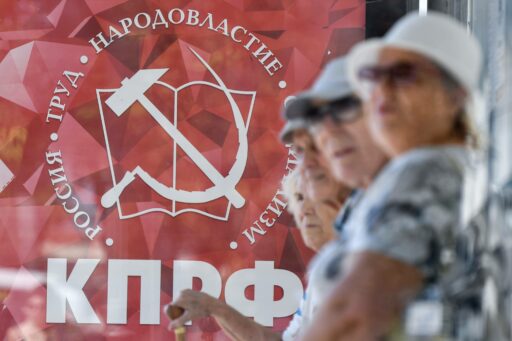
The political bloc’s motives are not hard to discern. For years it has wanted to strip the Communist Party (KPRF) of its status as the unambiguous second-most popular force in the country. So far, circumstances are working in the Communists’ favor. Russia is sliding into an economic downturn: major enterprises are cutting jobs or moving staff to part-time contracts, the recent tax rises will drive up prices and push a chunk of small and medium businesses into bankruptcy. The KPRF knows exactly how to campaign on those issues. Official polls currently show the Communists and LDPR neck-and-neck, but the worse the economy gets, the bigger the Communists’ lead is likely to become. By promoting two spoiler projects the Kremlin can hope to shave a few points off that advantage.
A properly promoted Pensioners’ Party would peel away older voters — the core of the KPRF electorate — especially those put off by the Communists’ Stalinist nostalgia and ultra-patriotic rhetoric. Rodina would target the patriotic wing of the Communist base. Three or four percent siphoned off in this way really could be enough to carry the Pensioners over the threshold. Rodina’s chances are slimmer, but with serious Kremlin backing a 3 percent result (enough for state funding) is perfectly achievable. It is also worth noting that the Pensioners’ Party is widely believed to be a personal project of Kharichev himself; its key operatives are political technologists close to him. The Kremlin’s chief ideologist therefore stands to profit directly from its promotion.
The main loser in this scenario would be A Just Russia. Both spoiler parties would eat into its electorate as well. Sergei Mironov’s party has run incoherent campaigns in recent years and lacks a clear identity: it tries to be both pro-war and the champion of social criticism and the less well-off — at a time when polls show that poorer Russians are disproportionately skeptical of the war. A Just Russia’s rating is already below the passing mark. Whereas an aggressive Pensioners/Rodina campaign might only dent the Communists, it could strip A Just Russia of almost its entire voter base: war-sceptic poorer citizens would migrate to the Pensioners, patriots to Rodina. Kharichev publicly insists that all parties currently represented in the Duma should remain there, yet his musings about possible new parliamentary factions suggest that A Just Russia may well lose its status. For Sergei Kiriyenko’s political team, Mironov’s party is more of a liability than an asset: it still contains some strong regional figures, and the leader himself has an old personal relationship with Putin that allows him to request presidential protection directly. The prospect of A Just Russia becoming collateral damage in the fight against the Communists would therefore be quietly welcomed in Kiriyenko’s office. Mironov may indeed appeal to Putin for guarantees, but it is far from certain that the president will bother with such minutiae on behalf of an old associate who is no longer part of the inner circle.
Dolina as a Political Asset
Russian political actors and well-connected players inside the power vertical are happily riding the Larisa Dolina scandal for their own publicity.
The popular singer sold an apartment, then claimed she had been defrauded, sued to annul the deal, and won: the flat was returned to her and the buyer lost both the property and her money. The story received massive media coverage, and the «Dolina scheme» was quickly copied by others — especially elderly people — who sold property and then challenged the transactions using the same template. Dolina instantly became meme fodder and one of the most discussed public figures in the country. Companies started using her image in advertising (publicly refusing her food deliveries, for example). She turned into a socially acceptable punching bag on whom people could vent quite vicious frustration. The «cancellation» of Larisa Dolina can hardly be called a genuine public campaign for justice — and therefore proof that Russian society is ready for real accountability struggles — but it certainly channeled some accumulated social anger.
Any politician or public figure knows that taking on someone with a high negative rating is an easy way to boost one’s own popularity. Dolina provides that resource in abundance, so prominent figures are happily exploiting her case. Supreme Court Chairman Igor Krasnov is one example. Already one of the most visible investigators when he was deputy head of the Investigative Committee, he has only increased his media profile since becoming Prosecutor General and then moving to the Supreme Court. The Dolina case reached the Supreme Court, and the court clearly decided to spotlight it. «Given the chairman’s principled stance on violations of citizens’ rights and the measures he has ordered to ensure the rule of law, there is no doubt that the dispute will be resolved strictly within the legal framework and with due regard to the parties’ lawful interests,» an obviously authorized court source told Interfax. The ruling, whatever it is, will be widely discussed — and so will the name of the Supreme Court chairman. The Dolina affair allows Krasnov to cement his image as a fair judge without expending political capital or picking fights with real powerbrokers.
The organizers of a State Duma roundtable on real estate ostentatiously invited Dolina to attend. And the lower house’s undisputed master of hype, Vice-Speaker Vladislav Davankov of New People, explicitly compared the singer’s case to the 2019 prosecution of journalist Ivan Golunov.”People genuinely feel that anyone could become a victim in a case like this. The last time I saw that reaction was the Golunov affair — when everyone realized that drugs could be planted on them tomorrow and they would find themselves in the dock," Davankov declared.
The use of the Dolina scandal in public politics demonstrates, on the one hand, that Russia still has players willing to chase hype on issues that resonate with public discontent — Davankov, for instance, has been systematically targeting Yekaterina Mizulina in the same calculated way. On the other hand, the limits of the game are rigidly defined: only figures without real power or protection come under fire. Criticizing Kremlin initiatives or genuinely influential individuals remains off-limits even for the most skilled hype merchants.