In February 2026, President Vladimir Putin signed a decree that formally regulated the Headquarters of the Russian National Guard (Rosgvardiya) as a separate command body. The decree solidified Rosgvardiya’s position as a standalone domestic security force. However, Rosgvardiya is neither becoming a super-agency nor positioning itself as a serious contender to the armed forces. It remains outside the Ministry of Defense chain of command, yet it is integrated into national defense planning through the Defense Plan and interfaces with the General Staff.
Analytically, Rosgvardiya is divided between two not entirely compatible operational purposes. First, it functions as a federal executive body—a «service» with a central apparatus and territorial organs that perform regulatory tasks such as weapons control, licensing, and facility security. At the same time, its paramilitary component—the National Guard troops—serves as the uniformed force element that has proven far more significant during the war in Ukraine. Accordingly, the new decree did not establish a new ministry-like headquarters for the agency. Instead, it formalized and centralized troop command functions, crystallizing Rosgvardiya’s role as the primary agency responsible for countering insurgency and dispersing protests, particularly in wartime.
Institutional Role
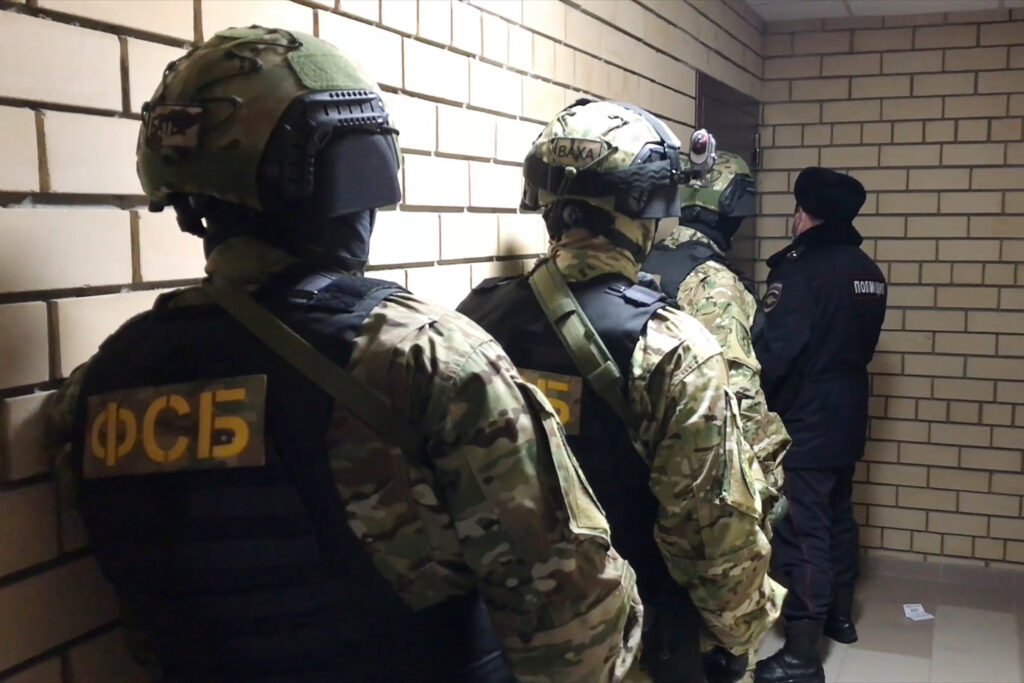
Rosgvardiya was created as a multi-mission internal security force. Its core remit includes maintaining public order (especially during protests and other mass events), protecting critical state facilities and sensitive shipments, enforcing firearms regulations, and overseeing the private security and detective sector. Since 2022, it has also operated in occupied areas of Ukraine in a combination of riot-control, counter-insurgency, and rear-area security roles, often alongside the Russian armed forces, the FSB, and regular police. This division of labor has allowed regular military units to focus on frontline operations while Rosgvardiya handles raids, checkpoints, facility protection, and counter-sabotage tasks.
Following the dismantling of the Wagner private military company, some former fighters were reportedly absorbed into Rosgvardiya-affiliated formations, enhancing its capacity to undertake higher-intensity missions when needed. Overall, the war has accelerated Rosgvardiya’s evolution—from a rebranded, Interior Ministry-derived structure that required careful and agile organizational adjustments—into a more autonomous paramilitary instrument with growing operational combat experience.
This is why the February presidential decree did not expand Rosgvardiya’s statutory functions as an agency. Instead, it elevated the legal status of its command-and-control body by approving its regulations at the presidential level and concentrating managerial and command authority within a dedicated headquarters structure. The Headquarters Regulations specify how Rosgvardiya organizes command and troop employment, how it coordinates with other defense actors and interagency groupings, and how it submits proposals to the General Staff of the Russian Armed Forces. In this sense, the decree did not create new missions but consolidated existing activities into a more formalized, centralized command-and-control framework—structurally analogous, though not equivalent in scope, to the Armed Forces’ General Staff.
At the same time, the Headquarters Regulations separately define «operational (combat) support» as a Headquarters function, listing tasks such as deception operations, engineer support, searching for and neutralizing explosive hazards, CBRN protection, cartographic support, and the use of or countermeasures against robotic systems. They also emphasize the development of a unified command-and-control system, information space management, and IT/digital transformation of the troops. In addition, the planning framework is now described in more explicitly military terms, including participation in strategic deterrence measures and the development of combat manuals. These functions are not new in practice, but they are now more precisely defined as duties assigned to the Rosgvardiya Headquarters.
In December 2023, Putin authorized Rosgvardiya to create and employ «volunteer formations» by presidential decision. The law effectively imported the wartime «volunteer unit» model into Rosgvardiya’s institutional framework, providing a legally clean mechanism to generate additional manpower outside its standard troop structure. Russian media reported in December 2023 that some Wagner mercenaries began receiving salaries from Rosgvardiya while deployed in Mali.
As a result, Rosgvardiya has emerged as a stronger paramilitary force, with its Headquarters better integrated into the national defense management system. This gives the Rosgvardiya command greater agility to deploy its guardsmen—including in joint operations with other Russian security bodies—and secures the institutional development of its command structures at the presidential level.
Staff Experiments and Enablers
The presidential Regulations represent the culmination of a series of staff-level changes within Rosgvardiya during the war in Ukraine. In March 2022, President Putin increased the number of Rosgvardiya deputy directors from eight to nine. Although the ninth deputy director was not immediately identified publicly, General Alexei Vorobyov most likely assumed the post in 2023 as deputy director for military-political affairs. Vorobyov brought diverse experience from the Soviet and Russian Ministries of Defense and Internal Affairs, as well as the customs agency and security positions in Ingushetia.
Alongside the expansion of the deputy corps, Putin accepted the resignation of Lieutenant General Roman Gavrilov in March 2022. Media reports linked Gavrilov to counterintelligence and internal security work and portrayed him as a loyalist of Rosgvardiya Director Viktor Zolotov, having previously served under Zolotov in the Federal Protective Service. In August 2022, Lieutenant General Vladislav Yershov was appointed deputy director for operative (combat) work. Yershov is a highly experienced and decorated counterterrorism officer who spent decades in police Spetsnaz units, including operations in Chechnya and hostage rescues.
The most revealing reshuffle occurred in April 2023, when Colonel General Aleksei Kuzmenkov was transferred from Rosgvardiya to the Ministry of Defense as deputy minister for logistics; roughly a year later, in 2024, he returned to Rosgvardiya. Given Kuzmenkov’s background as a career logistics officer, the move appeared to be an emergency command adjustment amid successive supply-chain leadership changes, starting with Deputy Defense Minister Dmitry Bulgakov’s removal in September 2022 and the brief tenure of General Mikhail Mizintsev that followed. These personnel shifts unfolded against the backdrop of the open feud between the Defense Ministry and Wagner chief Yevgeny Prigozhin, who publicly accused the ministry of restricting supplies and artillery ammunition. In that context, while Mizintsev assumed control of Wagner’s logistics, Kuzmenkov’s role in managing Ministry supplies can be seen as an effort to tighten political oversight of stockpiles and distribution decisions. Collectively, these appointments likely reduced opportunities for autonomous resourcing by Wagner forces and ensured that major transfers required explicit, centralized approval.
In 2025, Putin appointed Vasily Sonin as a deputy director of Rosgvardiya. Sonin previously headed the agency’s Moscow directorate and, as a career police officer, had joined Rosgvardiya only in 2022. Appointing a former commander of Moscow guardsmen is also significant for ensuring the security of central government installations in the capital. In November 2025, there was a reverse rotation in the military-political portfolio: Vorobyov was relieved of his post as deputy director for military-political work.
At the same time, President Putin revised the categories of deputy director posts and removed the licensing-and-permitting chief from the list of ex officio deputies. Together with the February 2026 elevation of the Headquarters as the primary troop command body, this December 2025 change can be understood as a supportive rebalancing: the regulatory «civilian security» pillar is becoming less prominent, while the center of gravity shifts toward military-style command functions and force employment.
Conclusion
All in all, Rosgvardiya is not turning into a super-agency, but it has been pushed toward becoming a more militarized, centrally managed security force within Russia’s broader security and national defense system. It retains its institutional dual nature—regulator and domestic security service on paper, paramilitary force in practice—yet it is increasingly optimized for wartime internal security tasks, rear-area control, and joint operations with other security agencies. Given the push for robotization and the growing manpower shortages in the Russian armed forces, Rosgvardiya could potentially evolve into an infantry-heavy light paramilitary force tasked with keeping domestic security firmly under Vladimir Putin’s control.