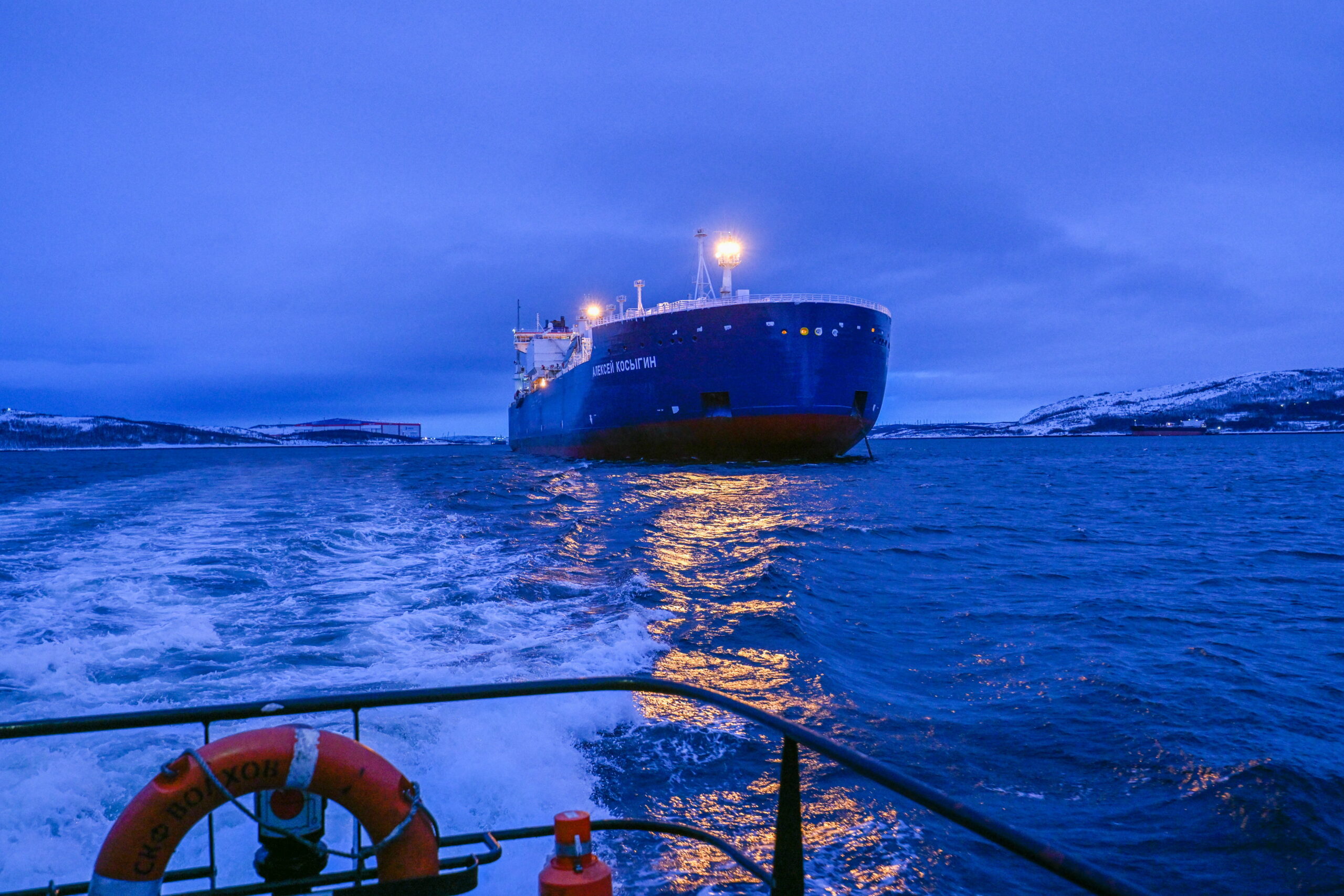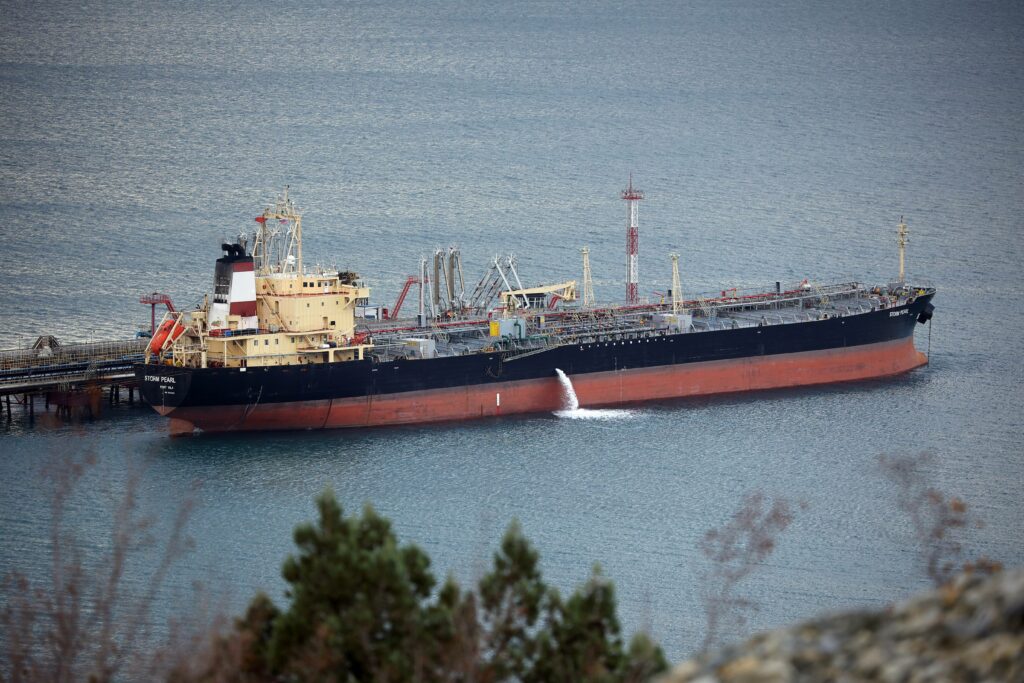
Four years into the full-scale war in Ukraine, Russia’s LNG industry outwardly appears resilient. Despite sanctions, production continues, some cargoes still head to Asia, European buyers keep accepting deliveries—occasionally at near-record levels—and Russian officials periodically revive talk of the country achieving «global leadership» in LNG exports.
This surface-level picture can easily be mistaken for proof that sanctions are ineffective. Yet beneath the veneer lies a different reality: sanctions function not as an immediate knockout blow but as a slow, grinding erosion of the industry’s technological and infrastructural foundation. Nowhere is this more evident than in LNG—a young, capital-intensive sector that depends critically on a sophisticated ecosystem of high-tech equipment, liquefaction technology, specialized tanker fleets, insurance, maintenance services, and access to international logistics networks.
Russia entered the LNG business relatively late: its first major plant came online only in 2009 on Sakhalin Island. But within a decade the country was drawing up ambitious plans for a breakthrough—to join the ranks of global leaders, rapidly scale up production and exports, and position LNG as a cornerstone of gas expansion and a key way to monetize Russia’s vast gas reserves. Those goals were formalized in the government’s long-term LNG development program adopted in 2021.
The war and ensuing sanctions have derailed that trajectory. Today Russian LNG is losing markets, technology access, investment, and its long-term development horizon. The industry is not collapsing outright, but its future growth has become structurally constrained.
A trajectory of (non-)development
Before 2022, Russian LNG followed the standard global playbook: partnerships with international majors, imported technology, construction of production trains, reliance on Western shipyards, and a financing model built on trust, insurance, and long-term contracts. This was never a fully «sovereign» industry in the sense of self-sufficiency. On the contrary, the success of Russian projects stemmed from deep integration into the global LNG industrial architecture. For example, Shell (Anglo-Dutch), Mitsui, and Mitsubishi (Japanese) joined Sakhalin-2 alongside Russian players; TotalEnergies (French), CNPC, and the Silk Road Fund (Chinese) took stakes in Yamal LNG. That integration made the stated ambitions look achievable: Russia could expand capacity while having access to every critical link in the value chain—from equipment and technology to services and specialized shipping.
After 2022 this foundation was methodically dismantled. Successive rounds of EU and U.S. sanctions progressively closed off the channels needed for industry growth. Unlike the oil sector—where some operations can slip into gray-zone workarounds—LNG is far less adaptable to circumvention. Transactions are more transparent, regulatory requirements stricter, and infrastructural loopholes far fewer.
The core logic of sanctions against Russian LNG is not to stop purchases today but to ensure the industry cannot expand tomorrow. That is why seemingly partial or delayed measures have proven especially damaging: restrictions on equipment, technology, and services; bans on new investment; curbs on transshipment via European terminals; sanctions targeting projects under construction; blows to shipbuilding and the tanker fleet; and finally the EU’s decision to impose a full import ban on Russian LNG starting January 1, 2027. All of these steps target not current export volumes but the industry’s future ability to grow and compete globally.
The market dimension
Europe has long been the most convenient and profitable destination for Russian LNG—geographically close, infrastructurally mature, creditworthy, and governed by transparent, predictable rules. In 2025 roughly half of Russia’s LNG exports went to European countries (mainly France, Belgium, and Spain), totaling around 15 million tons (equivalent to about 21 billion cubic meters) and generating roughly $ 8.4 billion in revenue.
For Europe itself, Russian LNG played a buffering role during periods of gas-market stress after pipeline supplies were sharply curtailed, which is why it long escaped a blanket ban. The EU’s sanction logic has been pragmatic rather than symbolic: a gradual, legally robust displacement compatible with the bloc’s own energy-security needs. For Russia this means losing its most comfortable and highest-margin sales channel. Moreover, the restrictions indirectly affect alternative markets. TotalEnergies management has acknowledged that once the EU ban takes effect the company may have to halt all exports from Yamal LNG, in which it holds a 20% stake.
Technology
The most acute vulnerability in Russian LNG remains technological dependence. Virtually every operating project in Russia relies on liquefaction technology from American, German, Dutch, or French companies.
In this industry you cannot simply «dumb down» the product or partially localize—like in some other sectors. Either you have a complete technological chain or you have nothing. When critical components drop out—compressors, cryogenic equipment, maintenance services, software—normal operations become impossible and the industry starts to stall.
Even if individual production lines can be kept running, strategic problems mount: without access to advanced technology and international services, plans for prospective projects must be rewritten, timelines for ongoing ones pushed back, and budgets inflated. New projects cannot be built quickly—and crucially, they cannot be built competitively, with acceptable costs, reliability, and delivery predictability.
What is at stake is not just individual plants but the broader industrial architecture envisioned in the 2021 long-term program: large integrated clusters built around new liquefaction capacity, gas processing, and gas-to-chemicals facilities that were meant to serve as engines of industrial growth for decades. With restricted access to equipment and services, such clusters are either postponed or implemented with drastically revised parameters, casting serious doubt over the future industrial ecosystem Russia hoped to build around LNG.
Logistics
If technology sanctions hit production, logistics sanctions hit sales potential. Russian LNG—especially Arctic volumes—relies on a unique transport model: ice-class Arc7 tankers, seasonal navigation, heavy dependence on the Northern Sea Route, European transshipment terminals, and reloading hubs.
Sanctions have struck at the very core of this model—fleet and shipbuilding. Russia lacks enough Arc7-class gas carriers to reliably serve even existing capacity, and dependence on foreign yards and equipment has become a critical bottleneck.
In this environment, the much-vaunted «pivot to Asia» amounts more to sporadic, unstable spot deliveries than a genuine substitute for the stable European market with its reliable logistics, insurance, servicing, and port infrastructure. Sanctions do not physically ban Russian LNG; they render it economically uncompetitive.
Finance
The industry’s vulnerability is compounded by its financial structure. LNG is a highly capital-intensive business where investment decisions span decades and project payback depends on capital costs, contract stability, and reputation.
Sanctions raise borrowing costs, force sales at steep discounts, inflate logistics expenses, and depress expected future revenues. Under these conditions even generous state support and tax breaks (Arctic LNG projects enjoy exemption from export duties and mineral extraction tax, reduced profit tax rates, and other preferences) cannot fully offset the damage. They may plug short-term cash gaps but cannot close the technological gap or compensate for lost premium markets.
As a result, the sector grows increasingly dependent on administrative decisions and state subsidies—and less on market logic. That shift—from competition and expansion to crisis management and survival—is perhaps the clearest sign of a degraded development path.
Leadership that almost certainly will not materialize
Before the war Russia’s LNG strategy centered on an ambitious target: reaching roughly 100 million tons of annual production by 2030 and securing a place among global leaders. LNG was seen not merely as another export commodity but as a strategic lever—to diversify gas delivery routes, reduce reliance on transit countries, and bolster Russia’s geo-economic influence.
Today that goal has lost all realism. Even official statements now concede that the targets will slip by many years—if they are met at all. Cargo volumes moving through the Russian Arctic already show negative trends. Deferred projects, revised investment decisions, delayed timelines, and constrained logistics all point to the same conclusion: industry development is no longer a manageable, forward-looking process.
Russia can still produce and export LNG. Existing facilities keep operating, some cargoes find new buyers, and state backing cushions the sharpest financial risks. But there is a fundamental difference between «keeping things running» and «becoming a leader.»
The global LNG market rewards scale, technology, and predictability. Its frontrunners—the United States, Australia, Qatar—are expanding capacity, attracting investment, signing long-term contracts, and building infrastructure. The U.S. alone saw record LNG export revenues to the EU in 2025, exceeding $ 23 billion. Against that backdrop, a technologically isolated Russian industry—with logistical chokepoints and limited market access—must focus on adaptation rather than expansion. It can sustain part of its current capacity and fulfill occasional deliveries, but it is losing the one thing that matters most: the ability to scale up, develop, and compete on equal terms globally.
In this sense sanctions act as a strategic limiter. They do not wipe out Russian LNG, but they lock it into a permanently lower tier of development. Instead of global expansion there is a struggle to preserve existing assets; instead of leadership there are workarounds and stopgap measures.
The sanctions’ most profound impact is not visible in today’s shipping statistics but in the altered horizon of tomorrow. Russia is losing LNG not as an operating industry but as a development project. It may continue exporting gas in liquefied form, but it is no longer capable of building a credible strategy for world leadership around it.