Moldova, wedged between Romania and Ukraine and thereby neighboring the largest war in Europe since the Second World War, is entering a difficult phase in its foreign and security policy. As the war in Ukraine approaches its fourth year, Moldova finds its decades-old security doctrine under pressure and in a state of renewal. The ruling Party of Action and Solidarity (PAS) is accelerating integration with the EU and deepening cooperation with NATO, yet this ambition clashes with the country’s constitutional commitment to permanent neutrality and with a population that still overwhelmingly views neutrality as the preferred security strategy. This internal tension constitutes a vulnerability that Russia is already well positioned to exploit.
Moldova adopted neutrality in 1994 after the war with the Russian-backed breakaway region of Transnistria. Originally, it was intended to shield Moldova from great-power interference, but today—given persistent Russian influence operations, hybrid threats, and the presence of Russian troops in Transnistria (a daily violation of the constitutional neutrality)—the principle has lost much of its original meaning.
That is why the direction of PAS’s foreign and security policy suggests a clear shift away from the traditional interpretation of neutrality as passivity. Increased defense spending, a new military strategy for 2025−2035, and the signing of a Security and Defence Partnership with the EU all point toward a move from minimal military capability to active deterrence. EU support through the European Peace Facility, cyber operations, and participation in CSDP missions—along with substantive NATO capacity-building support—further underline this transformation. In practice, the government appears to view neutrality as compatible with receiving military assistance, capacity building, and closer alignment with Western security structures.
The key question, however, is to what extent this evolving approach strengthens Moldova’s resilience rather than exposing the country to new vulnerabilities. If the government cannot convince the public that this reinterpreted neutrality enhances security, Russia will have an obvious opportunity to exploit societal divisions, amplify fears of NATO involvement (and potentially also EU membership), and undermine Moldova’s Western trajectory. In this sense, the future of Moldova’s security strategy depends not only on EU and NATO support, but also on domestic trust and political legitimacy.
Moldova’s Neutrality: Origins, Meaning, and Contradictions
Following the defeat by the Russian 14th Army in the 1992 war with Transnistria, Moldova yielded to Russian pressure and included the principle of permanent neutrality in its 1994 Constitution under Article 11. This was done partly as a concession to Russia—greatly limiting the pro-Romanian faction’s ability to pursue reunification with Romania—but also in the hope that Russia would withdraw its troops from Transnistria, which it did not. To this day, the presence of Russian troops in Transnistria constitutes a daily violation of Moldova’s constitutional neutrality. Ultimately, this demonstrates that neutrality has not had the intended effect envisioned in 1994.
There are different ways to interpret Moldova’s neutrality and what it entails. Article 11 of the Constitution of the Republic of Moldova states that Moldova is permanently neutral and «does not admit the stationing of any foreign military troops on its territory,» while Article 142 states that the provision on neutrality can only be revised by referendum based on a majority vote of registered citizens. As such, neutrality implies a commitment to non-alignment and non-militarization by foreign actors, protected by the mandatory referendum requirement.
From an academic perspective, neutrality is typically understood as refraining from taking sides in any armed conflict and—in the case of being caught in a great-power rivalry—providing symmetric benefits to the great powers while making them believe that a status of neutrality is to their advantage. Essentially, PAS is not only trying to flexibly work within Moldova’s constitutional provisions but is also breaking with the general academic expectation of neutrality as a strategy. While PAS does not bear the blame for the presence of Russian troops on its territory in Transnistria, it is in the midst of substantially redefining the original meaning of neutrality. Rather than staying outside any great-power rivalry, the strategy of the PAS government seems to focus on balancing against Russia through integration into the EU and building a strong partnership—short of membership—with NATO.
Winds of Change: From Passivity to Resilience
For much of its post-Soviet history, Moldova’s concept of neutrality relied on the non-prioritization of defense spending. Up until 2024, Chișinău on average spent around 0.3−0.4 percent of GDP on defense, effectively leaving the country with minimal capabilities to defend its territory. However, this was also part of a deliberate strategy of minimal focus on defense, signaling to great powers like Russia that Moldova was not interested in taking part in any military build-up or conflict.
Likewise, until pro-European political forces came to power in the late 2010s, it was not an objective of the Moldovan government to pursue membership in the EU (or NATO, for that matter)—something that would have constituted a red line for Russia. In other words, Russia had no incentive to launch military aggression toward Moldova as long as Socialist- and Communist-led governments pursued a policy of accommodation with Russia, which also held the military advantage of stationing soldiers in Transnistria. Back in 2011, Moldova’s National Security Strategy (NSS) even identified Russia as a «strategic partner.» In short, the country’s foreign and security policy was characterized by «strategic timidity» and military neglect, and its military capacity remained weak and largely dependent on outdated Soviet equipment.
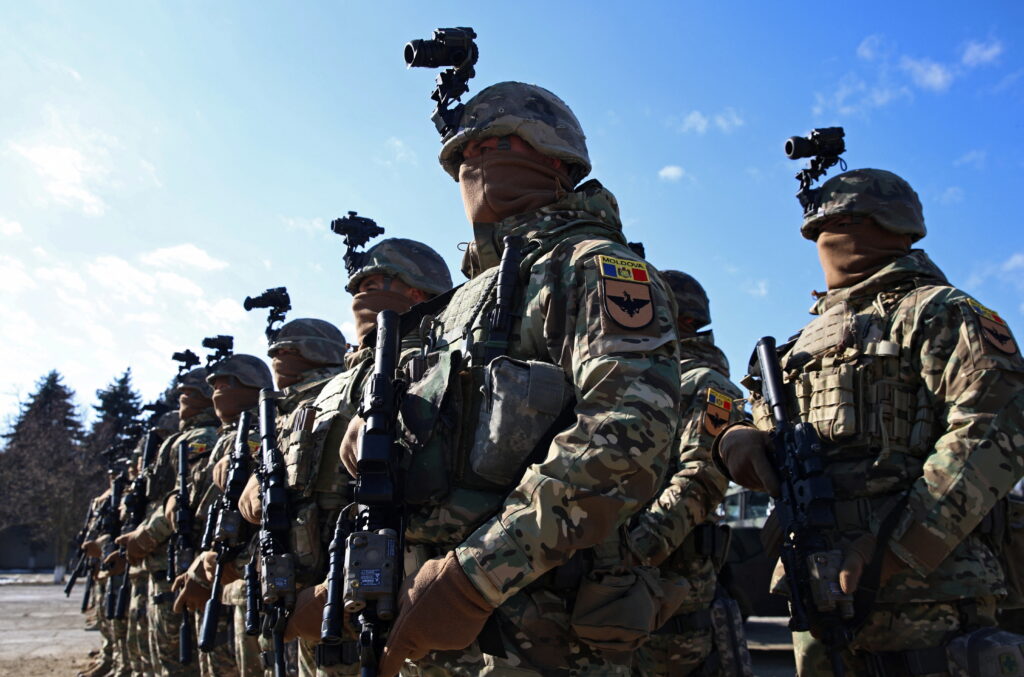
Russia’s full-scale invasion of Ukraine in February 2022, however, has undoubtedly acted as a catalyst for defense spending, forcing European states in particular to critically reassess their defense policies. This has also affected Moldova, as PAS updated the country’s national security and military strategies, began cooperating more closely with the EU on security and defense matters, and sought closer relations with NATO. With the new security and military strategies, Russia is now seen as an adversary, and its aggressive policies are described as the primary threat to Moldova’s national security. Additionally, Moldova is now committed to increasing defense spending to 1% of GDP and plans to expand the size of its national army. These reforms indicate Moldova’s intention to move closer to NATO standards.
In 2024, Moldova became the first non-EU country to sign a Security and Defence Partnership with the EU. The partnership covers areas such as cybersecurity, counterterrorism, countering foreign information manipulation, capacity building in defense and security, border management, and participation in the EU’s Common Security and Defence Policy (CSDP) missions and operations. Overall, the agreement strengthens Moldova’s resilience against security threats and aligns with Moldova’s National Security Strategy, which identifies EU accession as a strategic objective—particularly in response to Russian hybrid threats.
Moldova’s partnership with the EU is further reflected in its inclusion in the EU’s Security Action for Europe (SAFE) initiative. While SAFE loans are formally limited to EU member states, Moldova is explicitly eligible to participate in common procurement projects for priority defense products. This improves Moldova’s access to modern European defense equipment, even though it cannot access SAFE financing directly. Moldova has also benefited from EU cyber defense support, including European Cyber Rapid Response Teams under the PESCO framework. The EU has provided Moldova with both non-lethal and lethal military assistance through the European Peace Facility (EPF), totaling approximately € 200 million since 2021.
Beyond the EU, Moldova maintains an active partnership with NATO through Defense and Related Security Capacity Building initiatives. NATO support focuses on equipment, training, institutional reform, and interoperability, including participation in Partnership for Peace exercises and peacekeeping missions such as KFOR in Kosovo. Together, these arrangements have significantly enhanced Moldova’s defense capacity while gradually aligning its military with NATO standards. However, closer alignment with NATO introduces political and security risks, as Russia consistently frames such cooperation as a hostile move. By courting NATO and EU defense cooperation, Moldova encourages Russia to escalate its pressure through political and economic coercion or even more aggressive hybrid means. This means that the very steps that strengthen Moldova’s military resilience may simultaneously heighten its exposure to Russian countermeasures.
In this regard, the most striking aspect of the new NSS is that it makes no reference at all to Moldova’s constitutional neutrality. This marks a turning point. It suggests that neutrality is no longer treated as a cornerstone of national security, but rather as an identity marker that must adapt to changing circumstances (NSS 2023). In consideration of Moldova’s substantially strengthened defense partnerships with the EU and NATO, as laid out above, neutrality is no longer interpreted as passivity but rather as building resilience—that is, developing sufficient military capabilities to deter coercion and withstand hybrid threats without formally joining a military alliance (i.e., NATO). In this sense, neutrality is being redefined as an active strategy of survival rather than a static constitutional principle.
Public Perception Risks Defeating Resilience
But the central question is whether PAS can manage to convince the Moldovan public that their new form of neutrality is worthwhile. When examining public perception, neutrality remains the preferred security strategy in Moldova. This is not to say, however, that there is no divergence in views regarding the country’s security strategy. Opinion polls over the past few years consistently show that between 54% and 62% of respondents consider neutrality to be the best security strategy. One explanation for this preference may be the belief that neutrality offers protection—an assumption deeply rooted in Moldovan political culture.
Despite this general support for neutrality, public opinion becomes far more polarized when it comes to its practical implementation. For instance, opinion polls from May 2025 show that approximately 60% of respondents support EU membership, while only 26% oppose it. At the same time, the majority remains opposed to NATO membership. This contradiction may be explained by widespread fears that NATO membership would be perceived by Russia as a provocation, potentially increasing Moldova’s vulnerability rather than enhancing its security. By contrast, cooperation with the EU has historically been viewed in economic terms—even though the EU is undergoing increasing militarization, as seen in its Strategic Compass for Security and Defence.
Public debate reflects the same tension evident at both the political and societal levels. It is argued that «neutrality without cooperation becomes vulnerability,» pointing to Moldova’s limited resources and the need to leverage EU initiatives. Neutrality is being reinterpreted as resilience through cooperation. Looking ahead, Moldova’s challenge will be to sustain this balance. If EU integration means more militarization, neutrality may become increasingly difficult to reconcile with European defense policies such as the «Military Schengen.» And it may become increasingly difficult to convince the Moldovan electorate that neutrality is still being pursued—especially considering the substantial energy and resources that Russia will undoubtedly devote to spreading disinformation. This could mean that PAS’s new security and defense strategy is less sustainable than might be expected.
Even though it is certain that the EU and NATO will continue supporting the incumbent government to the greatest extent possible, the Moldovan electorate may choose a new government with different priorities in approximately four years if they are not convinced that the new strategy provides greater security. In short, whether the new strategy will prove resilient depends not only on the EU and NATO delivering the sought-after capabilities and support, but also on building trust between the Moldovan military and the population at large, as well as PAS’s ability to persuade voters that the new strategy is making them safer and more secure.