On 17 March 2026, Ilya Remeslo—a Nalchik-born lawyer, Z-blogger, and one of the Kremlin’s most prolific denouncers—published a post on his Telegram channel titled «Five Reasons I Stopped Supporting Vladimir Putin.» The post was viewed more than 560,000 times on Telegram alone. In it, he denounced the war in Ukraine as «a dead-end war fought exclusively for Putin’s complexes,» condemned the economic damage inflicted by the war and greed among the elite, attacked internet censorship and the forced adoption of «Kirienko’s messenger Max,» declared Putin’s 26 years in power excessive, lamented the absence of genuine political opposition, and—in a sixth point added the next day—described Putin’s «insane, borderline pathological craving for luxury.» Remeslo’s bottom line: «Vladimir Putin is not a legitimate president. Vladimir Putin must resign and be brought to trial as a war criminal and a thief.»
What makes the manifesto extraordinary is not that a pro-war Z-blogger and notorious Kremlin henchman had turned regime critic—that trajectory, while rare, has precedent. What was striking was the directness of the attack on Putin and his inner circle, including his family, as well as the author’s pedigree. Remeslo’s rhetoric contains tropes similar to those used by Evgenii Prigozhin in the months leading up to his failed mutiny and by the Russian opposition in exile alike. Remeslo was a professional denouncer: he played an instrumental role in a criminal case against Alexei Navalny and, by his own admission, took orders from the Presidential Administration and affiliated political technologists such as Konstantin Kostin. For any Kremlin insider, such a public defection either has to be punished immediately—as Remeslo’s prompt admission to the psychiatric ward suggests—or signals that a serious anti-Putin faction exists within the elite.
Since 18 March, Remeslo’s Telegram channel has fallen silent. He was admitted to the Skvortsov-Stepanov psychiatric facility in St. Petersburg, a hospital with a history of punitive psychiatry used against Soviet-era dissidents. He was reportedly released again on 27 March. We may never establish whether the manifesto was genuinely felt or whether it was written as a result of blackmail or under pressure to pre-empt a criminal case against Remeslo himself. It is also possible it was commissioned by a discontented elite faction—or even served as a trial balloon by the Presidential Administration itself to gauge public reaction.
What we can do is treat Remeslo’s Telegram channel as a textual source and examine how his narratives shifted over time. For this purpose, we scraped all posts from the channel’s creation in November 2018 to his last message on 18 March 2026—8,835 posts in total. Since this article focuses primarily on the period since the full-scale invasion, the analysis below examines January 2022 onwards (7,373 posts). Although Remeslo’s motives remain shrouded in mystery, we would argue that some of his narratives reflect conflicts within the elite and milblogger communities, as well as broader societal grievances.
Frequency of Engagement, 2022−2026
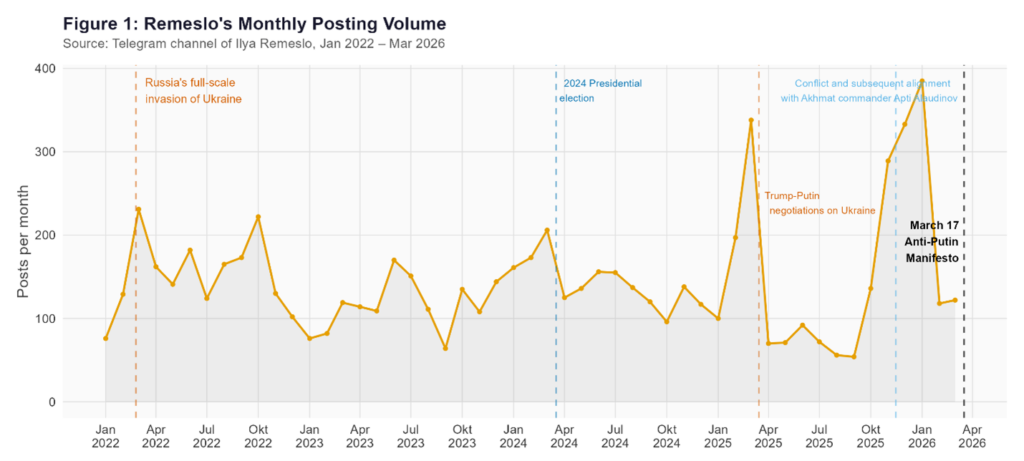
Figure 1 shows Remeslo’s monthly posting volume from January 2022. Four spikes stand out. The first came with the February 2022 full-scale invasion of Ukraine, when output jumped from 76 posts in January to 231 in March as Remeslo mobilized as a pro-war commentator. The second cluster surrounded the March 2024 presidential election (206 posts), where Remeslo campaigned energetically for Putin’s re-election, attacking opposition politicians such as Boris Nadezhdin on procedural grounds and celebrating record turnout and national unity against the backdrop of the war. The third and tallest spike before the autumn wave occurred in March 2025 (338 posts), driven almost entirely by the Trump-Putin peace negotiations over Ukraine: 61 percent of that month’s posts mentioned Trump or the US, and 25 percent explicitly discussed peace or negotiations. Remeslo was at peak alignment with the regime, framing Russia’s diplomacy as «pure high-level chess.» The final surge spanned November 2025 to January 2026 (289, 333, and 385 posts respectively), but its character was radically different. Here, the Alaudinov controversy (explained below), internet censorship battles, and debate around how easily the United States was able to snatch Venezuelan leader Maduro produced the channel’s highest-ever output—followed by a sharp drop in February-March 2026 before the anti-Putin manifesto was released.
Remeslo’s Telegram Network
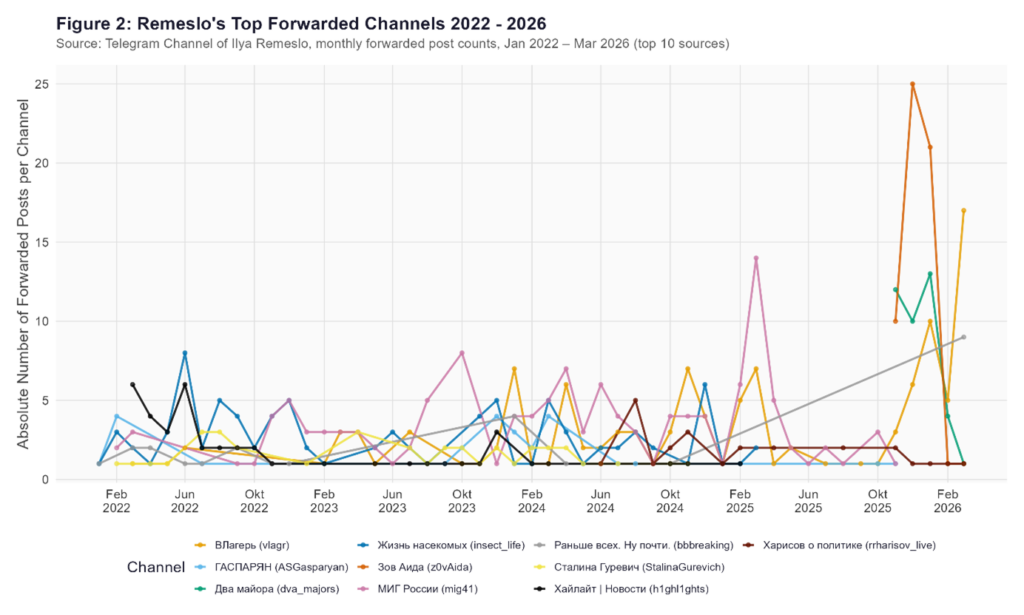
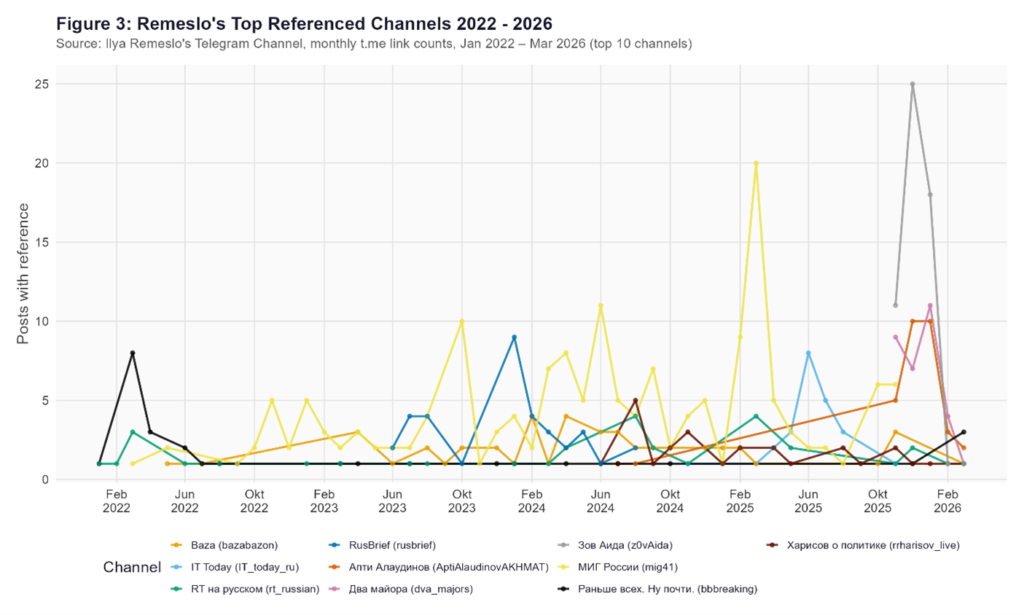
Figures 2 and 3 track which channels Remeslo forwarded from and linked to over time. Before October 2025, his information ecosystem was dominated by two sources: MIG Rossii (mig41), a major war-blogger account with more than 500,000 subscribers, which accounted for 128 forwards and 166 references in the January 2022-September 2025 period, making it by far his primary amplification source. VLager’ (vlagr) ranked second with 77 forwards. Both channels relayed a pro-Kremlin analytical line on the war and geopolitics.
The October-December 2025 period marked an abrupt realignment. Zov Aida (z0vAida), a channel controlled by «Aid,» a commander in the Chechen «Akhmat» Special Forces of the Russian Ministry of Defense, surged to 35 forwards and 38 references—displacing MIG Rossii, which dropped to just 4 forwards. Dva Maiora (dva_majors) rose to 22 forwards. As of the end of March, Dva Maiora was one of the largest milblogger channels, with roughly 1.28 million subscribers. The channel profited enormously from an alarmist tone in the wake of Ukraine’s invasion of Russia’s Kursk region, indicating that alarmism about deficiencies in Russian military management can be a rational strategy for gaining online followers. Since April 2024, Dva Maiora has also operated a charity foundation that collects donations for frontline needs. Since late 2025, Remeslo has repeatedly shared the channel’s calls for donations for specific frontline units. Dva Maiora has also expressed support for Commander Aid and Akhmat in the milblogger community’s conflict over control of donations for the front. Dva Maiora called for elite repression and a fully mobilized war economy and criticized Shoigu, the former Minister of Defense.
Zov Aida served as an amplifier in support of Akhmat’s commander-in-chief Apti Alaudinov, Deputy Chief of the Main Military-Political Directorate (GVPU) of the Armed Forces of the Russian Federation, amid a heated public dispute between Alaudinov and his critics within the military blogging community. The dispute revolved around criticism of Chechen battalions and the financial transactions related to donations for the front, which were collected by competing milblogger groups. Remeslo was initially a fierce critic of Akhmat. However, after an apparent personal threat from Alaudinov and a joint video declaring that the dispute had been settled, Remeslo intervened forcefully on Alaudinov’s side. Between November and December 2025, he produced 51 posts sharing Alaudinov’s own content. Alongside these, the highly manipulative, pro-Kremlin pseudo-investigative project Underside (underside_org) appeared 32 times as Remeslo amplified its exposés of allegedly Western-funded opposition networks in Russia—filing an official FSB complaint based on one of its investigations. This can be considered the final phase of Remeslo’s loyalist activities, during which he acted ostentatiously as a Kremlin attack dog. In January-March 2026, VLager’ returned to the top with 32 forwards, while Zov Aida and Dva Maiora remained present at a much lower scale. However, the anti-foreign influence channel Underside vanished entirely from Remeslo’s channel in 2026.
Election Narratives: From National Unity in 2024 to an Unsecured Domestic Rear in 2026
Of 410 election-related posts from 2022 onward, 56 percent also contained war-related vocabulary—indicating that for Remeslo, elections and the war were rarely discussed in isolation. His treatment of the March 2024 presidential election and the forthcoming September 2026 Duma elections illustrates the transformation of his war-related narratives.
In 2024, Remeslo operated as the regime’s election propagandist. Across 33 posts, he dissected Boris Nadezhdin’s signature collection failures, mocked Igor Girkin’s nomination attempt from prison, attacked Western non-recognition efforts, and celebrated Putin’s official 77.44 percent result as proof of national consolidation.
By March 2026, Remeslo’s rhetoric had completely reversed. On 7 March, Remeslo announced he would not vote for United Russia and would not help conduct the elections—after having assisted the Kremlin, by his own count, in 33 previous campaigns. He advanced three theses: Russia needs genuine political competition; honest elections benefit the state by forcing better candidates; and Duma elections serve as a release valve for social pressure. A post from 1 March framed the link to the war explicitly: «Ahead lie the Duma elections… it is necessary to have covered internal-political rear positions.» The military metaphor seems deliberate: an unsecured domestic rear weakens the war effort.
Dugin, the «Okhranota,» and the Various Understandings of «Patriotism» Among War Bloggers
Remeslo mentioned Alexander Dugin in 35 posts, and his treatment of him became increasingly dismissive. While he acknowledged Dugin as a public intellectual, he consistently denied him political influence—describing him as someone who «creates an illusion of relevance» without access to real power. Remeslo positioned himself as a classical liberal-right, pro-market, pro-progress conservative and saw Dugin as the opposite—an archaic, anti-capitalist pseudo-conservative who would drag Russia backward («dremuchee okhranitel’stvo»).
Revealing in this context is Remeslo’s sustained campaign against the okhranota—a pejorative term for a group of bloggers he accused of being paid to defend the regime while silencing legitimate criticism. He framed okhranota members as parasites who equate the Motherland with specific officials, thereby weaponizing patriotism against genuine discourse. By late December he was openly calling them «utterly degenerate okhranota» («konchenye okhranotnye degeneraty») and tracking their legal violations. On January 19, 2026, he announced four lawsuits filed simultaneously against okhranota figures, including one by himself.
This connects to a broader pattern in his use of the word «patriot.» «Radical patriots» («radikal-patrioty») was Remeslo’s label for figures like Prigozhin, Girkin/Strelkov, Tatarsky, and the milblogger ecosystem that combined ultra-nationalist rhetoric with calls for escalation and purges. Over time, Remeslo’s channel shows a noticeable shift in the ratio of pejorative patriotism labels (lzhepatriot, urapatriot, shizopatriot, psevdopatriot) relative to «genuine» («nastoiashchyi patriot», «zdorovyi patriot») or other positive usages. By 2025−2026, pejorative forms outweighed «genuine» ones roughly two to one. His view culminated in a November 14, 2025 essay «On Pseudo-Patriotism and False Conservatism» («O psevdo-patriotizme i lzhe-okhranitel’stve») in which he fused all his previous categories into a unified framework where both radical pseudo-patriotism and submissive okhranota-patriotism were manifestations of the same underlying problem of «voluntary slavishness» («dobrovol’noe rabolepstvo») that produces false patriotism. Beyond the material reasons related to competition for sponsorship, advertising revenue, and control over war-related donations, this also attests to the contested nature of what «patriotism» means within the war-blogging community.
Telegram, Max, and Internet Censorship
Remeslo’s position on internet policy reveals the clearest fault line within the pro-regime camp. His attitude toward Pavel Durov, the Russian-born founder of Telegram, followed a trajectory with several phases. In 2022−2023, Remeslo was critical of Durov as a «cowardly businessman» who cooperated with Western intelligence. After Durov’s temporary arrest in Paris in August 2024, Remeslo defended him on grounds of Russian sovereignty—arguing the arrest was an affront regardless of Durov’s personal failings. By 2025−2026, Durov’s fate became secondary to a more immediate concern: the regime’s throttling of Telegram and the «maneuver» to force users and public organizations to migrate to Max, a messenger released in spring 2025 that Remeslo repeatedly called «Kirienko’s messenger”—attributing the project directly to Sergei Kirienko, the first deputy chief of the Presidential Administration, and blaming «digital hurrah-patriots» more broadly. On 14 February, he asked rhetorically: «Is this our preparation for Duma elections? So that
Venezuela and Iran as Mirrors of Russia’s Domestic Degradation
The US capture of Venezuelan president Nicolás Maduro in early January 2026 generated an extraordinary 53 Putin mentions in a single week. Remeslo did not endorse the US special operation—he called it «vile American imperialism”—but he treated it as a sign of Venezuelan regime failure. «The elites struck a deal with US intelligence. They gave up Maduro—and everything is fine, full consensus,» he wrote. For Remeslo, this was the direct result of «negative selection» of elites: «performative loyalty and sycophancy do not mean your associates will protect you. More likely the opposite.»
Iran served as a complementary case. On 10 January, Remeslo wrote about the Iranian protests: «The root causes were created by Iran’s own government. Problems with the economy and the suppression of personal civil rights.» The following day, discussing the 87-year-old Ayatollah Khamenei, he wrote: «The man has long been harming his country, he is physically and morally incapable of leading it in the right direction. Why does he cling to power? […] You cannot rule a country this long without reforms.» On 9 January, he placed Russia, Iran, and Venezuela in a similar category of states afflicted by «bureaucratic indifference» where each official tends his own garden while the system rots.
Conclusions
When did Remeslo’s narrative turn against the regime and Putin more specifically? Using Remeslo’s Telegram channel as a benchmark, January/February 2026 appears to have been a turning point in his rhetoric. While we can reject his claims that he had held and expressed the views of the six-point manifesto for many years, the timing of his shift coincides with several crucial internal debates within Russia’s regime and society more broadly—debates whose contours are visible in the themes of his channel.
The first concerns the conduct of the war and the factional dynamics surrounding it. Remeslo’s realignment toward Akhmat-affiliated channels and personal rhetorical alliance with Alaudinov were short-lived. Anti-elite sentiment and alarmism about Russian wartime failures have typically boosted the social media following of milbloggers. However, the extent to which one can criticize Russia’s wartime civilian and military leadership is a matter of constant debate, and the boundaries have been shifting rapidly.
During wartime, the powers and leverage of the Ministry of Defense naturally expand, and the appointment of Andrei Belousov as Defense Minister in 2024 has reportedly been accompanied by efforts to rationalize military spending and reduce corruption—generating friction with figures associated with his predecessor Shoigu, who faces growing pressure through criminal cases against close associates such as Timur Ivanov and Ruslan Tsalikov. Remeslo’s dismissive tone toward top propagandist Vladimir Soloviev, who is associated with Shoigu, and his broader argument that the «negative selection» of elites and sycophancy erode state capacity and eventually risk elite defection—developed through the Venezuela and Iran parallels—echo the logic of the regime’s anti-corruption campaigns, though they do not allow one to establish a direct link to any specific faction.
The second debate revolves around internet policy and the upcoming September 2026 Duma elections. Remeslo’s campaign against the throttling of Telegram and the forced promotion of Max—which he attributes to Kirienko and the Presidential Administration—reflects grievances that are framed in free-speech principles. But for milbloggers whose monetization, coordination of frontline donations, and communication with soldiers all depend on Telegram, the regime’s digital repression represents a direct material threat. Remeslo explicitly connects this to the Duma elections, warning that internet censorship risks alienating the regime’s own base. Kirienko himself has come under pressure from other directions: his associate Anton Serikov was arrested, and Belousov has reportedly rejected Kirienko’s list of «SVO veterans» proposed for the next Duma convocation—suggesting a struggle within the regime over who deserves to be considered a «genuine» veteran of the war, a distinction that echoes Remeslo’s own sustained campaign against «fake patriots» and the okhranota.
A third, more speculative dimension involves the broader question of economic strategy and elite consensus on the war’s trajectory. Reports have circulated that figures such as Igor Sechin may have assumed a more prominent role in shaping Russia’s approach to negotiations with the United States since early 2026, and that the question of replacing Prime Minister Mishustin has accompanied the Duma elections campaign. At the very least, the criminal case against Sergei Matsotskii and the designation of Aleksandr Galitskii’s venture fund as an «extremist organization» suggest that the pressure on Mishustin is growing. These speculations point to the kind of elite-level maneuvering that Remeslo’s channel, with its shifting alliances and escalating attacks on regime insiders, appears to mirror at a distance.
Thus, the narratives on Remeslo’s Telegram channel reflect the ongoing conflicts among the elite, the grievances within the milblogger community—where, according to the astute observer Ivan Filippov, the sentiment can be described as «pre-revolutionary“—and society at large. Whether Remeslo’s trajectory was driven by a change of sponsor, a shift in priorities from an existing patron, a genuine personal evolution, or some combination of these factors cannot be established from the textual record alone. What the data does demonstrate is that the shift was not sudden but evolved across multiple dimensions over several months, tracking fault lines that run through Russia’s wartime elite. The direct attack against Putin, however, remains a mystery to be resolved—something that even Prigozhin avoided in the context of the mutiny.