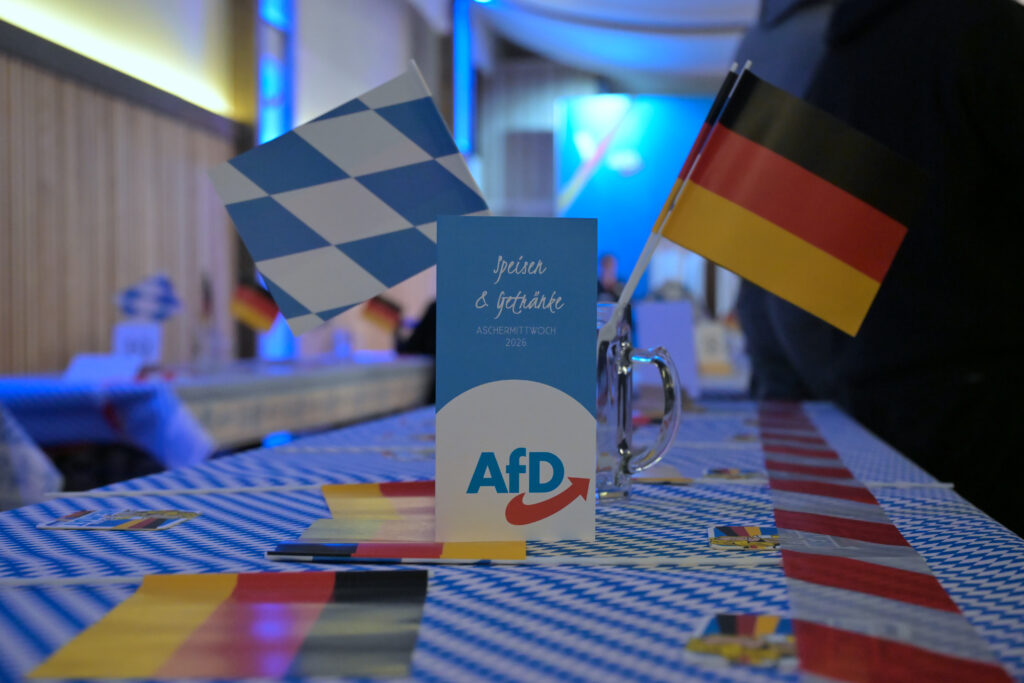
Germany holds elections at various levels every year. In 2026, five federal states will elect new Landtage (state parliaments): Baden-Württemberg on March 8, Rhineland-Palatinate on March 22, Saxony-Anhalt on September 6, Berlin on September 20, and Mecklenburg-Western Pomerania also on September 20. The far-right Alternative for Germany (AfD) is banking on a major breakthrough in this electoral cycle — and in the two eastern states of Saxony-Anhalt and Mecklenburg-Western Pomerania, it is even aiming for outright victory.
This once again brings the issue of relations with Vladimir Putin’s Russia to the fore — or more precisely, the foreign-policy orientation of the Germany that the AfD wants to build. For a long time, the AfD was seen as the most pro-Russian force in the German parliament. But in 2024−2025, a noticeable reassessment of ties to the Kremlin began within the party: some openly pro-Russian MPs failed to secure winnable list positions, official trips to Russia came under fire from party leadership, the foreign-policy spokesperson was replaced, and party leader Alice Weidel suddenly started voicing direct criticism of Putin.
Has the party’s positioning shifted further in recent months, and can the AfD push even harder toward distancing itself from Moscow?
The Trump Factor
One of the main drivers behind the AfD strategists’ decision to adjust their rhetoric and personnel on the «Russian front» was the open sympathy shown toward the party by the White House and figures close to the Trump administration.
Billionaire Elon Musk — who served as head of the Department of Government Efficiency (DOGE) until late May 2025 — appeared twice at AfD political events. In a video message to one pre-election rally, Musk not only wished the AfD success but called it «Germany’s hope for a better future.»
U.S. Vice President J.D. Vance went even further: at the Munich Security Conference in February 2025, he openly urged European politicians not to ignore the will of voters, endorsed cooperation with the AfD, spoke of the «fear» that European leaders feel toward their own peoples, and then met directly with the leadership of Germany’s far right.
Even Secretary of State Marco Rubio — usually seen as part of the more moderate Republican wing — accused the German government of «tyranny» and sharply criticized the domestic intelligence services’ decision to classify the AfD as right-wing extremist and place it under systematic surveillance.
The AfD could hardly have dreamed of stronger backing. The inner circle of the leader of the Western world now regards the far right as representatives of «classic Germany» and the «true traditional Europe» that the new U.S. National Security Strategy recognizes as a genuine ally — in contrast to the current «liberal» Europe.
This political advantage and ideological proximity to the White House gave the AfD room to scale back overly close ties to the Kremlin — a clearly weaker partner compared to the United States — without major losses. It was this shift that allowed Alice Weidel and other party leaders to begin openly criticizing Vladimir Putin, especially over the lack of progress in negotiations on Ukraine. At the same time, the entire «Russian» agenda was largely reduced to economic demands — above all, calls to resume Russian energy supplies for the sake of German industry. Party figures stressed that this was purely pragmatic, «not about politics at all.»
Yet the deep crisis in transatlantic relations — fueled by Trump’s verbal attacks, tariff wars, and peaking in the conflict over Greenland — has placed the AfD, like other European far-right parties, before a difficult choice. On one hand, losing Washington’s support was highly undesirable. On the other, the far right’s calling card — from Madrid to Berlin — has always been slogans about «defending national interests» and «European identity.» Trump’s actions, openly declaring intentions to annex part of a European state’s territory and exerting unprecedented pressure on Europe, ran directly counter to those principles.
Some European far-right figures sharply distanced themselves from Trump (a Danish right-wing radical even permitted himself completely unprintable remarks about him), but the AfD chose to pause and reflect. A February Forsa poll for RTL/ntv showed that among AfD voters, 51% now see Trump as «rather an opponent,» with only 39% still trusting him. In this situation, staying silent was no longer an option.
Tino Chrupalla, Weidel’s co-chair, stepped forward. In this duo, he has long held the more distinctly pro-Russian line and even during the rapprochement with Washington avoided criticizing the Kremlin. In a television interview, Chrupalla refused to call Trump a «model for Germany» and openly expressed «disappointment» with the American president’s actions. He then reverted to classic pro-Russian talking points: from claiming «no threat from Russia» to accusing NATO of provocations.
Weidel quickly distanced herself from her colleague, calling his words a «personal opinion.» Rüdiger Lucassen — AfD Bundestag member, defense spokesperson for the parliamentary group, and a retired Bundeswehr colonel — hurried to correct Chrupalla: the absence of a direct military threat to Germany from Russia stems not from «trust in Russian leadership» but from «NATO’s strength.» Lucassen advocates a hard line toward Moscow and sees «military deterrence» as the only correct strategy.
Lucassen represents the moderate wing of the party, which rejects any return to an unambiguously pro-Russian course and favors closer ties to conservatives in the CDU. He openly clashes with Björn Höcke — one of Germany’s most influential far-right extremists — and directly calls Russia’s attack on Ukraine a «violation of international law,» while condemning Moscow’s various «destabilizing actions and provocations.»
The Election Factor
The second major reason for the party’s «distancing» from Moscow is an analysis of its own electorate’s preferences. The AfD’s political strategists appear to have concluded that Russophilia is far from the most important motivation for voting far right. The image of Vladimir Putin as a «strong hand» — an authoritarian leader challenging «rotten Western democracy,» multiculturalism, and globalism — does enjoy popularity in Germany’s right-radical circles. But on a national scale, sympathy for Putin is not a key marker of right-wing identity in the way that migrant phobia or «resistance to the old parties» is.
2026 will be an exceptionally «fruitful» year for elections even by German standards. State elections will take place in Baden-Württemberg, Rhineland-Palatinate, Saxony-Anhalt, Mecklenburg-Western Pomerania, and Berlin. In addition, regional assemblies and other local bodies will be elected in three states, including Bavaria and Hesse. Alice Weidel has already called this year «fateful» and urged supporters to «give everything» for a strong result. The subtext is clear: the AfD aims to enter power precisely through state parliaments and municipalities.
The party’s polling numbers continue to climb. After a brief spell of CDU leadership, the AfD is once again tied for first or second place in national surveys. Double-digit results hold in all states except Hamburg. Even in western states long considered left-of-center strongholds — Rhineland-Palatinate (the SPD’s electoral bastion) and Baden-Württemberg (Germany’s only state led by a Green premier) — polls suggest the AfD could double its result from five years ago.
The most tempting prospects lie in the east: 39% in Saxony-Anhalt and 35% in Mecklenburg-Western Pomerania. In the latter, the Thuringia 2024 scenario is likely to repeat: the AfD takes first place on paper, but other parties cobble together a coalition without it. In Saxony-Anhalt, however, the situation is deadlocked: arithmetically, no majority is possible without the AfD at present, yet other parties refuse to bring the far right into government.
It is precisely in these two regions that the pro-Russian vector remains important for local politicians, activists, and voters. State-level leaders openly display sympathy for Moscow: three AfD deputies from Magdeburg attended a Russian embassy event celebrating Putin’s birthday in October 2025. In radical right circles, there is a firm belief that these states benefited significantly from cooperation with Russia. The Nord Stream 2 endpoint near Greifswald in Mecklenburg still fuels social-media lists of companies allegedly bankrupted by anti-Russian sanctions. In March 2025, the AfD faction in Schwerin put forward a motion to halt arms deliveries to Ukraine, accept peace at the price of territorial concessions to Russia, and «normalize relations» with the Russia. This was purely symbolic — foreign policy and defense fall outside state competence — but highly telling. Magdeburg party members have already unveiled a draft election program proposing expanded Russian-language teaching in schools «as a sign of friendship with Russia.» For the federal AfD leadership, publicly signaling a rethink on Putinism right now would hardly be advantageous — it risks costing votes in these highly promising eastern states.
The Merz Factor
The AfD has succeeded in winning over a substantial slice of the electorate, but simple arithmetic shows that without coalition partners, the party has no realistic chance of entering power even at state or municipal level. Beyond its solid core, the AfD provokes deep antipathy and is viewed as a threat to democracy. The only theoretical path to levers of power is a gradual ideological transformation that would make the party «acceptable» to the CDU — or at least to its right-conservative wing. In this context, sacrificing overly tight «friendship» with Moscow seemed a perfectly reasonable price.
Rüdiger Lucassen is one of the most consistent advocates of such a union with the CDU within the far-right ranks — precisely at the cost of abandoning the pro-Russian course, which he finds ideologically alien. He and two colleagues from the parliamentary group — also pushing for cooperation with Christian Democrats and rejecting the pro-Russian line — were the only AfD figures officially invited to the 2026 Munich Security Conference. Lucassen’s group actively engages with the «WerteUnion,» a small right-conservative party founded by former CDU members that effectively serves as a bridge between AfD and CDU. From the conservative side, occasional voices have suggested a softening of approach toward the far right — though explicit calls for coalition with the AfD, as from Brandenburg state deputy Saskia Ludwig, remain rare and invariably draw sharp rebukes from fellow party members. Still, proposals to «ease the stance» toward the ultra-right — voiced by former key and still-influential CDU politicians — cannot be ignored.
Yet the entire AfD strategy founders on Merz. Late in 2025, the chancellor directly called the AfD the CDU’s «main adversary» and stated there were no points of contact whatsoever between the two parties. Merz made it crystal clear: as long as he leads the Christian Democrats, there will be no cooperation — or even rapprochement — with the far right. CDU General Secretary Carsten Linnemann is no less firm. Even before the 2025 snap parliamentary elections, he emphasized he would not cooperate with the AfD «for a single second,» and in December he personally attacked Weidel, saying the AfD chair was «moving ever closer to right-wing extremism» and that her statements were «unbearable.»
Linnemann’s determination to confront the AfD across the board was confirmed in a late-January 2026 court case: Germany’s only district administrator with an AfD party card sued the CDU general secretary for allegedly defamatory claims about broken election promises. The court sided with Linnemann, deeming his criticism justified. One of the Christian Democrats’ top officials thus sent voters an unmistakable message: the AfD is not only ideologically incompatible with the CDU but incapable of effective governance even at municipal level. What cooperation could possibly be discussed under such conditions? The scandalous January 2025 Bundestag vote — where some observers believe Christian Democrats deliberately counted on far-right support for a migration-restriction resolution — is something the CDU prefers not to recall.
Political Expediency
Since its founding, the AfD has seen constant internal struggle between «ideologues» (convinced ultra-rightists) and «pragmatists» willing to sacrifice parts of the ideological agenda to strengthen the party’s position.
Relations with Russia remain one of the clearest markers of this conflict. Factions within the party now advocate dropping the pro-Russian course. One such center is the North Rhine-Westphalia organization — Germany’s most populous and industrially powerful state. It is no coincidence that Rüdiger Lucassen, who privately sharply criticizes the «Russian circles» inside the AfD, previously led the party there. His successor, Martin Vincentz, gained notoriety for pressuring fellow party members who traveled to Russia or occupied Ukrainian territories. When asked about the effectiveness of anti-Russian sanctions, Vincentz answered evasively — clearly trying to avoid clashing with the party line while refusing to back his pro-Russian colleagues.
The AfD — politically isolated in Germany and lacking stable allies even among ideologically kindred parties in the European Parliament — desperately needs backing from international players. In western Germany’s far-right milieu, many would gladly «trade Putin for Trump,» but the American president’s anti-European course blocks any final transformation.
Recent 2025 scandals — Bundestag inquiries from AfD deputies about German critical infrastructure that raised suspicions of espionage for Russia — have damaged the party’s image in the west. In the east’s radical circles, however, Vladimir Putin remains popular, and Alice Weidel is clearly unwilling — on the eve of the 2026 state elections — to alienate local voters.
For now, the AfD has failed to «sell» its electoral potential — estimated at around a quarter of German voters — at a high enough price. Christian Democrats are unwilling to «buy» that resource, preferring unstable multi-party coalitions in the east over a potentially stable majority including the AfD. They enjoy voter backing for this: polls show 39% of CDU voters would abandon the party altogether in the event of a coalition with the Alternative. The AfD’s political strategists understand that Merz will not deviate from his chosen path.
That is why uncertainty still reigns over the «Russian question.»