In recent years, Russian efforts to develop the International North-South Transport Corridor (INSTC) have accelerated. In particular, over the past months there has been growing momentum behind plans to advance the corridor’s eastern route. This reflects a shared interest among Russia, India, and Iran in avoiding excessive reliance on the western and Trans-Caspian routes of the project.
This analysis examines recent developments along the eastern branch of the INSTC, with a particular focus on Moscow’s strategic interests and calculations surrounding this route.
The INSTC and Its Routes
Established in 2000, INSTC is a multimodal network of sea, rail, and road routes. It was designed to connect northwestern Europe to the countries of Central Asia, the Persian Gulf, and the Indian Ocean. The 7,200 km project (from St. Petersburg to India) aims to promote economic cooperation among the participating countries and link the Indian Ocean and the Persian Gulf to the Caspian Sea, Russia, and Europe via Iran.
Although the INSTC is considered a multimodal project—as a network of interconnected motor roads, railways, ports, and aviation hubs—railways remain the primary means of transportation. The western and eastern routes account for approximately 60% and 24%, respectively, of total potential container freight traffic.
The three main routes of the INSTC—western, Trans-Caspian, and eastern—differ in length, mode of transport, and level of development of main and ancillary infrastructure:
- The western route, which runs along the western coast of the Caspian Sea through Russia and Azerbaijan, is approximately 5,100 km long. It has the best connections to the railway and road networks of the South Caucasus.
- The Trans-Caspian route, which uses ferry and feeder container lines across the Caspian Sea, is approximately 4,900 km long.
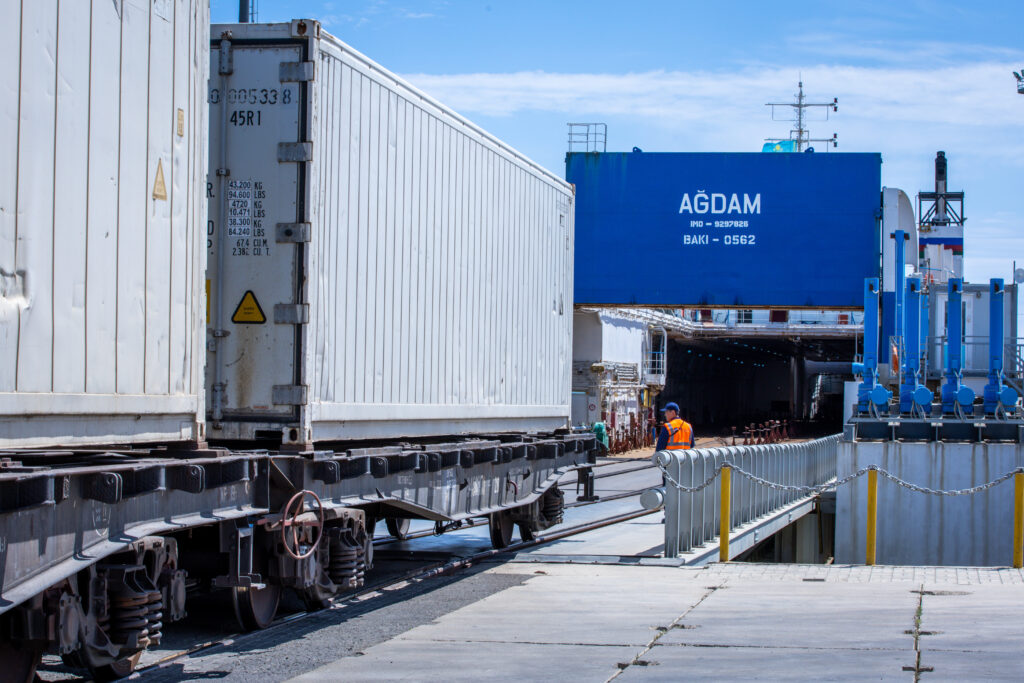
- The eastern route runs along the eastern coast of the Caspian Sea through Kazakhstan and Turkmenistan and is approximately 6,100 km long.
Among these routes, the western route is the most developed and capable compared to the eastern route, though all routes face challenges. The only INSTC route that can compete with the Suez Canal in terms of delivery time from India to Russia is the western one. Here, transportation transit time is 40 days, while the cost of delivery has decreased by half to $ 6,500 per TEU. Azerbaijan has more modernized infrastructure compared to the Trans-Caspian and eastern routes of the INSTC.
The roles of Kazakhstan and Turkmenistan in the development of the eastern route have increased since the launch in 2014 of the 928 km Kazakhstan-Turkmenistan-Iran (KTI) railway, which runs east of the Caspian Sea and connects the new Zhanaozen-Gyzylgaya-Bereket-Etrek-Gorgan route. In Bereket, the KTI line connects with the Trans-Caspian Railway, which travels across Turkmenistan and reaches into Uzbekistan and Tajikistan. It is used for Russian cargo deliveries to Turkmenistan, Afghanistan, and Iran. The KTI forms part of the INSTC and the Almaty-Bandar Abbas corridor (3,756 km, connecting Iran, Turkmenistan, Uzbekistan, and Kazakhstan).
In 2023, Kazakhstan, Turkmenistan, and Russia signed a memorandum on creating a single logistics operator for the development of transportation along the INSTC’s eastern route. In 2022, the Russian, Kazakh, Turkmen, and Iranian railways established lower uniform container-kilometer rates for the use of the eastern route’s infrastructure, and a Russian company will modernize the logistics of the route’s lines in Turkmenistan.
Despite these prospects and plans, the eastern route faces significant challenges in increasing its transportation capacity—specifically restrictions on train passage—because this section of the INSTC passes through mountain dips. Passenger trains use the same railways and have priority, which affects delivery times. In addition to weight restrictions and train car limits, this route crosses more country borders between Russia and India than the others, resulting in more customs procedures.
Why Is Moscow Keen to Develop the Eastern Route?
In recent months, Russia has accelerated its activities to develop the eastern route. Russian Railways and DP World have decided to develop a joint container service on the eastern route of the International North-South Transport Corridor, attracting shippers from South Asia and Africa, and to continue identifying barriers that hinder the development of BRICS transport routes.
Russian officials emphasize the need to ensure logistical connectivity between countries in the Asia-Pacific region, ASEAN, the Middle East, and BRICS. Russian Railways hopes that by leveraging the investment possibilities, global port capacity, and logistics expertise of Gulf companies like DP World, Russia’s access to the Middle East and Africa can increase.
There are plans for new routes to be established through the Serakhs border crossing between Iran and Turkmenistan, which together would provide access to Iranian ports on the Persian Gulf for the entire European part of Russia, the Urals, and Siberia.
Reportedly, in 2025 container traffic along the eastern branch, passing through Kazakhstan and Turkmenistan, nearly doubled. Discounts of 15 to 80% on shipments within Kazakhstan, Turkmenistan, and Iran helped attract customers. Russia is also supporting shippers: a tariff coefficient of 0.8 has been established for the transportation of large-capacity containers along the eastern route for 2025. These discounts have been extended through 2026.
An equally important factor in increasing customer interest in the International North-South Transport Corridor is the systematic work of the operator RZD Logistics to create and promote integrated logistics solutions. For example, in November, the first container trains carrying products from the Syktyvkar Timber Processing Plant (JSC SYPK) departed from the Koyty station of the Northern Railway (Komi Republic) to the Iranian dry port of Aprin. The trains, carrying sulphate pulp and paper, traveled along the eastern route of the North-South Corridor, a journey that took 13 days.
Aprin is located 20 km from Tehran and facilitates the redistribution of cargo within the country, as well as to Iraq, the Persian Gulf, and the Middle East. Previously, cargo was shipped to Iran via Azerbaijan in railcars, followed by truck pickup from the Astara border crossing, or by ship across the Caspian Sea. Reportedly, high-speed container trains to the port of Aprin reduce delivery times by approximately 30%. So far, Russia has sent two trains, and it is expected to send four more by the end of the year, though the current requirement is seven trains per month. The Aprin multimodal hub was launched in May and is gradually reaching its planned capacity. The company serves as the holding’s nominated operator on the INSTC.
Moreover, Russia’s leading role in the Eurasian Economic Union (EEU) is also contributing to expanding transit corridors. Reportedly, the agreement on a unified customs transit system between the Eurasian Economic Union and third countries will be ratified soon. Its goal is to strengthen Russia’s position as a transit hub for Eurasia and enhance its role in Eurasian integration. Four of the five EEU countries—Russia, Belarus, Kyrgyzstan, and Armenia—have already ratified the document. Kazakhstan has practically completed the process; it is now awaiting an official note confirming completion of ratification by the Majlis (the Senate has already approved the draft agreement).
Uzbekistan has already expressed interest in joining the unified customs transit system, and consultations are currently underway. The EEU also hopes to engage China in this cooperation, as China is one of the largest partners for all EEU countries; this is being carried out within the framework of the bilateral subcommittee on customs cooperation.
For Russia, this agreement is especially relevant due to its reorientation toward trade with countries in the East and South, as well as because of external restrictions. It will make it possible to minimize border delays, increase the competitiveness of transport corridors through the EEU compared with other routes, and reinforce Russia’s position in Eurasian integration.
The INSTC and Moscow’s Greater Eurasian Partnership
Moscow considers the development of the International North-South Transport Corridor (INSTC) as part of the concept of the Greater Eurasian Partnership it promotes, which is designed to logistically connect not only Eurasia but also East Africa via hubs on the Persian Gulf and Indian Ocean coasts. This can accelerate the transformation of the Russian 1520 mm track network, based on the North-South INSTC, into the backbone of a unified transport and logistics framework for Eurasia. Therefore, the launch of regular road and rail ferries on the Russia-Iran-Turkmenistan route and the development of a project for a new 1520 mm-gauge railway on the Russia-Central Asia-Iran route with access to the Iranian ports of Bandar Abbas and Bandar Lengeh in the Persian Gulf are important goals for Moscow.
Moscow wants the International North-South Transport Corridor to pass through states «friendly to Russia» and therefore be less susceptible to geopolitical fluctuations from «unfriendly countries.» Under these circumstances, Moscow is focusing on increasing the capacity of existing rail and road routes and creating new, shorter delivery routes along the eastern branch of the INSTC.
Geopolitics of Transport Routes in Eurasia
Russia, India, and Iran are geopolitically and geoeconomically interested in the development of the eastern route. Geoeconomically, all three are interested in the resources of Central Asia. On the other hand, they share geopolitical goals in developing the INSTC’s eastern route. They may want to diversify their connectivity projects, and all three have differing yet overlapping security concerns about relying solely on the western route, which passes through Azerbaijan.
India has concerns over developing relations between Azerbaijan and Pakistan, and between Azerbaijan and China. In this respect, Iran has concerns about Türkiye’s—its historical regional rival—involvement in the South Caucasus generally, and especially in Azerbaijan. Moreover, the recently declared ambitions of the United States’ transport interests in the form of the Trump Route for International Peace and Prosperity (TRIPP) surely add to Tehran’s concerns regarding the South Caucasus generally and its grievances toward Azerbaijan.
For Moscow, the value of the INSTC may even increase after the end of the war in Ukraine, because if that happens, the Kremlin might hope that—as planned at the very beginning of the project—northern Europe may use the INSTC. In this respect, Moscow most probably wants not to depend solely on Baku and to have another well-developed route amid warming relations between Baku and Washington. Moreover, after recent problems in relations between Baku and Moscow, the importance of the eastern route for the Kremlin has increased. Presence in Central Asia is as important as in the South Caucasus. Russia may also want Central Asian transport routes to pass through Russian territory. Moscow recently stated that the most economically advantageous route for supplying raw materials from Central Asia to North America runs through Russia, from Kazakhstan to ports on the Baltic and Barents seas.
China, which has essential economic relations with all large and small participants in the INSTC, has little interest in the development of this transport project, mainly because of India’s—China’s main regional competitor—interests in the project. Moreover, both China and the European Union are interested in developing another transport project, the Middle Corridor, which passes through Central Asia and the South Caucasus and mainly connects China and Europe. However, both Beijing and Brussels, which might compete to control main hubs along the Middle Corridor, now face the Trump Route in the South Caucasus, which is potentially considered as one of the routes of the corridor between the EU and China and can be potentially connected to the INSTC.
All of this once again demonstrates that the South Caucasus is becoming one of the key arenas where the interests of great and regional powers intersect, and at times collide. The outcomes of these dynamics may have a profound impact on the geopolitics and geoeconomics of Eurasia more broadly in the years ahead.
Please note that the views expressed in this publication are solely those of the author and do not reflect the official stance of the College of Europe