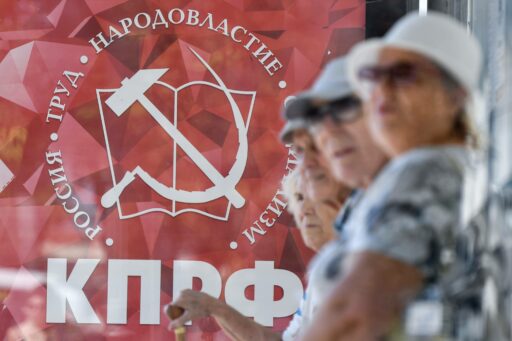
According to the reliably Kremlin-friendly VTsIOM poll, the party New People has climbed to second place in party ratings with 10.7% support. The Communists (CPRF) scored 9.2% in the same survey, and the LDPR 9.7%. Back in December, New People were stuck in fourth with just 7.7%. Meanwhile, FOM polls still put them at only around 5% (with LDPR at 10% and CPRF at 8%).
We’ve noted before that the Presidential Administration is clearly trying to strip the CPRF of its long-standing status as the country’s second-most popular party. At first, they seemed to be grooming the LDPR for the role — especially after Vladimir Zhirinovsky’s death left the party completely under Kremlin control and dependent on its whims. But the current surge in New People’s numbers suggests the LDPR promotion plan is stalling badly.
The new LDPR leader, Leonid Slutsky, simply doesn’t cut it as a charismatic public figure. Ever since Zhirinovsky, the party never really built up any other prominent faces beyond the chairman. Its ultra-patriotic, pro-war rhetoric is now clashing with growing public fatigue from the war and anger over unpopular measures — everything from tax hikes to internet crackdowns. The usual fix — doctoring results in the «electoral sultanates» — isn’t as easy here either. Many of those regions are ethnic republics where both the population and local elites have long disliked the LDPR (remember Zhirinovsky openly calling for the abolition of ethnic federal subjects). In this environment, New People suddenly look like a far more convenient choice for the «second place» slot.
At the same time, New People’s steady, traditional ratings (hovering around 5−7%) show that most Russians still see them at best as a fourth-tier party. So, Kremlin strategists are falling back on a tried-and-true trick: rolling out «formative» polls designed to convince people the party really has a shot at second place. Back in 2021, a similar VTsIOM survey — claiming New People were clearing the 5% barrier — dropped right before election day, and the gambit worked: they got their Duma faction.
They’re running the same playbook now. The growth looks plausible enough — the party has been publicly critical of harsh internet restrictions — so the manipulation might succeed again. Technologists working with New People are already spinning the «explosive» rise and predicting the party will soon stop competing with other systemic players and start challenging United Russia directly.
Remeslo’s Exit
Pro-Kremlin blogger and lawyer Ilya Remeslo — essentially a low-level contractor for the Presidential Administration and possibly the security services — suddenly launched a blistering attack on the Russian authorities and Vladimir Putin personally. «This war is being fought purely for Putin’s complexes. Ordinary citizens get nothing out of it — we only lose,» he wrote on his Telegram channel, branding the president a «war criminal and thief.» Remeslo slammed the conduct of the war (mentioning «meat-grinder assaults»), pointed to mounting economic problems, and concluded: «We need a new, modern president».
He didn’t spare Sergey Kiriyenko, the head of the political bloc who also oversees the fight against the opposition. Until very recently, Remeslo was an active participant in that fight: filing denunciations against Alexey Navalny and the Anti-Corruption Foundation (ACF) and effectively orchestrating the criminal case against Navalny for «insulting a veteran.» Later the ACF revealed that Remeslo was receiving money from the Kremlin via political consultants closely tied to the PA. He was also a regular guest on pro-regime media as a «legal expert» commenting on opposition events and developments in Western countries.
A critical outburst from one of the regime’s own foot soldiers is extraordinary by itself. The reasons could vary: a genuine psychological breakdown, or perhaps the looming threat of a criminal case (Remeslo was heavily involved in fundraising for the army). There’s also the theory that he’s acting as a provocateur — a «Trojan horse» meant to smoke out discontented ultra-patriots — but that seems the least plausible. The blowback from such a stunt would far outweigh any benefit for the PA or security services: Remeslo’s statements are now all over politicized Russian-language Telegram, and his «awakening» is starting to look like a symptom of instability inside the power vertical itself.
Whatever the real motive, none of the possibilities paints a reassuring picture of the mood within Russia’s ruling class. If this really was a breakdown in which Remeslo finally voiced his true thoughts, it signals deep fatigue among Kremlin-paid loyalists. They tolerated the war in hopes of victory, but now they’re disillusioned — helped along by a worsening economy and internet blocks, especially on Telegram. The attempt to throttle the messenger may have been the final trigger: that’s exactly where pro-regime bloggers raise money for the front (and for themselves). By going after Telegram, the state is cutting off its own online soldiers’ income stream — and apparently the officials pushing the blockade haven’t even considered the collateral damage. The crackdown has already prompted sharp criticism from Dmitry Olshansky, a pundit who has always been loyal to the Kremlin. Expect more of this: for these people, their own wallets matter far more than abstract loyalty to a regime whose true nature they’ve long understood.
It’s also possible Remeslo decided to rebrand himself as an opposition figure ahead of a potential criminal case he may have gotten wind of through his PA and siloviki connections. In the past, regional politicians or fallen loyalist activists used this tactic. But in recent years the pattern shifted to ultra-loyalty, ritual pledges of allegiance to Putin, and — in wartime — even requests to be sent to the front. Remeslo opted for the old playbook, apparently betting it offers better long-term prospects — and that choice alone reveals doubts about the system’s durability.
Soon after attacking Putin, Remeslo wound up in a psychiatric hospital. Given that his relatives include prominent psychiatrists, the hospitalization may have been arranged to shield him from prosecution (though punitive psychiatry can’t be ruled out entirely).
Don’t overstate the significance of this move: Remeslo’s words won’t spark protests or mass unrest. He isn’t telling politically aware people anything they didn’t already know, and the elites have long been fully aware of the regime’s quirks. What matters is this: open attacks on the Kremlin and Putin are starting to look like a viable future strategy even to systemic players.
Svintsov’s Expulsion
The LDPR has stripped deputy Andrey Svintsov of his party membership. The parliamentarian had been one of the loudest defenders of internet blocks in general and the Telegram crackdown in particular. He lectured Russians who opposed the restrictions, claiming they failed to appreciate the state’s efforts to keep them safe. «If they told me: you can never go to the theater, the movies, or any crowded place again. You can’t ride the metro or fly on planes. You have to walk around constantly looking over your shoulder. Why would I even need the internet? The whole internet,» he argued.
Obviously, Svintsov wasn’t seriously expecting those arguments to calm anyone down or lower the temperature. On the eve of the Duma campaign, he was simply trying to prove his usefulness to the Kremlin, which appreciates it when MPs or senators absorb the flak for unpopular policies. LDPR deputies have long specialized in flashy prohibitive initiatives that catch the PA’s eye, and the approach used to work. Mikhail Degtyarev, for instance, rode a string of deliberately toxic but widely quoted proposals all the way to governor of Khabarovsk Krai and then sports minister.
But Svintsov had already accumulated problems: he was suspected of selling spots at State Duma roundtables, which forced him to fire several aides. As the scandal grew, it became clear he had serious conflicts with LDPR leadership, who had no intention of keeping him in the next Duma convocation. Party head Leonid Slutsky wants to build a faction of people loyal to him personally, plus carve out spots for sponsors. Svintsov belongs to the «old guard» — the apparatchiks close to the late Zhirinovsky. Slutsky, who happily milks Zhirinovsky’s image in his campaigning, has no use for such figures.
Svintsov apparently thought aggressively defending the blocks would earn him protection from the PA’s political bloc. That calculation failed. His expulsion clearly had Kremlin approval — telling evidence comes from the criticism leveled at him by Andrey Lugovoy, a former security-service operative the Kremlin placed in the party after the Litvinenko poisoning affair. In trying to look useful, Svintsov achieved the opposite: he only inflamed public anger over one of the Kremlin’s most sensitive and problematic issues. Internet blocks irritate people in both the capital and the regions, and the official line about «security» has long since lost all credibility.
Worse, Svintsov damaged the LDPR’s own position. The Kremlin hasn’t yet fully abandoned the idea of pushing the LDPR into second place in the next Duma elections, and stunts like this make that goal harder. The speed, theatricality of the punishment, and the blunt explanation («he talked too much and said the wrong things») show just how toxic the internet/Telegram blocking issue has become for the authorities. The usual lectures about security and the harmful influence of Russia’s enemies no longer work.
Andrey Svintsov has become the first sacrificial victim meant to slightly dampen public discontent. The Kremlin is signaling that even overly zealous loyalists who justify every government move can be thrown under the bus, and political managers are ready to offer ritual sacrifices. Especially since Svintsov — who was never going to make it into the next Duma anyway — had already lost any real value to either the PA’s political bloc or the current version of the LDPR.